Want to test what you know?
Try our free Grade 6 Biology quiz — 25 questions, instant results, no sign-up.
Photosynthesis: How Plants Make Food — Complete Guide With Diagram
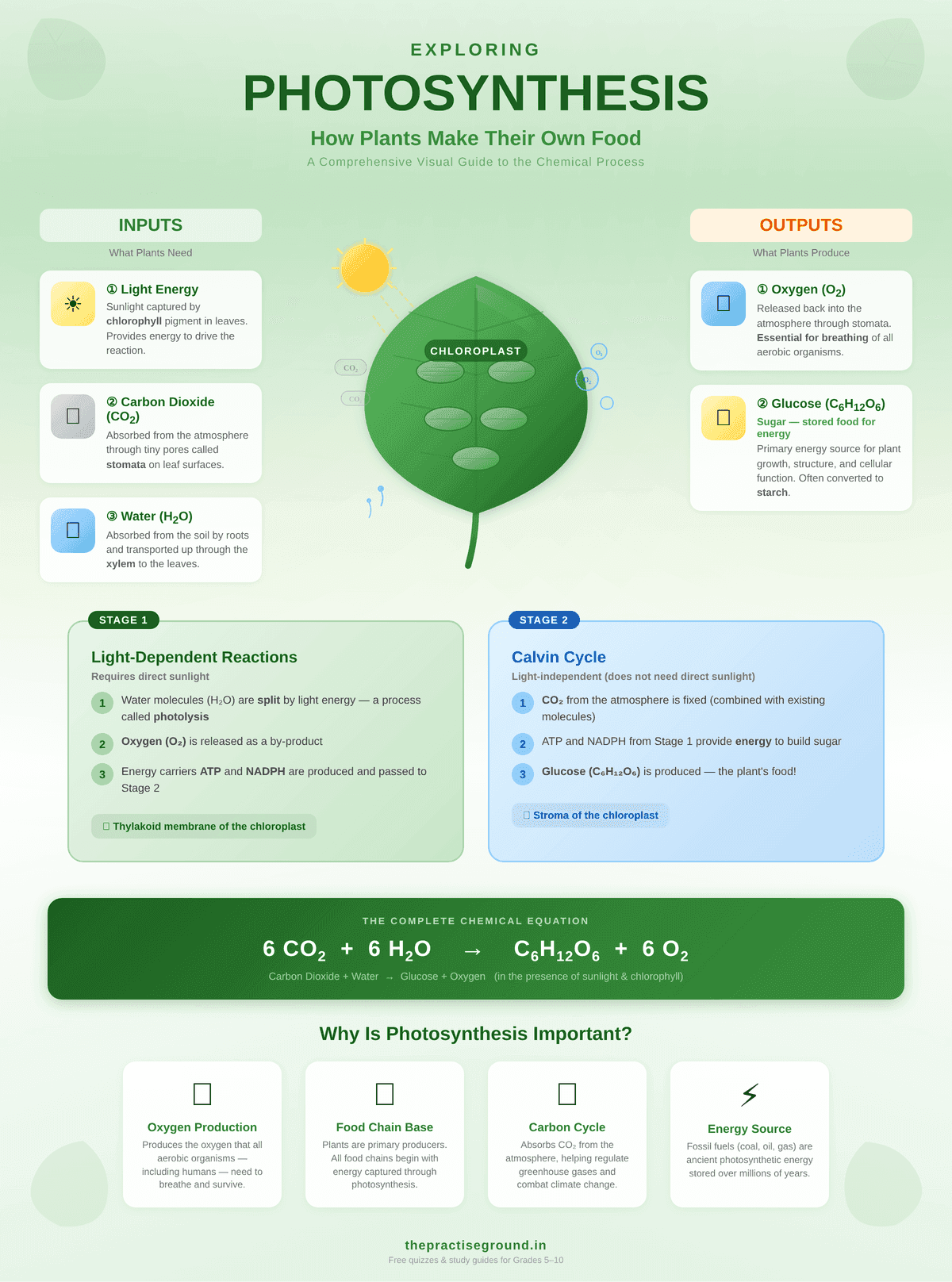
Photosynthesis is one of the most important biological processes on Earth. It's how plants convert sunlight into food (glucose), and in doing so, release oxygen that all animals depend on.
If you're preparing for CBSE, ICSE, Cambridge IGCSE, or IB exams, photosynthesis is a must-know topic. Let's break it down in a way that actually makes sense.
What Is Photosynthesis?
Photosynthesis is the process by which plants, algae, and some bacteria use light energy to synthesize glucose from carbon dioxide and water.In simple terms: Plants take in sunlight, water, and CO₂, and produce glucose (food) and oxygen.
The Photosynthesis Equation
CODEBLOCK0 What's happening:- Reactants (Input): 6 molecules of carbon dioxide, 6 molecules of water, light energy
- Products (Output): 1 molecule of glucose, 6 molecules of oxygen
Where Does Photosynthesis Happen?
Photosynthesis occurs in the chloroplasts of plant cells. The chloroplast has:
Different stages of photosynthesis happen in different parts:
Stage 1: Light Reactions (Light-Dependent Reactions)
Light reactions happen in the thylakoid membranes when sunlight is present.
What Happens in Light Reactions?
- Chlorophyll absorbs light energy from the sun
- Water molecules (H₂O) are split into hydrogen and oxygen
- Oxygen is released as a byproduct (this is the oxygen we breathe!)
- Energy is captured in the form of ATP and NADPH (energy-rich molecules)
Step-by-Step Process
Step 1: Photosystem II (PSII) ActivationSummary of Light Reactions
CODEBLOCK1Stage 2: Dark Reactions (Light-Independent Reactions / Calvin Cycle)
Dark reactions occur in the stroma and don't directly require light (though they depend on ATP and NADPH from light reactions).
What Happens in the Calvin Cycle?
The Calvin cycle is the process where CO₂ is converted into glucose using the ATP and NADPH from light reactions.
The Three Phases of the Calvin Cycle
Phase 1: Carbon FixationWhy Is It Called "Dark Reactions"?
It's called "dark reactions" because they don't directly require light. However, they depend entirely on the ATP and NADPH produced during light reactions. If you kept only the dark reactions in complete darkness, they would quickly stop (because ATP and NADPH would be depleted).
Modern biologists call them "light-independent reactions" because the term "dark reactions" is somewhat misleading.
Factors Affecting the Rate of Photosynthesis
The rate of photosynthesis depends on several environmental factors. Understanding these is crucial for CBSE/ICSE exams.
1. Light Intensity
Effect: As light intensity increases, the rate of photosynthesis increases—up to a point. Why: More light energy means more electrons are excited, producing more ATP and NADPH. At saturation point: Further increase in light doesn't increase photosynthesis rate. Other factors become limiting.2. Carbon Dioxide Concentration
Effect: Increased CO₂ increases photosynthesis rate—up to a point. Why: More CO₂ means more substrate for the Calvin cycle. Limiting factor: Above a certain concentration, the rate plateaus. Other factors (like light or temperature) become limiting.3. Temperature
Effect: Photosynthesis rate increases with temperature—up to an optimum point. Why: Enzymes work faster at higher temperatures (RuBisCO, for example). Danger: Above the optimum (usually 25-35°C), enzymes denature and the rate drops sharply.4. Chlorophyll Content
Effect: More chlorophyll = more light absorption = higher photosynthesis rate. Real-life example: This is why plants appear darker green in areas with higher nutrients (more chlorophyll can be produced).5. Availability of Water
Effect: Water is required for light reactions and as a raw material. Stress condition: During drought, plants close their stomata (pores), reducing CO₂ uptake and photosynthesis rate.Quick Graph: Photosynthesis Rate vs. Light Intensity
Imagine a curve that rises steeply at first, then flattens out. This plateau is the "light saturation point"—beyond this, light is no longer limiting.
Common Misconceptions About Photosynthesis
Misconception 1: Plants use the oxygen they produce. Truth: Plants produce oxygen, but they primarily use it for respiration (just like animals). At night, plants respire, consuming some of the oxygen they produced during the day. Misconception 2: Plants get their energy from soil nutrients. Truth: Nutrients from soil (like nitrogen, phosphorus) are building blocks for proteins and other molecules, but energy comes from the sun. Sunlight is the primary energy source. Misconception 3: All plants photosynthesize using the same pathway. Truth: Most plants use C3 photosynthesis (like wheat, rice). Some use C4 (like corn, sugar cane), which is more efficient in hot, dry climates. A few use CAM (like cacti), adapted for extreme drought.Real-Life Application: Indian Agriculture
In India's agriculture, understanding photosynthesis is crucial:
Quick Recap: Photosynthesis Summary
| Stage | Location | Input | Output |
|---|---|---|---|
| Light Reactions | Thylakoid membranes | Light, H₂O | ATP, NADPH, O₂ |
| Dark Reactions (Calvin Cycle) | Stroma | CO₂, ATP, NADPH | Glucose |
Try This: Practice Diagrams
Exam Questions: CBSE/ICSE Pattern
Q1: Write the overall equation for photosynthesis.A: 6CO₂ + 6H₂O + Light energy → C₆H₁₂O₆ + 6O₂
Q2: In which part of the chloroplast do light reactions occur?A: In the thylakoid membranes (or grana).
Q3: What is the function of chlorophyll in photosynthesis?A: Chlorophyll absorbs light energy and helps transfer this energy to start the light reactions.
Q4: Why does the rate of photosynthesis plateau even after increasing light intensity?A: Because light is no longer the limiting factor. Other factors like CO₂ concentration or temperature become limiting.
Q5: Draw a diagram showing how light reactions produce ATP and NADPH.A: [Students should show: water splitting → electron excitation → electron transport → proton gradient → ATP synthase creating ATP; and NADP⁺ being reduced to NADPH]
FAQ: Photosynthesis
Q: Why is oxygen released during photosynthesis if plants need it for respiration?A: Plants produce much more oxygen than they need. During the day, photosynthesis produces far more oxygen than the plant consumes through respiration. The excess is released into the atmosphere for other organisms to use.
Q: Can photosynthesis happen at night?A: No, not in the traditional sense. Light reactions require light. The dark reactions can happen at night using stored ATP and NADPH, but these stores are quickly depleted without light reactions to replenish them.
Q: Why is RuBisCO important?A: RuBisCO is the enzyme that catalyzes carbon fixation—the first step of the Calvin cycle. It's the most abundant protein on Earth and arguably the most important enzyme for life itself.
Q: What's the difference between C3 and C4 photosynthesis?A: C3 plants (like rice and wheat) fix CO₂ directly into a 3-carbon compound. C4 plants (like corn and sugarcane) first fix CO₂ into a 4-carbon compound, which is more efficient in hot, dry conditions. C4 plants have higher photosynthesis rates in tropical climates.
Q: How does photosynthesis relate to food chains?A: Photosynthesis is the base of almost all food chains. Plants produce glucose (food) from sunlight, herbivores eat plants, carnivores eat herbivores. Without photosynthesis, there would be no energy input into ecosystems.
Next Steps
Master photosynthesis and explore related topics:
Photosynthesis is a fundamental process that connects the sun's energy to all life on Earth. Understanding it deeply will help you ace your biology exams and appreciate how interconnected nature truly is.
Taking a quick break? Test yourself!
Pause and try a quick Grade 6 Biology quiz — see how much you've picked up so far.