Want to test what you know?
Try our free Grade 11 Biology quiz — 25 questions, instant results, no sign-up.
Class 11 Biology introduces the molecular and cellular foundations of life. Understanding cell structure, biomolecules, and classification systems is essential for Class 12 topics like genetics and ecology, and for competitive exams like NEET.
How Are Living Organisms Classified?
The five-kingdom classification system by R.H. Whittaker (1969) divides all living organisms based on cell structure, mode of nutrition, body organisation, and reproduction:
| Kingdom | Cell Type | Nutrition | Examples |
|---|---|---|---|
| Monera | Prokaryotic | Autotrophic or heterotrophic | Bacteria, cyanobacteria |
| Protista | Eukaryotic, unicellular | Varied | Amoeba, Paramecium, algae |
| Fungi | Eukaryotic, cell wall (chitin) | Heterotrophic (saprophytic) | Mushrooms, yeast, moulds |
| Plantae | Eukaryotic, cell wall (cellulose) | Autotrophic (photosynthesis) | Mosses, ferns, flowering plants |
| Animalia | Eukaryotic, no cell wall | Heterotrophic (holozoic) | Insects, fish, mammals |
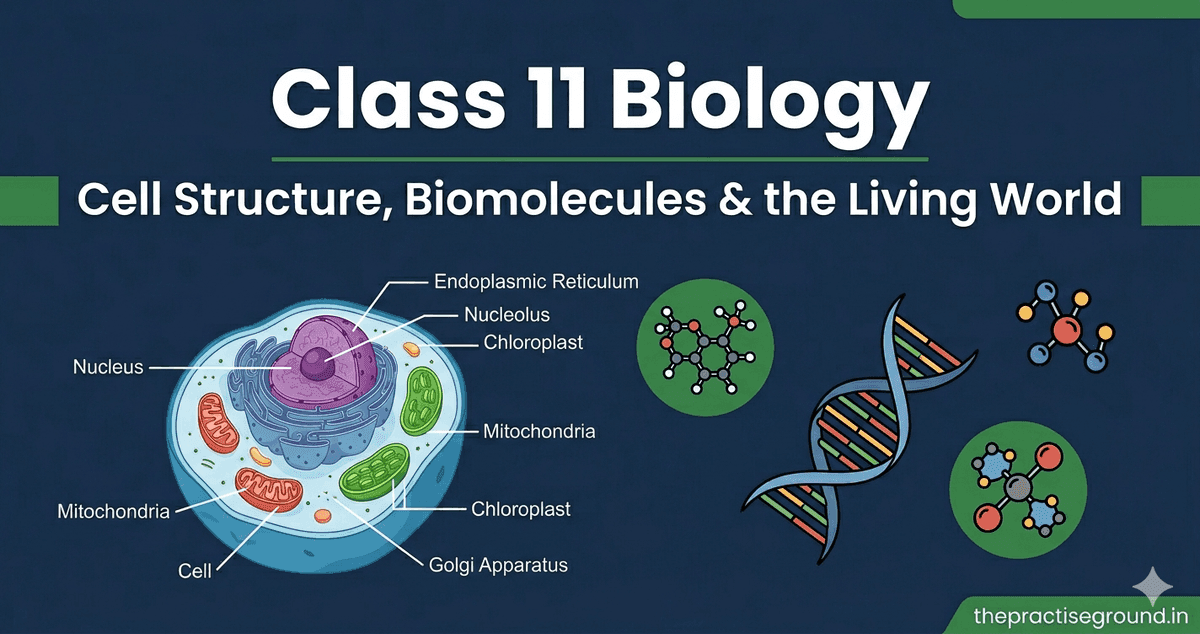
What Are the Major Cell Organelles and Their Functions?
| Organelle | Structure | Function |
|---|---|---|
| Nucleus | Double membrane, contains DNA | Controls cell activities, stores genetic material |
| Mitochondria | Double membrane with cristae | Cellular respiration (ATP production) — powerhouse of the cell |
| Chloroplast | Double membrane with thylakoids (in plant cells only) | Photosynthesis — converts light energy to chemical energy |
| Endoplasmic Reticulum (ER) | Network of membranes; rough ER has ribosomes | Rough ER: protein synthesis. Smooth ER: lipid synthesis |
| Golgi apparatus | Stack of flattened membrane sacs | Packaging, modification, and transport of proteins |
| Lysosomes | Single membrane vesicles | Digestion of worn-out organelles and foreign material — suicide bags |
| Ribosomes | RNA and protein (no membrane) | Protein synthesis |
| Vacuole | Single membrane (tonoplast) | Storage; maintains turgor pressure in plant cells |
| Cell membrane | Phospholipid bilayer with proteins | Selective permeability; controls what enters and exits the cell |
What Are Biomolecules?
Biomolecules are the chemical compounds found in living organisms. The four major classes are:Carbohydrates
- General formula: Cn(H₂O)n
- Functions: Energy source (glucose), structural support (cellulose), energy storage (starch, glycogen)
- Types: Monosaccharides (glucose, fructose), disaccharides (sucrose, lactose), polysaccharides (starch, cellulose)
Proteins
Lipids
Nucleic Acids
How Does Transport Work in Plants?
Plants move water and nutrients through two vascular tissues:
Key Takeaways
Frequently Asked Questions
What is the difference between prokaryotic and eukaryotic cells?
Prokaryotic cells lack a true nucleus and membrane-bound organelles. Their DNA is circular and lies in the nucleoid region. Eukaryotic cells have a defined nucleus enclosed by a nuclear membrane, along with organelles like mitochondria, ER, and Golgi apparatus. Bacteria are prokaryotic; plants, animals, and fungi are eukaryotic.
Why are mitochondria called the powerhouse of the cell?
Mitochondria are the site of aerobic cellular respiration, where glucose is broken down to produce ATP (adenosine triphosphate), the energy currency of the cell. A single glucose molecule can yield up to 36-38 ATP molecules through oxidative phosphorylation in the mitochondria.
What is the difference between DNA and RNA?
DNA is double-stranded, contains deoxyribose sugar and the base thymine. RNA is usually single-stranded, contains ribose sugar and the base uracil instead of thymine. DNA stores genetic information permanently; RNA carries and translates that information during protein synthesis.
Which biomolecule provides the most energy per gram?
Lipids (fats) provide approximately 9 calories per gram, compared to 4 calories per gram for both carbohydrates and proteins. This is why fats are the most efficient form of long-term energy storage in the body.
Practice Class 11 Biology with our Biology Grade 11 quizzes covering cell biology, classification, and all major NEET topics.
Taking a quick break? Test yourself!
Pause and try a quick Grade 11 Biology quiz — see how much you've picked up so far.