Want to test what you know?
Try our free Grade 12 Biology quiz — 25 questions, instant results, no sign-up.
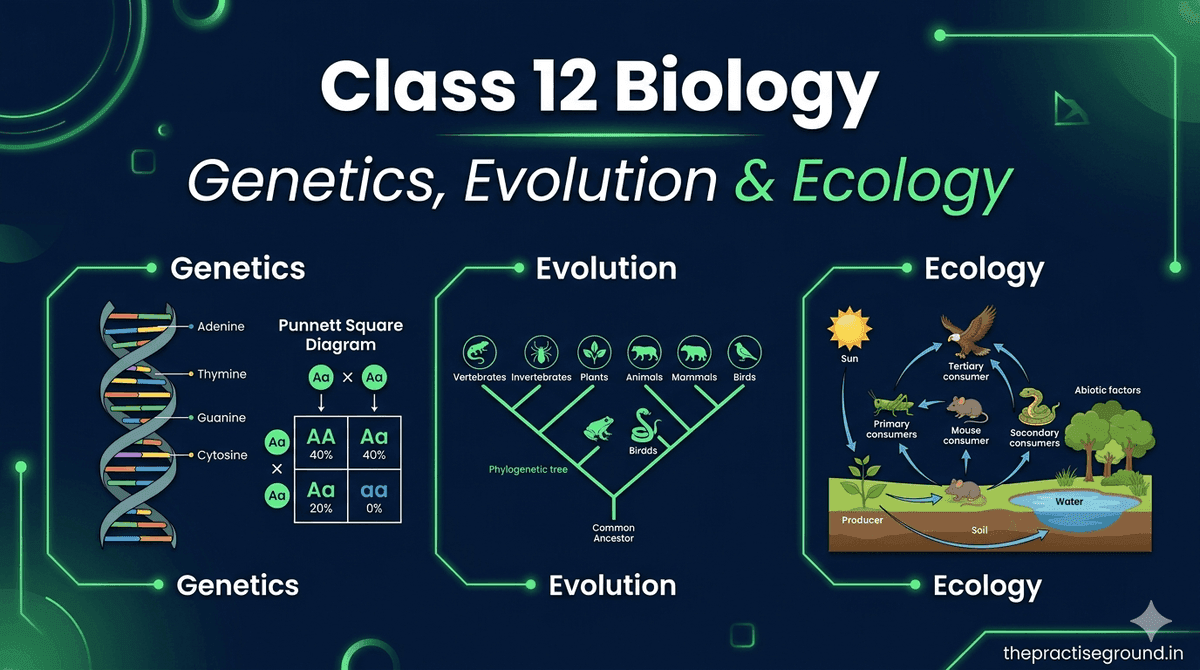
Class 12 Biology is dominated by genetics (Mendel's laws and molecular biology), evolution, and ecology. Together, these units carry the highest weightage in both CBSE board exams and NEET, making them the most important chapters to master.
What Are Mendel's Laws of Inheritance?
Gregor Mendel's experiments with pea plants established the foundation of genetics. His three laws are:
Law of Dominance: When two contrasting alleles are present, only the dominant allele expresses itself in the phenotype. The recessive allele is masked but still present in the genotype. Law of Segregation: During gamete formation, the two alleles of a gene separate so that each gamete receives only one allele. This is also called the law of purity of gametes. Law of Independent Assortment: Genes for different traits are inherited independently of each other, provided they are on different chromosomes.Monohybrid Cross Example
Cross: Tt x Tt (tall x tall, both heterozygous)
| T | t | |
|---|---|---|
| T | TT | Tt |
| t | Tt | tt |
Dihybrid Cross
Cross: RrYy x RrYy (round yellow x round yellow) Phenotypic ratio: 9 Round Yellow : 3 Round Green : 3 Wrinkled Yellow : 1 Wrinkled Green (9:3:3:1)
What Is the Molecular Basis of Inheritance?
DNA Structure
DNA is a double helix made of two antiparallel polynucleotide strands held together by hydrogen bonds between complementary bases: adenine (A) pairs with thymine (T) via 2 hydrogen bonds, and guanine (G) pairs with cytosine (C) via 3 hydrogen bonds.DNA Replication
DNA replication is semi-conservative — each new DNA molecule consists of one original strand and one newly synthesised strand. This was proved by the Meselson-Stahl experiment using heavy nitrogen (N-15).Key enzymes in replication:
- Helicase — unwinds the double helix
- DNA polymerase — synthesises new strand (5' to 3' direction only)
- Primase — lays down RNA primers
- Ligase — joins Okazaki fragments on the lagging strand
The Central Dogma
The central dogma of molecular biology describes the flow of genetic information:
DNA → (Transcription) → mRNA → (Translation) → Protein
Transcription is the synthesis of mRNA from a DNA template, catalysed by RNA polymerase. Translation is the synthesis of protein from mRNA at ribosomes, using tRNA to carry amino acids.How Does Evolution Work?
Darwin's Theory of Natural Selection
Natural selection is the process by which organisms with favourable traits are more likely to survive and reproduce. Over generations, this leads to the accumulation of advantageous traits in a population.The four conditions for natural selection:
- Variation exists within a population
- Some variations are heritable
- More offspring are produced than can survive
- Individuals with advantageous traits have higher fitness
Evidence for Evolution
| Type of Evidence | Example |
|---|---|
| Fossil record | Transitional forms (Archaeopteryx — link between reptiles and birds) |
| Comparative anatomy | Homologous organs (human arm, whale flipper, bat wing) |
| Molecular evidence | DNA and protein sequence similarities across species |
| Biogeography | Darwin's finches on Galapagos Islands |
| Embryology | Similar embryonic stages across vertebrates |
Hardy-Weinberg Principle
The Hardy-Weinberg principle states that allele frequencies in a population remain constant across generations if five conditions are met: no mutation, no migration, large population, random mating, and no natural selection.
The equation: p² + 2pq + q² = 1, where p is the frequency of the dominant allele and q is the frequency of the recessive allele.
What Are the Key Concepts in Ecology?
Ecosystem Components
An ecosystem has two components:
Energy Flow
Energy flows in one direction through an ecosystem: Sun → Producers → Primary consumers → Secondary consumers → Tertiary consumers.
Only about 10 percent of energy is transferred from one trophic level to the next (10 percent law by Lindeman). This is why food chains rarely have more than 4-5 trophic levels.
Biodiversity
Biodiversity refers to the variety of life at genetic, species, and ecosystem levels. India is one of the 17 mega-diverse countries. Threats to biodiversity include habitat loss, overexploitation, pollution, and invasive species.Key Takeaways
Frequently Asked Questions
What is the difference between genotype and phenotype?
Genotype is the genetic makeup of an organism (the alleles it carries, such as Tt). Phenotype is the observable characteristic (such as tall or short). The same phenotype can result from different genotypes — for example, both TT and Tt produce a tall phenotype.
What is codominance?
Codominance is when both alleles of a gene express themselves equally in the phenotype, rather than one being dominant over the other. The classic example is ABO blood groups, where the IA and IB alleles are codominant — a person with genotype IAIB has blood type AB, expressing both A and B antigens.
Why is ecology important for NEET?
Ecology consistently carries 12-14 marks in NEET, making it one of the highest-weightage units. Questions on ecosystem services, biodiversity hotspots, food webs, and ecological succession are common. It is also considered one of the easier units to score in because it relies more on factual recall than complex problem-solving.
How do you solve Hardy-Weinberg problems?
Start with the recessive phenotype frequency, which equals q². Take the square root to find q. Then p = 1 - q. You can now calculate p² (homozygous dominant frequency), 2pq (heterozygous frequency), and verify that p² + 2pq + q² = 1.
Practise Class 12 Biology with our Biology Grade 12 quizzes covering genetics, evolution, ecology, and all NEET topics.
Taking a quick break? Test yourself!
Pause and try a quick Grade 12 Biology quiz — see how much you've picked up so far.