
Want to test what you know?
Try our free Grade 11 Maths quiz — 25 questions, instant results, no sign-up.
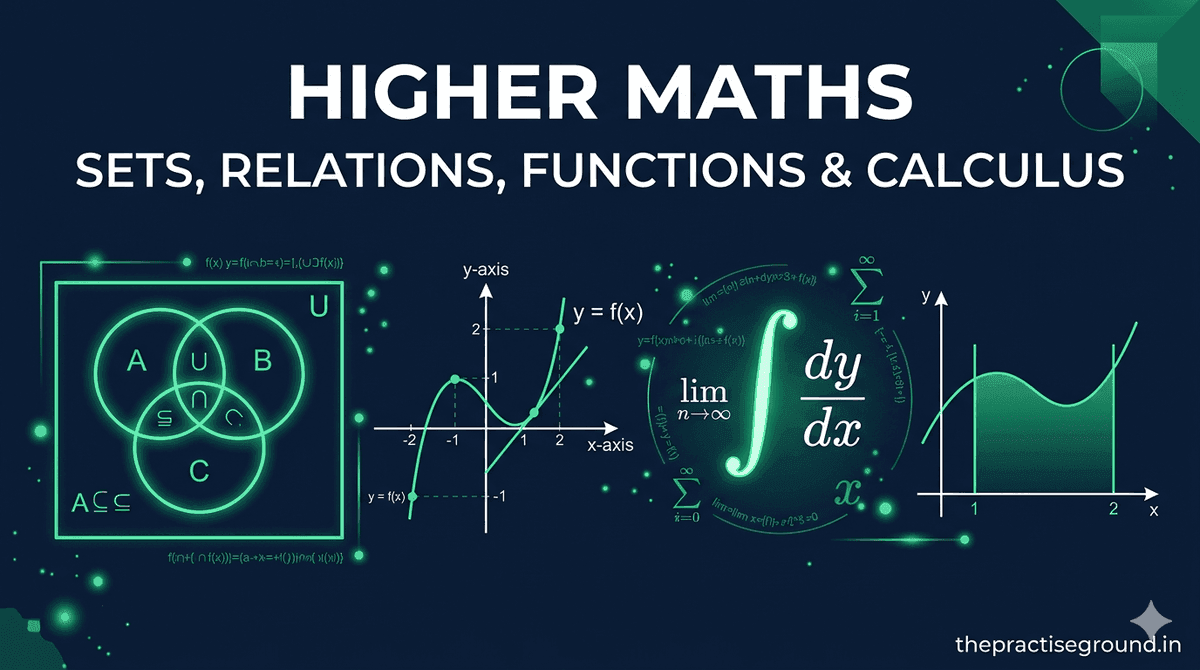
Higher mathematics in Class 11 and 12 introduces abstract concepts like sets, relations, and functions, then builds up to calculus — the most powerful mathematical tool you will learn in school. These topics are essential for CBSE board exams, JEE Mains, JEE Advanced, and form the mathematical backbone for physics and engineering.
What Are Sets and How Do You Work With Them?
A set is a well-defined collection of distinct objects. Sets are the foundation of modern mathematics.
Set Operations
| Operation | Symbol | Definition | Example (A = {1,2,3}, B = {2,3,4}) |
|---|---|---|---|
| Union | A ∪ B | All elements in A or B or both | {1, 2, 3, 4} |
| Intersection | A ∩ B | Elements common to both A and B | {2, 3} |
| Difference | A - B | Elements in A but not in B | {1} |
| Complement | A' | Elements not in A (relative to universal set) | Depends on U |
- (A ∪ B)' = A' ∩ B'
- (A ∩ B)' = A' ∪ B'
What Are Relations and Functions?
A relation from set A to set B is a subset of A × B (the Cartesian product). A function is a special type of relation where every element of A is associated with exactly one element of B.
Types of Functions
| Type | Definition | Example |
|---|---|---|
| One-one (injective) | Different inputs give different outputs | f(x) = 2x + 1 |
| Onto (surjective) | Every element of codomain has a preimage | f: R → R, f(x) = x³ |
| Bijective | Both one-one and onto | f(x) = x³ (on R to R) |
| Many-one | Different inputs can give the same output | f(x) = x² |
How Do Limits Work?
A limit describes the value a function approaches as the input approaches a certain value.
lim (x→a) f(x) = L means that as x gets closer and closer to a, f(x) gets closer and closer to L.
Key Limit Results
| Limit | Value |
|---|---|
| lim (x→0) sin x / x | 1 |
| lim (x→0) (1 - cos x) / x | 0 |
| lim (x→0) tan x / x | 1 |
| lim (x→0) (eˣ - 1) / x | 1 |
| lim (x→0) ln(1 + x) / x | 1 |
What Is Differentiation?
Differentiation finds the instantaneous rate of change of a function. The derivative of f(x) with respect to x is written as f'(x) or dy/dx.Standard Derivatives
| Function f(x) | Derivative f'(x) |
|---|---|
| xⁿ | nxⁿ⁻¹ |
| sin x | cos x |
| cos x | -sin x |
| tan x | sec²x |
| eˣ | eˣ |
| ln x | 1/x |
| aˣ | aˣ ln a |
Differentiation Rules
- Sum rule: d/dx [f(x) + g(x)] = f'(x) + g'(x)
- Product rule: d/dx [f(x) · g(x)] = f'(x)g(x) + f(x)g'(x)
- Quotient rule: d/dx [f(x)/g(x)] = [f'(x)g(x) - f(x)g'(x)] / [g(x)]²
- Chain rule: d/dx [f(g(x))] = f'(g(x)) · g'(x)
Applications of Differentiation
What Is Integration?
Integration is the reverse of differentiation. It finds the area under a curve or the anti-derivative of a function.Standard Integrals
| Function | Integral | ||
|---|---|---|---|
| xⁿ (n ≠ -1) | xⁿ⁺¹/(n+1) + C | ||
| 1/x | ln | x | + C |
| eˣ | eˣ + C | ||
| sin x | -cos x + C | ||
| cos x | sin x + C | ||
| sec²x | tan x + C |
Methods of Integration
Definite Integrals
A definite integral ∫(a to b) f(x) dx gives the exact area under the curve from x = a to x = b. Use the Fundamental Theorem of Calculus: evaluate the anti-derivative at b and subtract its value at a.
Key Takeaways
Frequently Asked Questions
What is the best way to learn calculus for the first time?
Start with a strong understanding of limits and continuity before moving to differentiation. Practice the standard derivatives until they become automatic. Then learn the rules (product, quotient, chain) with worked examples. Only move to integration after you are comfortable with differentiation, since integration is its reverse process.
How do I know when to use differentiation vs integration in a problem?
If the problem asks for a rate, slope, maximum, minimum, or instantaneous value, use differentiation. If it asks for area, total quantity, or accumulation, use integration. In physics, differentiation gives velocity from displacement and acceleration from velocity. Integration does the reverse.
What is the LIATE rule for integration by parts?
LIATE stands for Logarithmic, Inverse trigonometric, Algebraic, Trigonometric, Exponential. When using integration by parts (∫u dv = uv - ∫v du), choose u in the order given by LIATE — the function that appears first in the list should be chosen as u.
How important is calculus for JEE?
Calculus is the single most important topic in JEE Mathematics, carrying approximately 35-40 percent of the total maths marks. Limits, differentiation, integration, and applications of derivatives and integrals are tested heavily. A strong command of calculus is essential for a competitive JEE score.
Practice higher maths with our Maths Grade 11 quizzes and Maths Grade 12 quizzes.
Taking a quick break? Test yourself!
Pause and try a quick Grade 11 Maths quiz — see how much you've picked up so far.