
Want to test what you know?
Try our free Grade 5 Maths quiz — 25 questions, instant results, no sign-up.
Stop thinking of maths as numbers and calculations. Maths is the language of patterns.
Patterns are everywhere: in nature, in art, in music, in how you grow. Once you see them, maths transforms from a subject you "have to learn" into something genuinely fascinating.
Let's explore the hidden beauty of mathematics.
What is a Pattern?
A pattern is a sequence that repeats or follows a predictable rule.
Simple patterns:- 2, 4, 6, 8, 10, ... (even numbers)
- 1, 3, 5, 7, 9, ... (odd numbers)
- 1, 1, 2, 3, 5, 8, 13, ... (Fibonacci!)
Number Sequences
Arithmetic Sequences
An arithmetic sequence has a constant difference between consecutive terms.
Example 1: 5, 10, 15, 20, 25, ...Geometric Sequences
A geometric sequence has a constant ratio between consecutive terms.
Example 1: 2, 4, 8, 16, 32, ...Triangular Numbers
These are numbers that form triangles:
CODEBLOCK0The pattern: 1, 3, 6, 10, 15, 21, 28, ...
The rule: Position n gives n(n+1)/2So position 10 = 10(11)/2 = 55
Triangular numbers appear throughout nature and mathematics!
Square Numbers
Numbers that form squares:
1² = 1 2² = 4 3² = 9 4² = 16 5² = 25
Sequence: 1, 4, 9, 16, 25, 36, 49, 64, ...
Pentagonal Numbers
Numbers that form pentagons:
Position 1: 1 Position 2: 5 Position 3: 12 Position 4: 22 Position 5: 35
The pattern: n(3n-1)/2
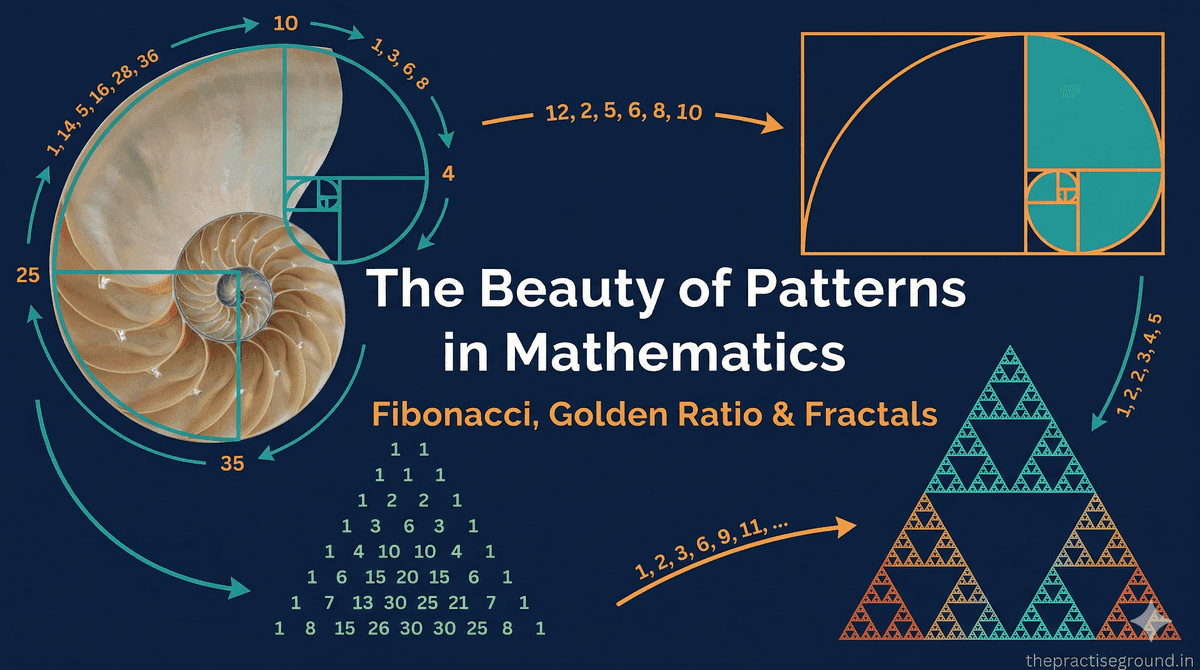
The Fibonacci Sequence: Nature's Blueprint
The Fibonacci sequence is perhaps the most famous mathematical pattern: 0, 1, 1, 2, 3, 5, 8, 13, 21, 34, 55, 89, ...
The rule: Each number = sum of the two previous numbers.The answer: Fibonacci numbers!
The Fibonacci Sequence in Nature
Flower Petals
Many flowers have Fibonacci numbers of petals:
Why? It optimizes space and growth efficiency.
Spiral Patterns
Sunflower seed arrangements follow Fibonacci spirals. Seeds spiral outward in a pattern that ensures optimal packing—no space is wasted.
Similar spirals appear in:
Tree Branches
As a tree grows:
The branching pattern follows Fibonacci numbers!
Human Body
The Golden Ratio
The Fibonacci sequence reveals the Golden Ratio (φ ≈ 1.618):
As you go further in the Fibonacci sequence, the ratio of consecutive numbers approaches the golden ratio:
This ratio is found throughout nature and is considered aesthetically pleasing in art and architecture.
Prime Numbers: The Atoms of Mathematics
Prime numbers are building blocks of all numbers. They're only divisible by 1 and themselves.
First primes: 2, 3, 5, 7, 11, 13, 17, 19, 23, 29, 31, ...Properties of Primes
Patterns in Primes
While primes seem random, patterns exist:
Twin primes: Pairs differing by 2These are so common that mathematicians conjecture infinitely many exist!
Pascal's Triangle: Patterns Hidden in Rows
Pascal's Triangle is constructed by adding adjacent numbers:
CODEBLOCK1Patterns Within Pascal's Triangle
Row sums: 1, 2, 4, 8, 16, 32, 64, ... (Powers of 2!) Diagonals: 1, 2, 3, 4, 5, ... and 1, 3, 6, 10, 15, ... (Triangular numbers!) Middle element: Always the largest in each rowThis triangle appears in algebra, probability, and combinatorics. It's full of hidden patterns!
Patterns in Everyday Life
Shopping Prices
Prices often end in .99: Rs. 99, Rs. 199, Rs. 499. Why? Psychological pricing exploits how our brains perceive numbers.
Traffic Patterns
Rush hours follow patterns based on work schedules, school timings, and commute times.
Weather Patterns
Seasons follow annual patterns. Weather forecasts use historical patterns to predict.
Growth Patterns
Heights follow normal distribution patterns. Test scores, plant growth, animal populations—all follow mathematical patterns.
Why Patterns Matter
Pattern recognition is a superpower:Finding Patterns: An Exercise
Look around you. Can you spot patterns?
Mathematics is the study of these patterns. Every pattern you find deepens your understanding of our universe.
Practice on The Practise Ground
Recognize and extend patterns through interactive problems! Our Grade 5-7 quizzes include:
Make mathematics beautiful!
FAQ
Is the Fibonacci sequence just theoretical or does it really appear in nature?
It really appears! Sunflower spirals, flower petals, tree branches, seashells—nature uses Fibonacci patterns extensively. Look around and you'll find it!
Why does nature "choose" Fibonacci patterns?
They're efficient. Fibonacci spirals pack seeds with minimal overlap. Flower petals in Fibonacci numbers receive optimal sunlight. Evolution favors patterns that work.
Are there other important mathematical patterns?
Absolutely! Prime number patterns, fractals (self-similar patterns), wave patterns, and more. Mathematics is patterns all the way down!
Can I use pattern recognition to predict the future?
Sometimes! Weather, stock markets, and social trends follow patterns. But remember: patterns are probabilistic, not certain. Understanding patterns helps predict likely futures.
Patterns Across Curricula: Global and Indian Perspectives
The study of mathematical patterns is fundamental across all international curricula—CBSE, ICSE, Cambridge, and IB all include pattern recognition as a key competency.
Indian Mathematics Education: Vedic mathematics, an ancient Indian mathematical tradition, is built entirely on recognizing patterns. Many patterns in this guide trace back to Vedic principles studied in Indian schools. International Standards: Cambridge and IB curricula emphasize pattern recognition as a path to deeper mathematical understanding, with the same Fibonacci and geometric patterns explored worldwide. Universal Truth: Whether you're in Delhi studying CBSE, London studying Cambridge IGCSE, or preparing for IB in any country, the patterns you discover are the same. Mathematics is truly universal.Taking a quick break? Test yourself!
Pause and try a quick Grade 5 Maths quiz — see how much you've picked up so far.