
Want to test what you know?
Try our free Grade 5 Maths quiz — 25 questions, instant results, no sign-up.
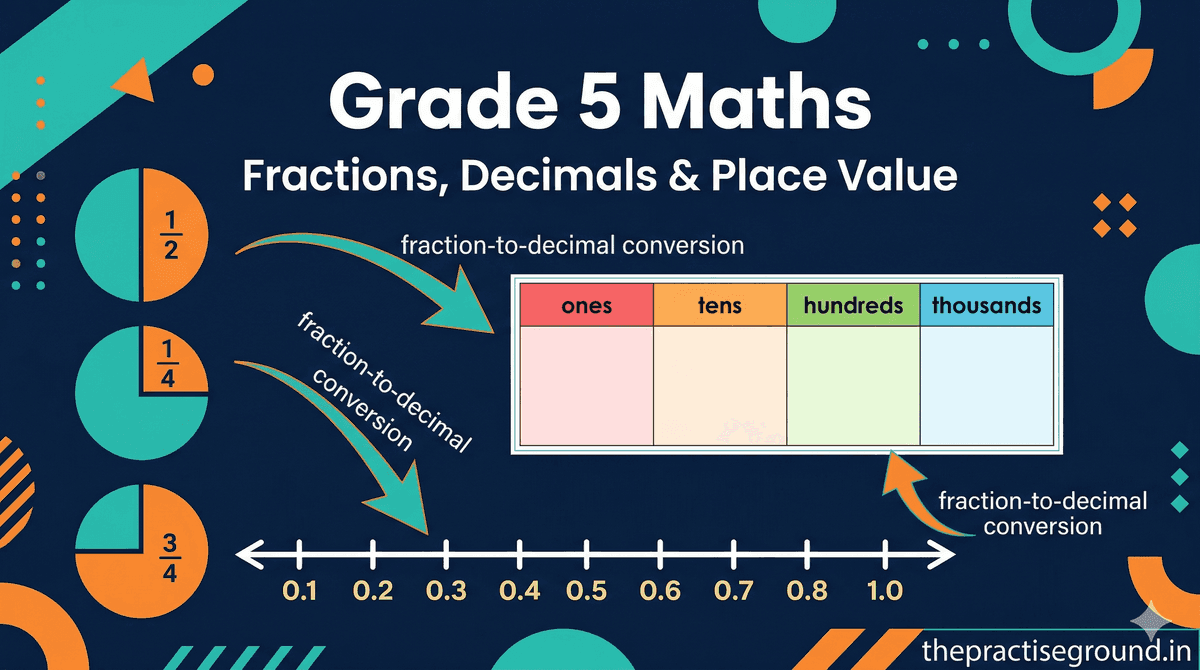
Grade 5 Maths introduces some of the most important number concepts you will use for the rest of your school life. Place value, fractions, and decimals are the foundation for algebra, percentages, and advanced maths. This guide breaks them down into simple, clear steps.
What Is Place Value?
Place value tells you what a digit is worth based on its position in a number. In the number 45,327:| Ten Thousands | Thousands | Hundreds | Tens | Ones |
|---|---|---|---|---|
| 4 | 5 | 3 | 2 | 7 |
| 40,000 | 5,000 | 300 | 20 | 7 |
Expanded Form
45,327 = 40,000 + 5,000 + 300 + 20 + 7Understanding place value helps you:
- Compare and order large numbers
- Round numbers to the nearest ten, hundred, or thousand
- Add and subtract large numbers mentally
What Are Fractions?
A fraction represents a part of a whole. It has two numbers:
Types of Fractions
| Type | Definition | Example |
|---|---|---|
| Proper fraction | Numerator is less than denominator | 3/4 (three quarters) |
| Improper fraction | Numerator is greater than or equal to denominator | 7/4 (seven quarters) |
| Mixed number | A whole number plus a proper fraction | 1 3/4 (one and three quarters) |
Converting Between Improper Fractions and Mixed Numbers
To convert 7/4 to a mixed number: divide 7 by 4 = 1 remainder 3, so 7/4 = 1 3/4.
To convert 2 1/3 to an improper fraction: multiply 2 x 3 = 6, then add 1 = 7, so 2 1/3 = 7/3.
Equivalent Fractions
Equivalent fractions look different but represent the same amount. To make equivalent fractions, multiply or divide both the numerator and denominator by the same number:
1/2 = 2/4 = 3/6 = 4/8 = 5/10
This is important for comparing fractions and adding fractions with different denominators.
What Are Decimals?
A decimal is another way to write fractions using the base-ten place value system. The decimal point separates whole numbers from parts:
| Ones | . | Tenths | Hundredths | Thousandths |
|---|---|---|---|---|
| 3 | . | 2 | 5 | 0 |
Converting Fractions to Decimals
Divide the numerator by the denominator:
Converting Decimals to Fractions
Look at the place value of the last digit:
Mental Maths Tricks for Grade 5
Here are some quick tricks to make maths easier:
- Multiplying by 10, 100, 1000: Just move the decimal point right by 1, 2, or 3 places
- Multiplying by 5: Multiply by 10, then divide by 2 (e.g., 14 x 5 = 140 / 2 = 70)
- Doubling and halving: To multiply 25 x 16, double 25 to get 50, halve 16 to get 8, so 50 x 8 = 400
Key Takeaways
Frequently Asked Questions
Why do I need to learn fractions if I have decimals?
Fractions and decimals are two ways of expressing the same thing, but each is more useful in different situations. Fractions are better for exact values (1/3 is exact, while 0.333... goes on forever). Decimals are better for measurement and money calculations. You need both.
How do I compare fractions with different denominators?
Find a common denominator by finding the least common multiple (LCM) of both denominators. Convert both fractions to equivalent fractions with this common denominator, then compare the numerators. For example, to compare 2/3 and 3/4: LCM of 3 and 4 is 12, so 2/3 = 8/12 and 3/4 = 9/12. Since 9 is bigger than 8, 3/4 is greater.
What does rounding to the nearest hundred mean?
Look at the tens digit. If it is 5 or more, round up. If it is less than 5, round down. For example, 347 rounded to the nearest hundred is 300 (because the tens digit 4 is less than 5). 382 rounds to 400 (because 8 is 5 or more).
Practise Grade 5 Maths with our free Grade 5 Maths quizzes covering fractions, decimals, place value, and all key topics.
Taking a quick break? Test yourself!
Pause and try a quick Grade 5 Maths quiz — see how much you've picked up so far.