Want to test what you know?
Try our free Grade 5 Science quiz — 25 questions, instant results, no sign-up.
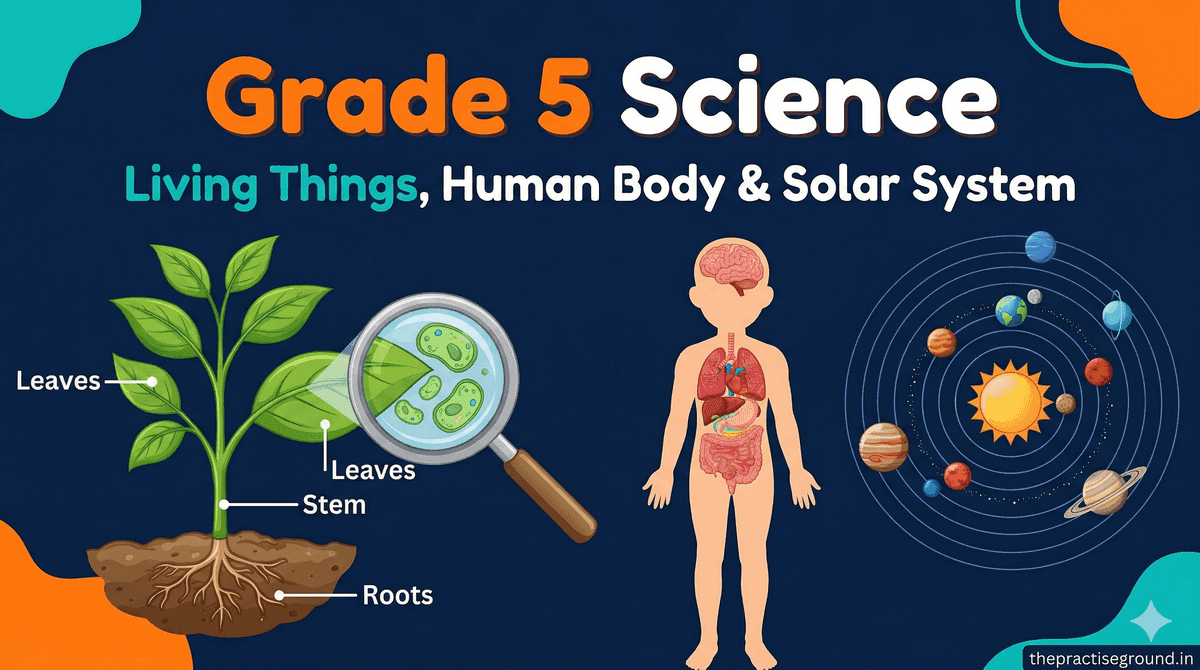
Grade 5 Science is all about exploring the world around you and understanding how things work. This year, you will learn about what makes something alive, how your body functions, and what is out there in our solar system. These are topics that make science exciting and relevant to everyday life.
What Makes Something a Living Thing?
All living things share seven characteristics, often remembered with the acronym MRS GREN:
| Characteristic | What It Means | Example |
|---|---|---|
| Movement | Living things can move (even plants move towards light) | A sunflower turning to face the sun |
| Respiration | Using food to release energy | You breathe in oxygen and breathe out carbon dioxide |
| Sensitivity | Responding to changes in the environment | Your eyes adjust to bright light |
| Growth | Getting bigger and developing over time | A seed growing into a tree |
| Reproduction | Making new living things | A hen laying eggs |
| Excretion | Getting rid of waste products | Sweating to remove waste from your body |
| Nutrition | Taking in food for energy and growth | Plants making food through photosynthesis |
How Does the Human Body Work?
Your body is an amazing machine made up of systems that work together to keep you alive and healthy.
The Digestive System
The digestive system breaks down the food you eat into nutrients your body can use:
- Mouth — teeth chew food, saliva starts breaking down starch
- Oesophagus — a tube that pushes food to the stomach
- Stomach — acids and enzymes break food into a thick liquid
- Small intestine — nutrients are absorbed into the blood
- Large intestine — water is absorbed, waste is formed
- Rectum — waste is stored until it leaves the body
The Circulatory System
The circulatory system transports blood around your body:
The Respiratory System
The respiratory system helps you breathe:
What Is in Our Solar System?
Our solar system has eight planets orbiting the Sun, along with moons, asteroids, and comets.
| Planet | Position | Fun Fact |
|---|---|---|
| Mercury | 1st (closest to Sun) | Has no atmosphere and extreme temperature swings |
| Venus | 2nd | Hottest planet (even hotter than Mercury) due to thick atmosphere |
| Earth | 3rd | The only planet known to support life |
| Mars | 4th | Known as the Red Planet; has the tallest volcano in the solar system |
| Jupiter | 5th | Largest planet; could fit 1,300 Earths inside it |
| Saturn | 6th | Famous for its beautiful rings made of ice and rock |
| Uranus | 7th | Rotates on its side like a rolling ball |
| Neptune | 8th (farthest) | Has the strongest winds in the solar system |
Key Takeaways
Frequently Asked Questions
Is Pluto a planet?
Pluto was reclassified as a dwarf planet in 2006 by the International Astronomical Union. It is smaller than Earth's Moon and shares its orbital space with other objects in the Kuiper Belt. While it orbits the Sun like a planet, it does not meet all the criteria for full planet status.
Why do we need to breathe?
Your body needs oxygen to release energy from the food you eat (this process is called cellular respiration). Without oxygen, your cells cannot produce the energy needed to keep your organs functioning. When energy is released, carbon dioxide is produced as a waste product, which you breathe out.
How long does it take food to travel through your digestive system?
The entire journey from eating to waste removal takes about 24-72 hours. Food spends about 6-8 hours in your stomach, 6-8 hours in the small intestine, and up to 36 hours in the large intestine.
Explore more with our free Grade 5 Science quizzes — 52 weeks of questions covering living things, the human body, and Earth science.
Taking a quick break? Test yourself!
Pause and try a quick Grade 5 Science quiz — see how much you've picked up so far.