Want to test what you know?
Try our free Grade 5 Science quiz — 25 questions, instant results, no sign-up.
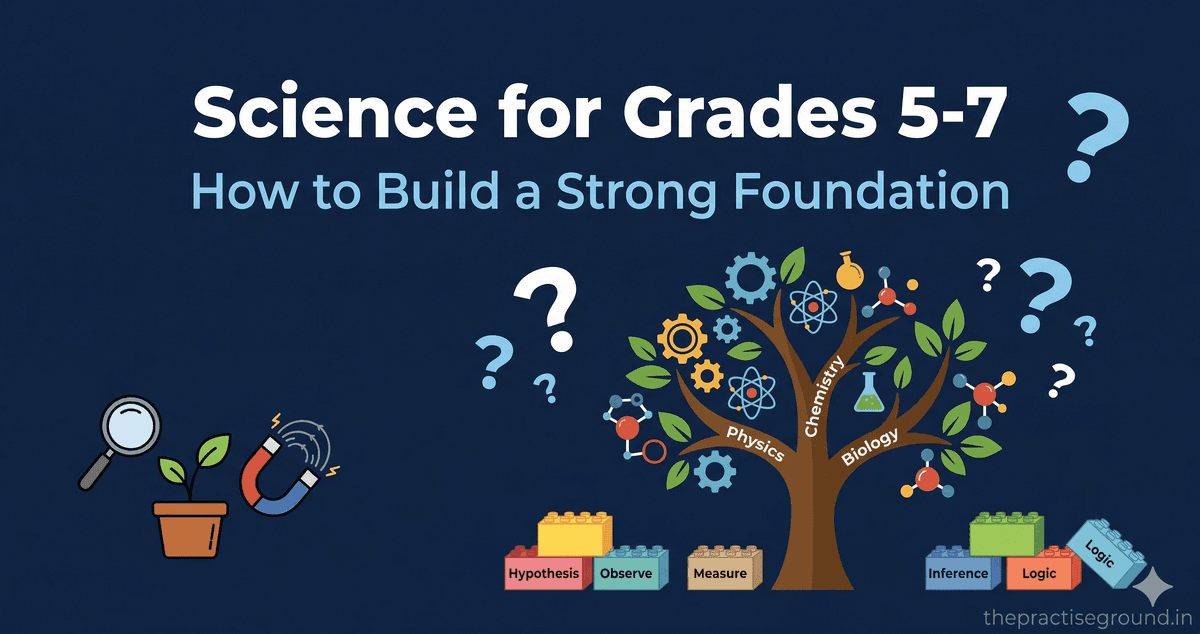
Science for Grades 5-7: How to Build a Strong Foundation
Grades 5-7 are a magical time in your science journey. You're curious about everything—why leaves are green, how plants drink water, where lightning comes from. This is the age when science can become your absolute favorite subject, or it can start to feel disconnected from real life.
The difference? How science is taught and learned.
In this guide, we'll show you how to learn science in a way that makes it relevant, engaging, and unforgettable. You'll connect your everyday observations to science concepts, conduct fun experiments at home, and build the strong foundation that makes advanced science in Grade 8+ feel like a natural progression—not a sudden jump in difficulty.
Why These Years Matter: The Foundation Principle
Think of your science education like building a house. Grades 5-7 are the foundation. If you build it strong, the house (higher grades and science mastery) will stand firm. If you skip this stage, cracks appear later, and catching up becomes hard.
Many students struggle with Grade 8 Science or Grade 10 CBSE Biology not because Grade 8 is harder, but because their Grades 5-7 foundation was weak.
In these years, you're learning:
- How to observe carefully
- How to connect observations to explanations
- How to ask "why" and find answers
- How to think scientifically
Integrated Science in Grades 5-7
In Grades 5-7, science is usually "integrated"—you study Physics, Chemistry, and Biology mixed together rather than as separate subjects. This is actually brilliant because it mimics real life. In nature, everything is interconnected.
For example:
Understanding this integration early prepares you perfectly for when subjects separate in Grade 8+.
Strategy 1: Learn Science Through Daily Life Observations
The most powerful science learning happens when you notice science in your everyday world. Here's how to develop this habit:
The "Science Notebook" - Your Secret Weapon
Get a simple notebook. Throughout the week, write down observations:
Monday: Noticed that plants in my room lean toward the window (light). Asked: Why do plants do this? It might be to get more sunlight. Wednesday: Boiling water creates steam. Condensation appears on cold glass. This might be related to the water cycle I learned about. Saturday: During a rain, noticed earthworms coming to the surface. Why do they come up? Maybe the soil gets waterlogged.Once you write an observation, bring it to class or look it up. Your science teacher can help explain it. You've now turned a random observation into a learning moment.
Why this works: Your brain remembers what's personally meaningful. Self-discovered observations stick far better than textbook facts.Kitchen Chemistry Adventures
Your kitchen is a science lab. Here are safe, fun experiments you can do:
Experiment 1: Volcano Reaction (Acid-Base Reaction)
Materials: Baking soda, vinegar, food coloring, dish soap, paper cup Steps:- Mix baking soda, food coloring, and dish soap in a paper cup
- Pour vinegar slowly and watch the "eruption"
Experiment 2: Invisible Ink (Oxidation Reaction)
Materials: Lemon juice, paper, paintbrush, heat source (stove or sunny window) Steps:Experiment 3: Growing Crystals (Crystallization)
Materials: Salt, sugar, hot water, string, jar Steps:Each of these experiments teaches chemistry concepts in a memorable, hands-on way.
Strategy 2: Plant Observation Project
Growing plants teaches Biology and connects to Physics and Chemistry.
Simple Plant Projects
Project 1: Seed GerminationWhat You Learn From Plant Projects
Strategy 3: The Human Body is Fascinating
Grades 5-7 introduce basic human body systems. Make it personal:
Understand Your Own Digestive System
Experience digestion:The Five Senses as Experiments
Each sense demonstrates Physics principles (vibration, light, temperature) in your own body.
Strategy 4: Reading Beyond Textbooks
Textbooks are important, but they're not enough. Read engaging science books:
Recommended Books for Grades 5-7
Building Your Science Notebook
This is your personal science record. Unlike textbook learning, this is your work.
What to Include
Preparing for the Grade 8+ Transition
By the end of Grade 7, science splits into Physics, Chemistry, and Biology as separate subjects. Here's how to prepare:
Understand Basic Concepts Now
Physics foundations (Grade 5-7):In Grade 8+, these become rigorous with formulas and calculations.
Chemistry foundations (Grade 5-7):In Grade 8+, you'll study atomic structure, bonding, reactions with equations.
Biology foundations (Grade 5-7):In Grade 8+, you'll dive deep into cells, photosynthesis, respiration, reproduction, genetics.
The Transition Mindset
Instead of fearing Grade 8 Science, think of it this way:
Your Grade 5-7 foundation makes this transition smooth, not sudden.
Parent Tips: Supporting Your Child's Science Learning
If you're a parent reading this, here's how you can help:
FAQs
My child thinks science is boring. How do we fix this?
Start with their interests. Do they like cooking? Explore kitchen chemistry. Animals? Study food chains and ecosystems. The goal is to show that science is everywhere in their life.
How much time should we spend on science daily?
In Grades 5-7, science should be enjoyable, not stressful. 30-45 minutes of focused learning, plus daily observations in your notebook is ideal. Quality over quantity.
Should we be concerned about test scores in Grades 5-7?
School tests in Grades 5-7 are less about scores and more about learning. Focus on understanding, not memorizing. Strong understanding leads to strong scores naturally.
Is it okay to not understand every concept in Grade 5-7?
Absolutely. There's no concept in Grade 5-7 that you won't revisit in Grade 8+. If something doesn't make sense now, trust that it will become clearer with more exposure.
What if my child wants to do more advanced science?
Encourage curiosity through books, documentaries, and YouTube channels. You can explore topics beyond the textbook without pressure.
How do diagrams help in these grades?
Diagrams are powerful learning tools. Drawing the water cycle or a plant's structure helps cement understanding better than reading about it. Encourage your child to draw frequently.
Your Science Journey Starts Now
Grades 5-7 aren't just preparing you for exams. They're cultivating a mindset: What makes things work? How is everything connected? Why does the world function this way?
This curiosity, combined with hands-on exploration and careful observation, creates scientists—not just students who memorize facts.
Your foundation is being built right now. Make it strong, make it personal, make it fun. Your future self—in Grade 8, Grade 10, and beyond—will thank you.
Start this week: Begin your science notebook, grow a seed, and observe your world through a scientist's eyes. Science isn't something that happens in a classroom. It's happening everywhere around you, all the time. Your job is to notice it, question it, and learn from it.
Ready to dive deeper? The Practise Ground has age-appropriate quizzes and activities for Grade 5-7 students. Use them to test your understanding and keep your curiosity alive!
Taking a quick break? Test yourself!
Pause and try a quick Grade 5 Science quiz — see how much you've picked up so far.