
Want to test what you know?
Try our free Grade 5 Maths quiz — 25 questions, instant results, no sign-up.
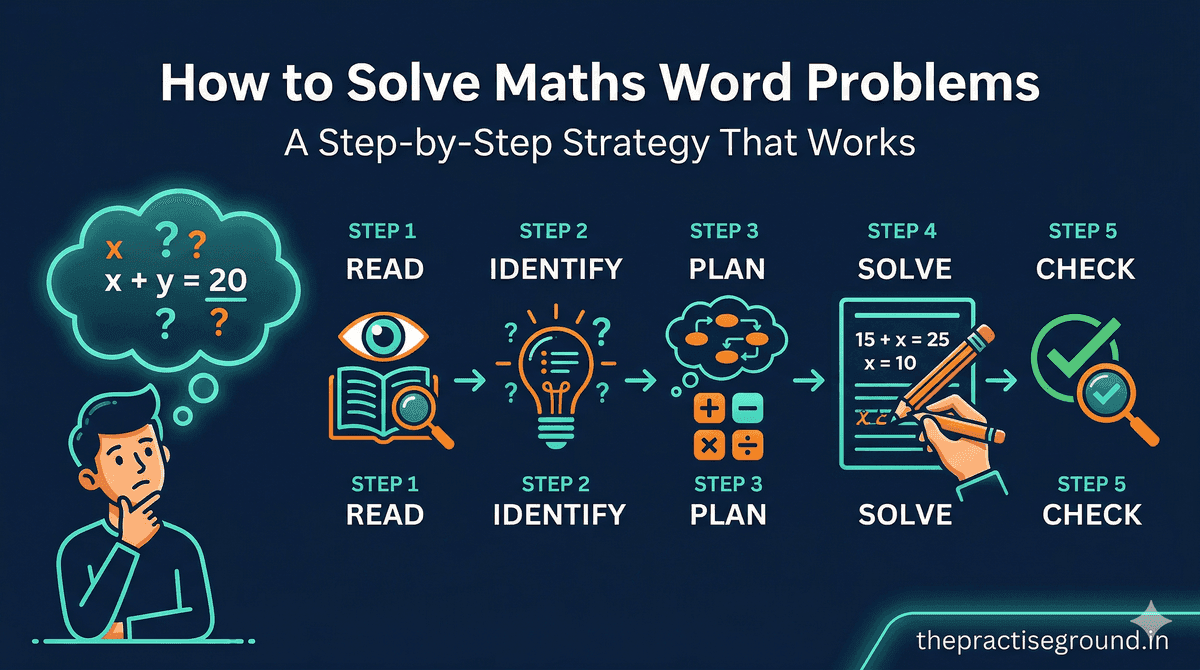
Maths word problems are where many students struggle — not because the maths is hard, but because translating words into equations feels unfamiliar. The RUCSAC method gives you a reliable step-by-step process that works for any word problem from Grade 5 to Grade 10.
What Is the RUCSAC Method?
RUCSAC stands for:| Step | Action | What To Do |
|---|---|---|
| R | Read | Read the problem carefully, at least twice |
| U | Understand | Identify what you know and what you need to find |
| C | Choose | Choose the right operation or method |
| S | Solve | Do the calculation step by step |
| A | Answer | Write a clear answer with units |
| C | Check | Check your answer makes sense |
How to Translate Words into Maths
Certain words and phrases map to specific mathematical operations:
| Words/Phrases | Operation |
|---|---|
| more than, increased by, total, sum, combined | Addition (+) |
| less than, decreased by, difference, remaining, fewer | Subtraction (-) |
| times, product, of, each, per, every | Multiplication (x) |
| shared equally, divided by, per, ratio, out of | Division (/) |
| is, equals, gives, results in | Equals (=) |
Common Word Problem Types
1. Age Problems
"Ravi is 12 years old. His father is 3 times his age. How old will his father be in 5 years?"- Father's current age: 12 x 3 = 36
- Father's age in 5 years: 36 + 5 = 41 years
2. Speed-Distance-Time Problems
"A car travels 240 km in 4 hours. What is its speed?"3. Profit and Loss Problems
"A shopkeeper buys a shirt for Rs 400 and sells it for Rs 500. What is the profit percentage?"4. Ratio and Proportion Problems
"Divide Rs 750 between A and B in the ratio 2:3."5. Percentage Problems
"A school has 800 students. If 35% are girls, how many boys are there?"Common Traps and How to Avoid Them
- Not reading the question carefully — The problem might ask for the difference, not the total
- Forgetting units — Always include units (km, hours, Rs, kg) in your answer
- Rounding too early — Keep full precision until the final answer
- Not checking if the answer makes sense — If a person's age comes out negative, something went wrong
- Confusing "of" and "more than" — "25% of 200" is 50, but "25% more than 200" is 250
Key Takeaways
Frequently Asked Questions
Why do I understand maths concepts but struggle with word problems?
Word problems require two skills: reading comprehension and maths. Many students are good at maths when given an equation, but struggle to extract the equation from the words. The RUCSAC method bridges this gap by giving you a structured way to translate words into maths.
How can I practise word problems effectively?
Start with simple problems and work up to complex ones. After solving each problem, write down the type (age, speed, ratio, etc.) and the approach you used. Over time, you will recognise patterns and know which approach to use immediately.
What should I do if I get stuck on a word problem?
Go back to steps R and U. Re-read the problem and list all the information given. Draw a diagram if possible. Try simpler numbers to understand the structure (replace 347 with 10 to see the pattern). If you are still stuck, skip it and come back later with fresh eyes.
Practise problem-solving with our Maths quizzes covering word problems and logical reasoning for Grades 5-10.
Taking a quick break? Test yourself!
Pause and try a quick Grade 5 Maths quiz — see how much you've picked up so far.