
Want to test what you know?
Try our free Grade 5 English quiz — 25 questions, instant results, no sign-up.
A strong vocabulary improves your reading comprehension, writing quality, and exam scores across every subject. Research shows that vocabulary knowledge is one of the strongest predictors of academic success. Here are 10 strategies that actually work.
Why Does Vocabulary Matter?
Vocabulary affects everything:
- Reading comprehension — You cannot understand a passage if you do not know the words
- Writing quality — Precise vocabulary makes your writing clearer and more engaging
- Exam scores — Questions in English, Science, and Social Studies all depend on understanding key terms
- Learning new subjects — Every subject has its own vocabulary that you need to master
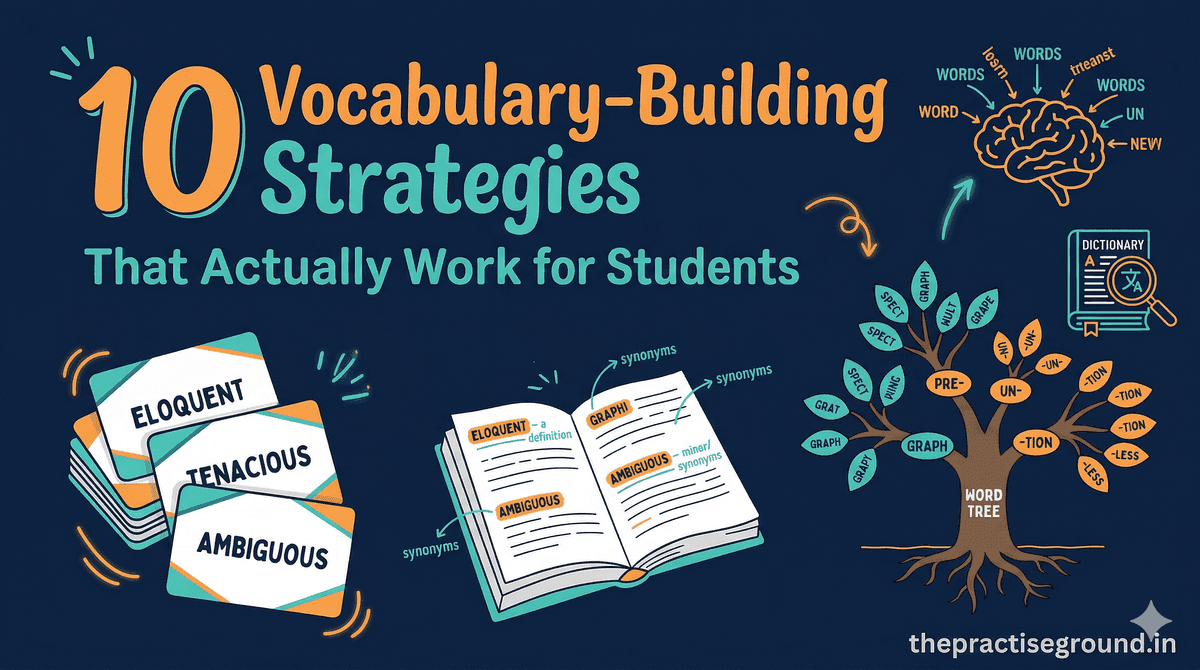
Strategy 1: Learn Root Words
Root words are the building blocks of English vocabulary. Learning common Latin and Greek roots helps you decode thousands of unfamiliar words.| Root | Meaning | Example Words |
|---|---|---|
| bio | life | biology, biography, antibiotic |
| graph | write | autograph, photograph, geography |
| port | carry | transport, export, import, portable |
| rupt | break | interrupt, erupt, corrupt, disrupt |
| spec | look | inspect, spectacle, respect, perspective |
Strategy 2: Use Context Clues
When you find an unknown word while reading, look at the surrounding sentences for clues:
Strategy 3: Keep a Vocabulary Notebook
Write each new word with:
- The word and its pronunciation
- The definition in your own words
- A sentence using the word
- A synonym and an antonym
Strategy 4: Read Widely
Reading exposes you to words in context, which is how most vocabulary is naturally acquired. Read a mix of:
The more you read, the more words you encounter and retain.
Strategy 5: Use Spaced Repetition
Review new words at increasing intervals: after 1 day, 3 days, 1 week, and 2 weeks. This method (called spaced repetition) moves words from short-term to long-term memory far more effectively than cramming.
Strategy 6: Learn Words in Groups
Learn words in thematic groups rather than random lists. For example, learn all the words related to weather (drizzle, downpour, gust, breeze, humidity) together. Grouping creates mental connections that make recall easier.
Strategy 7: Use New Words Immediately
Use every new word you learn in a sentence within 24 hours — in your writing, in conversation, or in a journal. Active use is far more effective than passive recognition.
Strategy 8: Play Word Games
Games like Scrabble, crossword puzzles, and word searches make vocabulary practice enjoyable. Online word games and quiz platforms (like our English quizzes) provide structured practice with immediate feedback.
Strategy 9: Study Word Families
A word family is a group of words with the same root but different prefixes and suffixes:
Learning one root word gives you access to an entire family of related words.
Strategy 10: Test Yourself Regularly
Active recall (testing yourself) is the most effective way to remember words. Take vocabulary quizzes, use flashcards, or have someone quiz you from your vocabulary notebook.
Key Takeaways
Frequently Asked Questions
How many new words should I learn per week?
Aim for 5-10 new words per week with deep understanding rather than 50 words you will forget. Quality beats quantity. If you learn 7 words per week and truly remember them, that is over 350 new words per year.
What is the fastest way to improve vocabulary for an upcoming exam?
Focus on subject-specific vocabulary first. Make a list of key terms from your textbook chapters, write definitions in your own words, and test yourself daily. For English vocabulary questions, learn common roots and prefixes — this helps you decode unfamiliar words during the exam.
Does reading fiction or non-fiction help vocabulary more?
Both help, but in different ways. Fiction exposes you to descriptive and emotional vocabulary. Non-fiction introduces technical and academic vocabulary. A mix of both gives you the broadest vocabulary range. Read whatever genuinely interests you — engaged reading leads to better word retention.
Build your vocabulary with our free English quizzes covering vocabulary, grammar, and comprehension for Grades 5-10.
Taking a quick break? Test yourself!
Pause and try a quick Grade 5 English quiz — see how much you've picked up so far.