
Want to test what you know?
Try our free Grade 5 English quiz — 25 questions, instant results, no sign-up.
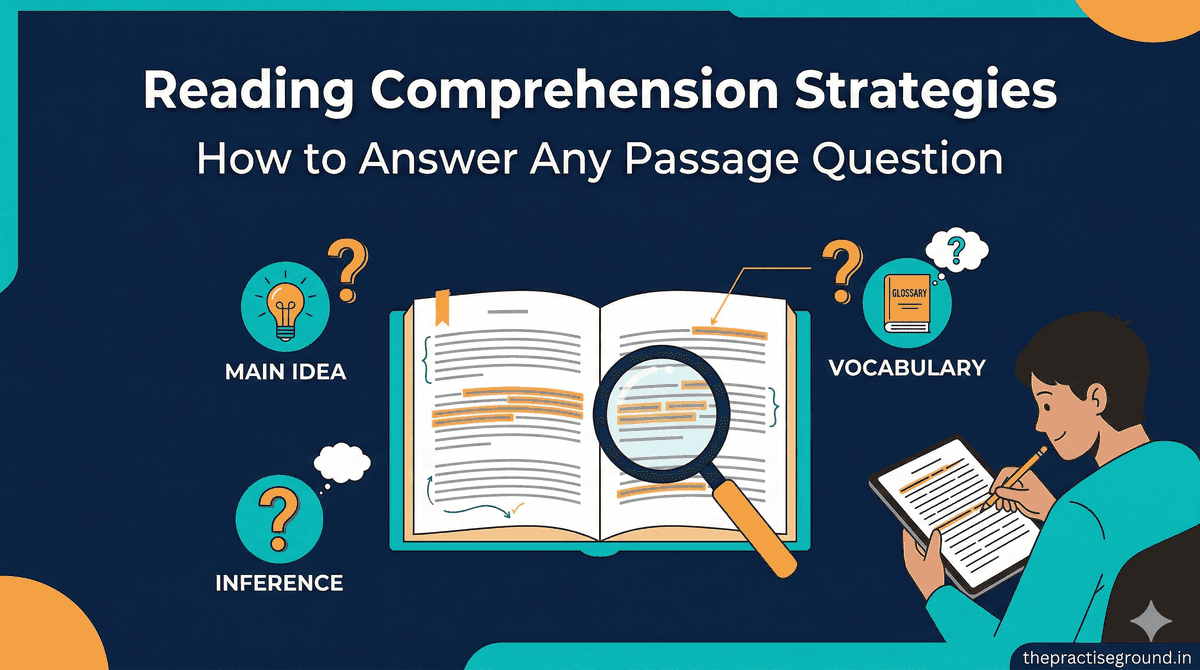
Reading comprehension tests your ability to understand, analyse, and draw conclusions from a text. Whether it is an unseen passage in your English exam or a reading section in a competitive test, the same strategies apply. Here is a step-by-step approach that works for every passage question.
Step 1: Read the Questions First
Before reading the passage, scan the questions. This tells your brain what to look for while reading, making you a more targeted and efficient reader. Note:
- What type of information is being asked for (facts, opinions, meanings)?
- Are there line references or paragraph references?
- What are the key words in each question?
Step 2: Read the Passage Actively
Active reading means engaging with the text, not just letting your eyes move across the words:
Step 3: Identify the Question Type
Different question types require different approaches:
| Question Type | What It Asks | How to Answer |
|---|---|---|
| Factual | A specific detail from the text | Find the exact line and copy or paraphrase |
| Inferential | What can be concluded from the text | Combine clues from multiple parts of the passage |
| Vocabulary | The meaning of a word in context | Read the sentence around the word for clues |
| Main Idea | What the passage is mainly about | Look at the title, first paragraph, and final paragraph |
| Tone/Attitude | How the author feels about the topic | Look for opinion words, adjectives, and the overall approach |
Step 4: Answer Using Evidence From the Passage
Every answer should be supported by the text. Use this formula:
- State your answer clearly
- Reference the relevant part of the passage
- Explain how the evidence supports your answer
Step 5: Watch Out for Common Traps
Time Management for Comprehension Sections
| Total Time | Reading | Answering | Reviewing |
|---|---|---|---|
| 30 minutes | 8-10 min | 15-18 min | 4-5 min |
| 20 minutes | 5-7 min | 10-12 min | 2-3 min |
Key Takeaways
Frequently Asked Questions
How can I improve my reading speed without losing comprehension?
Practice daily reading with a timer. Start with easier texts and gradually increase difficulty. Do not re-read sentences unless absolutely necessary. Focus on understanding paragraphs as units rather than individual words. Speed comes naturally with regular practice.
What should I do if I do not understand a word in the passage?
Use context clues — look at the surrounding sentences for hints about the word's meaning. Often, the passage provides examples or explanations nearby. If you still cannot figure it out, make your best guess and move on. Do not spend more than 30 seconds on a single word.
Should I read the entire passage or just skim it?
Read the entire passage at least once. Skimming risks missing key details, especially for inferential questions. However, you do not need to memorise everything — your margin notes and underlines will help you find information quickly when answering questions.
How do I answer inference questions?
Inference questions ask you to draw conclusions that are not directly stated. Look for clues across multiple sentences or paragraphs. The answer should be logically supported by the text. If you have to make a big leap of logic, the inference is probably wrong.
Practise comprehension skills with our free English quizzes covering grammar, vocabulary, and reading comprehension for all grades.
Taking a quick break? Test yourself!
Pause and try a quick Grade 5 English quiz — see how much you've picked up so far.