
Want to test what you know?
Try our free Grade 8 English quiz — 25 questions, instant results, no sign-up.
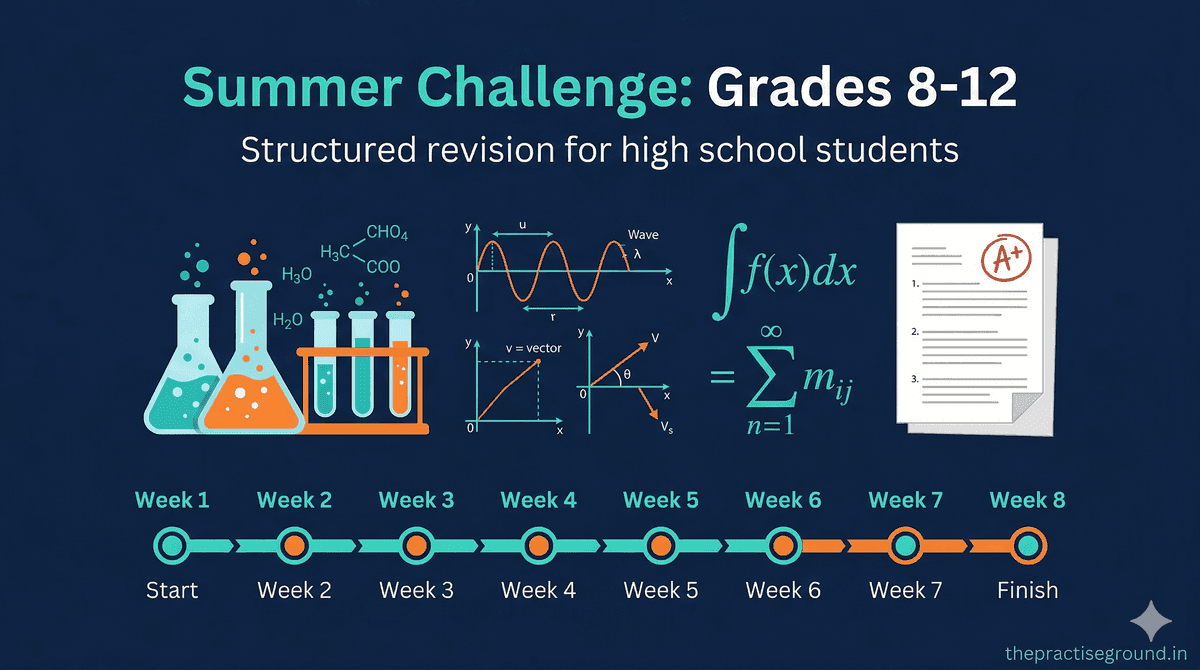
For Grades 8-12 students, the summer break is not just about preventing learning loss — it is an opportunity to build a head start for the next academic year, board exams, and competitive entrance tests. The Summer Challenge provides a structured framework to make the most of this time.
How Is the Summer Challenge Different for High School?
Grades 8-10: Building Board Exam Foundations
Students in Grades 8-10 cover English, Maths, and Science each week (75 questions per week). The focus is on consolidating core concepts that form the foundation for Grade 10 board exams.Grades 11-12: Competitive Exam Preparation
Students in Grades 11-12 cover English, Maths, Physics, Chemistry, and Biology each week (125 questions per week). This expanded subject list reflects the demands of CBSE board exams and competitive tests like JEE and NEET.Why Summer Revision Matters for High School Students
| Grade | Why Summer Matters |
|---|---|
| Grade 8-9 | Foundation for Grade 10 boards; core concepts are heavily tested |
| Grade 10 | Board exam year; summer before Grade 10 is prime revision time |
| Grade 11 | Transition to senior secondary; concepts jump significantly in difficulty |
| Grade 12 | Board exam and entrance exam year; every week of practice counts |
Self-Study Strategies for Older Students
Unlike younger students, Grades 8-12 students can manage their own learning. Here is how to structure your summer:
1. Assess Your Weak Areas First
Before starting the Summer Challenge, take a honest look at which subjects and topics you struggled with during the school year. Spend extra time on these areas rather than revising topics you already know well.2. Set Weekly Goals, Not Daily Ones
Older students benefit from flexibility. Instead of a rigid daily schedule, set weekly goals: complete all quizzes for the week by Sunday. This allows you to adjust for social plans, family trips, or days when you want to study more.3. Combine Quiz Practice With Concept Review
If you get a question wrong, do not just note the correct answer. Go back to your textbook or notes and understand why. This turns a quiz from a testing tool into a learning tool.4. Build Competitive Exam Habits Early (Grades 11-12)
If you are targeting JEE or NEET, use the summer to:- Complete NCERT thoroughly for Physics, Chemistry, and Biology
- Start with basic-level practice questions
- Build a daily practice habit that will carry through the academic year
- Focus on conceptual understanding before problem-solving speed
5. Use the Quizzes for Active Recall
Active recall (testing yourself) is far more effective than passive re-reading. The Summer Challenge quizzes are designed for this — each question forces you to retrieve information from memory, which strengthens long-term retention.How to Map Summer Challenge Weeks to Board Exam Topics
The Summer Challenge weeks are designed to cover a broad range of topics within each subject. Here is how they relate to board exam preparation:
Key Takeaways
Frequently Asked Questions
Is the Summer Challenge enough for NEET or JEE preparation?
The Summer Challenge provides a solid foundation and helps maintain your knowledge during the break. However, JEE and NEET require additional preparation with specialised problem sets and mock tests. Think of the Summer Challenge as your baseline daily practice, and supplement it with targeted competitive exam preparation.
Should I study ahead or revise previous topics?
For most students, revision is more valuable. If you have not fully mastered the previous year's concepts, studying ahead will be difficult. However, if you are confident in your current syllabus, reading ahead (especially for Grade 11 students) can give you a useful head start.
How do I balance summer revision with other activities?
The Summer Challenge is designed to take 30-40 minutes per day for high school students. This leaves plenty of time for sports, hobbies, family time, and relaxation. The key is to make it a non-negotiable part of your day, like brushing your teeth, rather than something that competes with fun activities.
Can I use the Summer Challenge alongside coaching classes?
Yes. Many students attend coaching during summer, and the quizzes complement classroom learning by providing daily practice and active recall. Use them as a quick daily check on what you are learning in class. Start the High School Summer Challenge
Taking a quick break? Test yourself!
Pause and try a quick Grade 8 English quiz — see how much you've picked up so far.