
Want to test what you know?
Try our free Grade 9 English quiz — 25 questions, instant results, no sign-up.
Board exams are high-stakes. A 10-mark improvement in maths can change your overall percentage and open doors to better colleges. Yet many students struggle not because they're incapable, but because their preparation strategy is flawed.
This guide breaks down practical, evidence-based strategies to help you score higher on CBSE, ICSE, or Cambridge board exams.
Understanding Why Students Underperform
Before jumping to solutions, let's diagnose the problem:
Weak Fundamentals: Students memorize formulas without understanding concepts. When exam questions require application, they're stuck. Poor Time Management: Spending 20 minutes on a 2-mark question wastes precious exam time. Better allocation can unlock 5-10 extra marks. Last-Minute Cramming: Reviewing topics superficially a week before exams means knowledge is fragile and quickly forgotten. Incomplete Practice: Solving only textbook problems misses question variations that appear in exams. Test Anxiety: Even well-prepared students panic during exams, leading to careless mistakes.The good news? All of these are fixable with deliberate strategy.
Strategy 1: Diagnose Your Starting Point
Before preparing, you need a baseline.
Take a Mock Exam: Solve a full previous year's board exam paper under timed conditions (3 hours for Class 10). Mark it honestly. Analyze Mistakes:- Did you lose marks due to conceptual gaps (didn't understand the topic)?
- Did you lose marks due to careless errors (understood but made calculation mistakes)?
- Did you lose marks due to time pressure (didn't complete all questions)?
- Did you lose marks due to presentation (didn't show steps; answers weren't clear)?
Strategy 2: Master Topic Prioritization
Not all maths topics carry equal weight on board exams. Prioritization is crucial.
CBSE Class 10 Weightage (approximate):- Master High-Weightage Topics First (60% of study time on topics worth 8+ marks)
- Ensure Clarity on Medium-Weightage Topics (30% of study time)
- Quick Review of Low-Weightage Topics (10% of study time)
Strategy 3: Build Strong Fundamentals
Conceptual Understanding Before Problem-SolvingSpend 2-3 weeks building crystal-clear understanding:
Week 1: Understand sin, cos, tan as ratios in right triangles. Solve basic problems like "Find sin(30°)."
Week 2: Learn complementary angle relationships. Solve problems requiring these relationships.
Week 3: Combine with Pythagoras theorem and heights-and-distances problems. These are harder applications.
Week 4: Attempt mixed questions and previous papers.
This builds confidence and eliminates the "I don't understand this topic" barrier.
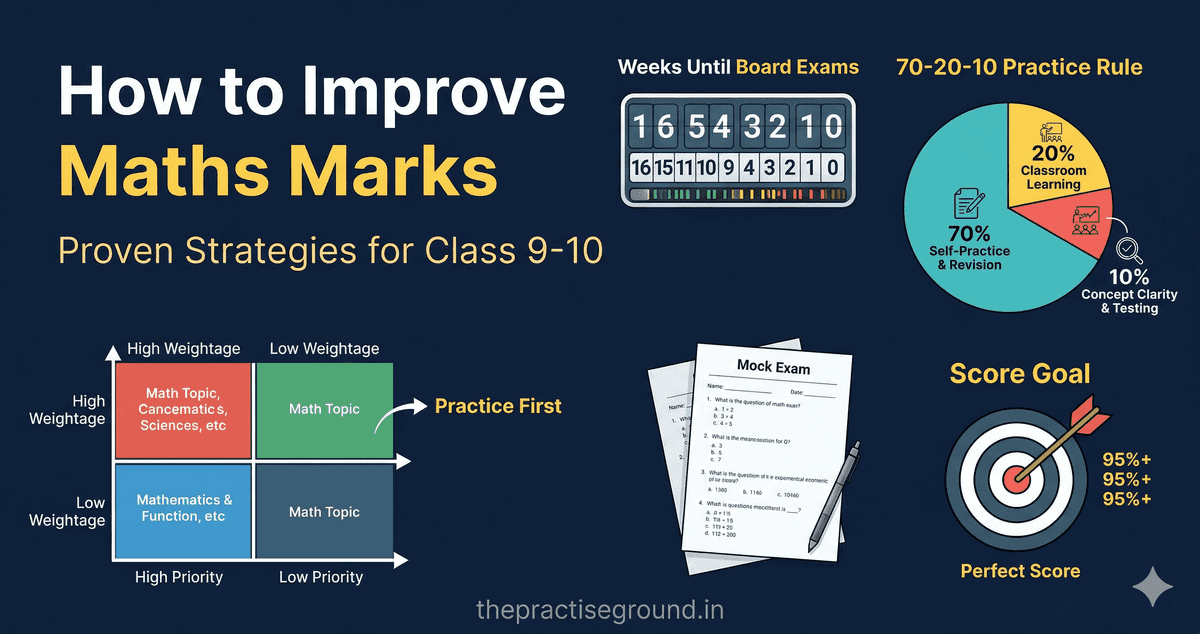
Strategy 4: The 70-20-10 Practice Pattern
Your exam preparation should follow this pattern:
70% Targeted Topic PracticeStrategy 5: Master Time Management in Exams
Board exams are typically 3 hours for 80 marks (Class 10 CBSE).
Ideal Time Allocation:Strategy 6: Reduce Careless Errors
Careless mistakes are demoralizing because they're avoidable.
Common Errors:Strategy 7: Use Smart Practice Tools
Online Maths Quizzes accelerate improvement because they:Platforms like The Practise Ground offer free Class 9-10 maths quizzes aligned with CBSE, ICSE, and Cambridge syllabi. Practice 20-30 minutes daily on topic-specific quizzes, then attempt mixed and full-length quizzes as exams approach.
The 16-Week Board Exam Prep Plan
Weeks 1-4: Foundation BuildingSpecific Topics for Focused Attention
Geometry (Often Underperformed)
Trigonometry (Often Overlooked)
Algebraic Problem-Solving
Conclusion
Improving maths marks isn't about luck—it's about strategy. Diagnose your gaps, prioritize high-impact topics, build conceptual understanding, practice systematically (70-20-10 pattern), and master time management.
Start with The Practise Ground's free Class 9-10 maths quizzes aligned with your board's syllabus. Practice daily, track progress, and improve. Your goal of scoring 70+, 80+, or even 90+ marks is absolutely achievable with focused preparation.
The time to start is now. Your board exam score awaits.
Frequently Asked Questions
How many months before board exams should I start preparing for maths?
Ideally 4-6 months (16-24 weeks). This gives enough time for foundation building, mixed practice, and mock exams. Even 8 weeks of focused preparation can produce significant improvement if you follow a structured plan with daily quiz practice.
Which maths topics should I focus on first for board exams?
Start with high-weightage topics. For CBSE Class 10, Algebra and Geometry together carry about 40 marks. For ICSE, focus on Commercial Mathematics and Mensuration early. Always prioritise topics where you currently score lowest — the gap between your current and target marks is where the most points are waiting.
Is solving previous year papers enough to score well in maths?
Previous year papers are essential but not sufficient on their own. They show you the exam pattern and question types, but you need conceptual understanding first. Use the 70-20-10 practice rule: 70 percent targeted topic practice, 20 percent mixed practice, 10 percent full mock exams.
How do I stop making careless mistakes in maths exams?
Careless mistakes are usually speed errors or skipped steps. The fix is to show all working (even for easy steps), plug your answer back into the equation to verify, and reserve the last 10 minutes of the exam for checking. Practice under timed conditions to build the habit.
Taking a quick break? Test yourself!
Pause and try a quick Grade 9 English quiz — see how much you've picked up so far.