
Want to test what you know?
Try our free Grade 5 Maths quiz — 25 questions, instant results, no sign-up.
Word problems intimidate many students. But here's a secret: a word problem is just a story told in words with numbers sprinkled in. Your job is to extract the mathematical meaning and solve it.
Let's learn a systematic approach that works for every problem, from Grade 5 to Grade 10, across CBSE, ICSE, Cambridge, and beyond.
The RUCS Method
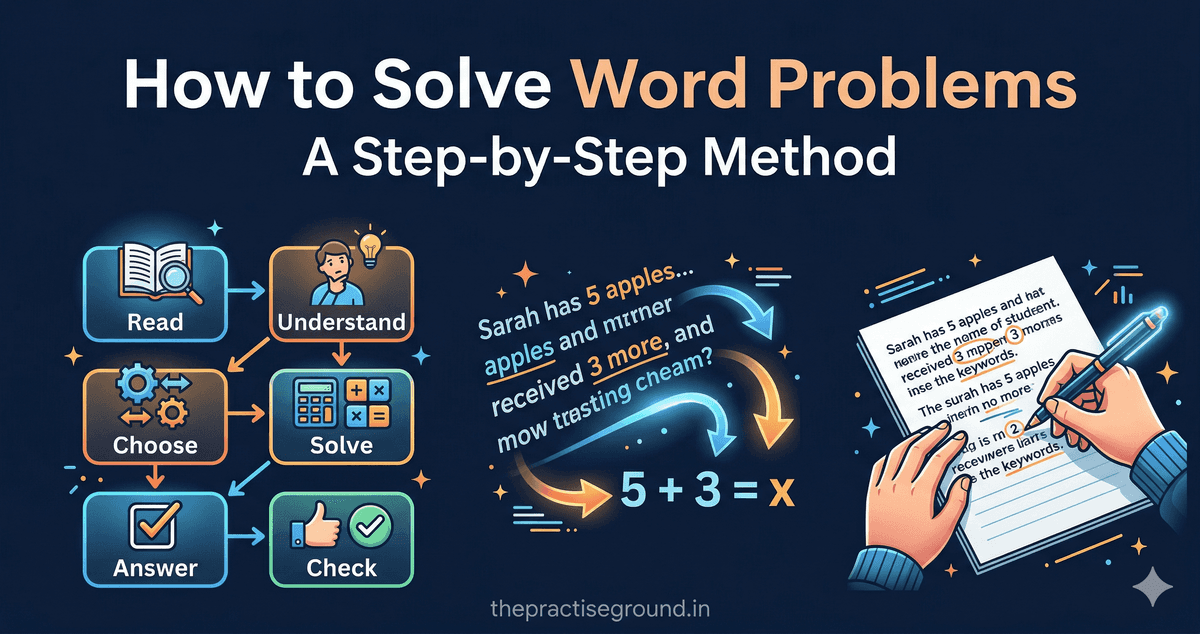
Word problems become manageable when you follow a consistent process. RUCS stands for:
R — Read the problem carefully U — Understand what's being asked C — Choose operations and Create equations S — Solve and Verify your answerStep 1: READ (R)
Read the problem at least twice. The first time, read for general understanding. Don't panic about numbers yet—just understand the story.
Example Problem: "Aisha buys 3 books for Rs. 480 each and 5 notebooks for Rs. 60 each. How much does she spend in total?"First reading: Aisha is buying books and notebooks. I need to find the total cost.
Step 2: UNDERSTAND (U)
Now, identify the critical information:
- What do I know? (Given information)
- What am I looking for? (The question)
- What's irrelevant? (Extra information that doesn't matter)
Step 3: CHOOSE AND CREATE (C)
Decide which mathematical operations you need. Convert the words into mathematical language.
Common word patterns:| Word Pattern | Operation | Example |
|---|---|---|
| "altogether", "total", "in all" | Addition | Total cost = cost of books + cost of notebooks |
| "more than", "less than", "fewer" | Addition/Subtraction | If A has 5 more than B, then A = B + 5 |
| "times", "each", "per" | Multiplication | 3 books at Rs. 480 each = 3 × 480 |
| "divided equally", "shared" | Division | If 20 apples are shared among 4 children, each gets 20 ÷ 4 |
| "per", "rate of" | Division | Speed = distance per time |
Step 4: SOLVE AND VERIFY (S)
Do the calculation carefully and double-check!
For our example:Common Word Problem Types
Type 1: Simple Arithmetic Problems
"A farmer has 45 hens and 30 goats. How many animals does she have in total?"
Type 2: Comparison Problems
"Raj scored 85 marks. His sister scored 12 marks more. How much did his sister score?"
Type 3: Rate and Ratio Problems
"A car travels 60 km per hour. How far does it travel in 5 hours?"
Type 4: Multi-step Problems
"A book costs Rs. 250. A student buys 4 books and pays with Rs. 1,200. How much change does she get?"
Type 5: Percentage Problems
"A shirt originally costs Rs. 800. It's on sale for 25% off. What's the final price?"
Type 6: Ratio and Proportion
"In a class, the ratio of boys to girls is 3:2. If there are 15 boys, how many girls are there?"
Type 7: Age Problems
"A father is 40 years old. His son is 12 years old. After how many years will the father be twice as old as the son?"
Common Mistakes in Word Problems
Mistake 1: Misreading the questionStrategies for Tough Problems
Strategy 1: Work Backwards If you don't know how to start, work backwards from the answer. Strategy 2: Use Variables Define unknowns clearly:Real Exam Scenarios
CBSE/ICSE Style Question: "The cost of a pen is Rs. x and the cost of a notebook is Rs. y. If 3 pens and 2 notebooks cost Rs. 80 total, and a pen costs Rs. 10, find the cost of a notebook."The notebook costs Rs. 25.
Cambridge IGCSE Style: "A factory produces 200 items daily. If 5% are defective and defective items cost Rs. 50 to replace, what's the replacement cost per week?"Practice on The Practise Ground
Word problem mastery comes from solving diverse problems. Our interactive quizzes include:
Practice regularly and watch your problem-solving confidence soar!
FAQ
How do I know which operation to use?
Look for keywords! "Total" → add, "left" → subtract, "each" → multiply, "shared" → divide. Create a keywords reference sheet.
What if a problem has multiple steps?
Break it into smaller problems. Solve one step at a time. Write intermediate answers clearly.
How should I manage word problems in exams?
Read twice (once for understanding, once for details). Write the equation clearly. Show all steps. Verify your answer if time permits.
Why are word problems important if we can just calculate?
Word problems teach problem-solving thinking. In real life, you don't see "calculate 3 × 5." You see scenarios requiring you to identify what needs calculating. This skill is invaluable.
Taking a quick break? Test yourself!
Pause and try a quick Grade 5 Maths quiz — see how much you've picked up so far.