
Want to test what you know?
Try our free Grade 6 English quiz — 25 questions, instant results, no sign-up.
Vocabulary is the foundation of good English. With a larger vocabulary, you can express yourself better, understand texts more easily, and score higher marks in exams. Let's explore proven strategies to build your vocabulary efficiently.
Why Vocabulary Matters
A strong vocabulary helps you:
- Write better: Express ideas clearly in essays and letters
- Read faster: Understand texts without constant dictionary use
- Score more: Exams test vocabulary through comprehension and writing
- Speak confidently: Communicate without repetition
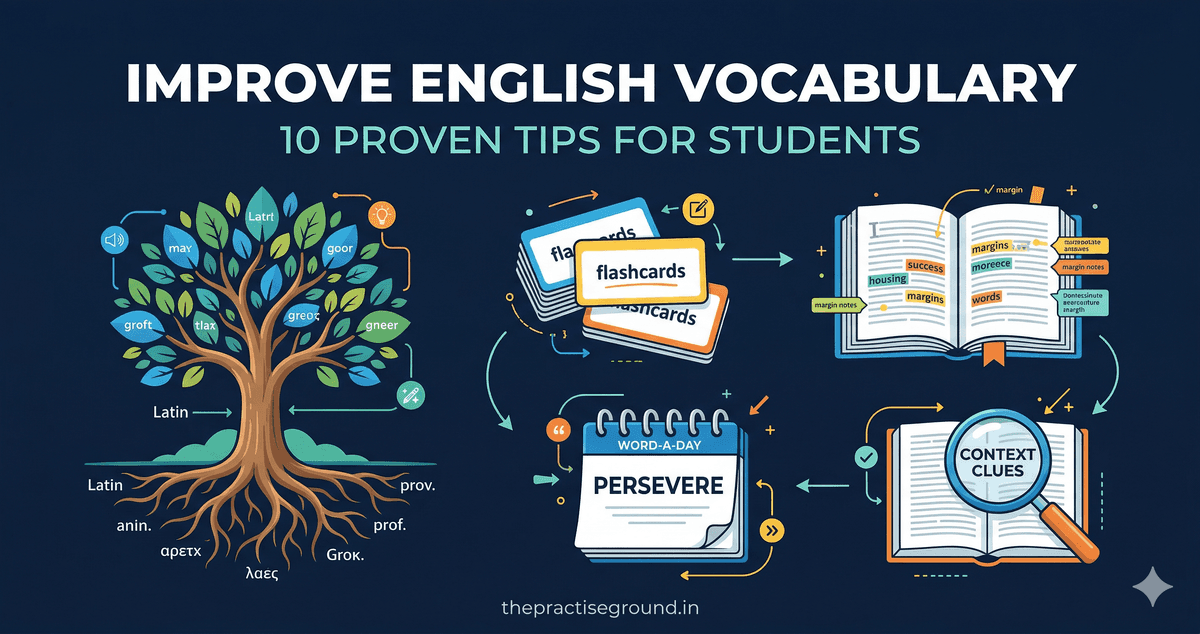
Strategy 1: Learn Words in Context, Not Isolation
Wrong approach: Learning random word lists without meaning Right approach: Learn words from sentences and passagesWhen you see a word like "persevere," read the full sentence:
"Despite numerous failures, she persevered in her efforts and eventually succeeded."
From context, you understand:
Strategy 2: Use Flashcards Effectively
Flashcards are powerful tools when used correctly.
Word Card Front: persevere Word Card Back:Apps like Anki make this automated!
Strategy 3: Learn Word Families and Roots
Learning related words together is more efficient than learning words randomly.
Example: "Happy" Word Family
Learning one root word helps you understand multiple words!
Common Root Words
| Root | Meaning | Examples |
|---|---|---|
| port | carry | transport, export, import |
| scrib/script | write | description, prescription, manuscript |
| phon | sound | telephone, symphony, microphone |
| graph | write | photography, paragraph, biography |
| aud | hear | audience, audio, audition |
Strategy 4: Read Extensively and Actively
Reading is the best vocabulary builder.
Types of Reading Material:- News Articles (Times of India, The Hindu, BBC, CNN)
Strategy 5: Create Vocabulary Notebooks
Maintain an organized vocabulary journal.
Format:Date: 15 February 2026 Word: Ubiquitous
Pronunciation: yoo-BIK-wi-tus Part of Speech: Adjective Definition: Present everywhere; widespread Example: Smartphones are ubiquitous in modern society. Synonyms: omnipresent, universal, common Antonyms: rare, scarce, uncommon
Sentence I Created: "With internet connectivity, online education has become ubiquitous among students worldwide."
Why this works:Strategy 6: Learn Synonyms and Antonyms
Understanding word relationships expands vocabulary.
Synonyms (similar meanings):Create a "Word Web" for important words:
excellent ↑ good ← brilliant → outstanding → amazing ← great
Strategy 7: Use Words in Writing Immediately
The best way to remember new words is to use them.
Weekly Writing Challenges:Instead of: "The old building was interesting and had many rooms."
Better: "The dilapidated mansion harbored numerous antique chambers, each containing remnants of its bygone grandeur."
Strategy 8: Join Vocabulary Communities
Learning with others keeps you motivated.
Options:Strategy 9: Learn Subject-Specific Vocabulary
Different subjects have unique vocabulary.
Science vocabulary: photosynthesis, enzyme, metamorphosis Literature vocabulary: metaphor, protagonist, narrative Economics vocabulary: inflation, commodity, deficit History vocabulary: dynasty, conquest, civilization Tip for Exam Students: Focus on vocabulary from your syllabus topics first.Strategy 10: Use Etymology (Word Origins)
Understanding where words come from helps remember them.
Example: "Astronaut"Knowing the origin helps you understand and remember "astro" words:
Vocabulary Building Timeline
Month 1: Foundation
Month 2-3: Building
Month 4-6: Strengthening
How Many Words Do You Need?
Vocabulary Resources
Free Resources:FAQ: Vocabulary Learning Questions
How many words should I learn per day?
Start with 5-10 new words daily. Quality matters more than quantity.
Should I learn difficult words first?
No! Learn words you encounter in your reading first. This ensures they're practical.
Will learning vocabulary improve my grammar?
Not directly, but seeing words used correctly in context helps grammar.
How long until I remember a word?
Most people need 5-7 exposures to truly remember a word. That's why spaced repetition works!
Common Vocabulary Mistakes
Mistake 1: Learning words without examplesVocabulary Challenge for This Week
Choose 7 new words (one per day) from a news article or book you're reading:
Master Vocabulary with Our Quiz
Build vocabulary faster with our targeted English quizzes. Practice daily and watch your vocabulary grow!
Conclusion
Vocabulary building is a marathon, not a sprint. Consistency matters more than intensity. Read regularly, learn words in context, use them immediately, and review them repeatedly. With these strategies, you'll naturally expand your vocabulary and improve your English scores.
Start today: Pick one strategy, commit to it for a month, and measure your progress. You'll be amazed at how much your vocabulary improves!
Taking a quick break? Test yourself!
Pause and try a quick Grade 6 English quiz — see how much you've picked up so far.