
Want to test what you know?
Try our free Grade 5 English quiz — 25 questions, instant results, no sign-up.
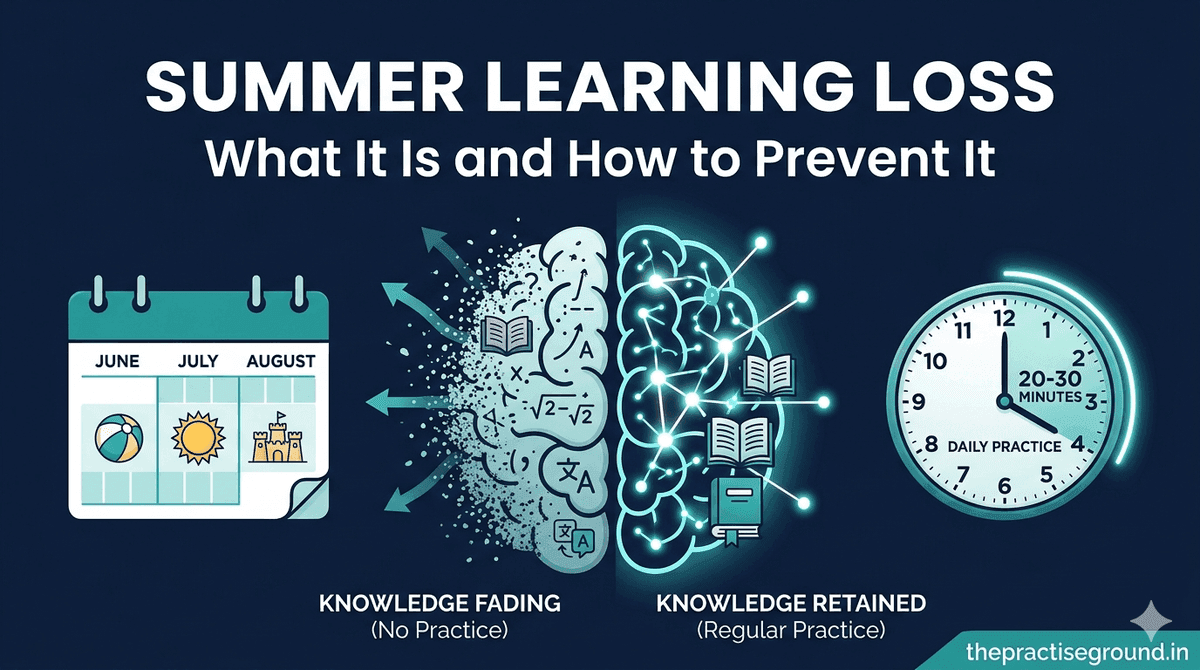
Summer learning loss (also called the summer slide) is the decline in academic skills that occurs when students are away from school during summer holidays. Research shows that students can lose 2-3 months of grade-level progress, with maths being the most affected subject.
What Does the Research Say?
Studies have consistently found that:
- Students lose an average of one to three months of learning over summer
- Maths skills decline the most because they require regular practice
- Reading skills tend to hold better for students who read recreationally
- The effects are cumulative — summer losses add up year after year
- By the end of primary school, cumulative summer loss can account for a significant gap between students
Why Does Maths Suffer the Most?
Maths is a procedural skill that requires regular practice to maintain. Unlike reading, which students often do for pleasure, few students voluntarily practise maths during holidays. Formulas, procedures, and problem-solving techniques fade faster without reinforcement.
This is why structured daily practice — even as little as 15-20 minutes — can make a significant difference.
How Does Spaced Repetition Help?
Spaced repetition is the practice of reviewing material at increasing intervals over time. It is one of the most effective learning strategies supported by cognitive science.Instead of cramming all revision into the last week before school, spread it out:
| Approach | Retention After 1 Month |
|---|---|
| One 4-hour session | Low — most material forgotten |
| 30 minutes daily for 8 days | High — material retained long-term |
Practical Strategies to Prevent Summer Learning Loss
1. Set a Daily Routine (20-30 Minutes)
The most effective strategy is simple consistency. Set aside 20-30 minutes each morning for academic practice. This is short enough to not feel like a burden but long enough to maintain skills.2. Focus on Maths and Science
Since maths and procedural science skills decline the fastest, prioritise these subjects. Reading can be maintained through recreational books, but maths needs structured practice.3. Use Free Online Quizzes
Platforms like The Practise Ground offer free, structured quiz programmes designed specifically for summer revision. The quizzes cover English, Maths, and Science for Grades 5-12 and require no signup.4. Make It Social
Challenge friends or siblings to complete quizzes together. Competition and social accountability increase motivation and consistency.5. Track Progress Visually
Use a simple chart or calendar where your child marks each day they complete their practice. Visual progress tracking is a powerful motivator for younger students.A Sample Weekly Schedule
| Day | Morning (20 min) | Notes |
|---|---|---|
| Monday | Maths quiz | Focus on current grade topics |
| Tuesday | English quiz | Grammar and vocabulary |
| Wednesday | Science quiz | Grade-specific science topics |
| Thursday | Maths quiz | Problem-solving focus |
| Friday | Fun quiz | General knowledge or fun topics for motivation |
| Saturday | Free reading (30 min) | Any book of choice |
| Sunday | Rest | No academic work |
Key Takeaways
Frequently Asked Questions
At what age does summer learning loss start?
Summer learning loss can begin as early as primary school (around age 6-7), but it becomes more significant from Grade 5 onward as the curriculum becomes more complex. The cumulative effect means that by the time students reach secondary school, multiple summers of lost learning can create noticeable gaps.
Can summer learning loss be reversed once school starts?
Teachers typically spend 4-6 weeks at the start of the school year re-teaching material lost over summer. While students can catch up, this time could be spent on new material. Prevention is more efficient than remediation.
Is 20 minutes really enough to make a difference?
Yes. Research on spaced repetition shows that short, consistent practice sessions are highly effective for maintaining skills. The key is daily consistency, not session length. Twenty minutes every day for 8 weeks totals over 18 hours of focused practice — more than enough to maintain academic skills.
Should I force my child to study during summer?
Framing it as play rather than study helps. Quiz-based learning feels more like a game than homework. Keep sessions short, celebrate progress, and allow plenty of free time. The goal is to maintain skills, not to push ahead of the curriculum.
Prevent summer learning loss with our free Summer Challenge — 8 weeks of structured quizzes for Grades 5-12.
Taking a quick break? Test yourself!
Pause and try a quick Grade 5 English quiz — see how much you've picked up so far.