
Want to test what you know?
Try our free Grade 5 English quiz — 25 questions, instant results, no sign-up.
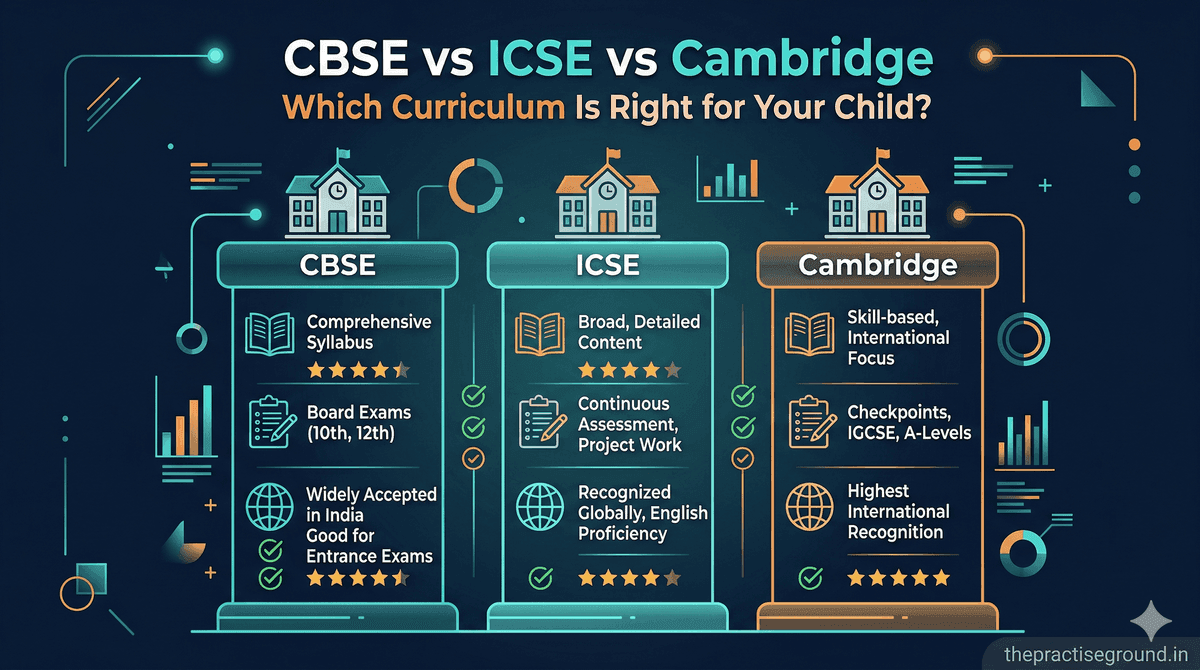
Choosing the right school board is one of the most important decisions parents make for their children's education. Each curriculum — CBSE, ICSE, and Cambridge — has distinct strengths, exam patterns, and recognition. This guide compares them across the factors that matter most.
Quick Comparison Overview
| Factor | CBSE | ICSE | Cambridge (IGCSE/A-Level) |
|---|---|---|---|
| Full name | Central Board of Secondary Education | Indian Certificate of Secondary Education | Cambridge Assessment International Education |
| Approach | Concept-based, structured | Application-based, detailed | Skill-based, international |
| Subjects | Fewer, focused | Broader range | Flexible choice |
| Exam style | Objective + subjective | Mostly subjective, detailed answers | Varied (structured, essays, practicals) |
| Language emphasis | Hindi and English | Strong English focus | English only |
| Recognition | India, widely accepted | India, growing acceptance | Worldwide |
| Competitive exam alignment | Strong (JEE, NEET) | Moderate | Lower (different syllabus) |
How Do the Curricula Differ in Content?
Science
- CBSE covers science concepts in a structured manner with a focus on understanding formulas, laws, and their applications. The approach is theoretical with emphasis on NCERT textbooks.
- ICSE covers science in greater depth and breadth, with more descriptive answers and application-based questions. Students often study more detailed content than CBSE counterparts.
- Cambridge focuses on practical skills, scientific inquiry, and experimental design alongside theory. The approach is less about memorisation and more about understanding processes.
Mathematics
English
Which Board Is Best for Competitive Exams?
For students targeting JEE (engineering) or NEET (medical):
Which Board Is Best for Studying Abroad?
How Does Our Quiz Platform Help?
The Practise Ground's quizzes are designed to be curriculum-neutral. The questions cover core concepts that are common across CBSE, ICSE, and Cambridge:
This means students from any board can use our quizzes for practice and revision.
Key Takeaways
Frequently Asked Questions
Can I switch boards in the middle of school?
Yes, but it is easier at certain transition points (after Grade 5, 8, or 10). Switching from ICSE to CBSE is relatively smooth because ICSE covers more. Switching to Cambridge requires adjustment to the different exam format and approach. Plan the switch at least one academic year in advance.
Which board has the easiest exams?
CBSE exams are generally considered more straightforward because they follow the NCERT textbook closely. ICSE exams require more detailed answers and application. Cambridge exams test understanding in novel contexts. However, grading curves differ between boards, so a high percentage in one board is not directly comparable to another.
Does the board matter for college admissions in India?
Most Indian universities accept all three boards. For top engineering and medical colleges, what matters most is your performance in competitive exams (JEE, NEET), not your board. For liberal arts colleges and universities with their own entrance exams, the board matters less than your overall profile.
Is CBSE really better for JEE preparation?
CBSE has the closest syllabus overlap with JEE and NEET. The NCERT textbooks, which CBSE follows, are considered the starting point for competitive exam preparation. However, students from any board can crack these exams with additional coaching and preparation.
Explore our curriculum-neutral quizzes: English | Maths | Science | Physics | Chemistry | Biology
Taking a quick break? Test yourself!
Pause and try a quick Grade 5 English quiz — see how much you've picked up so far.