
Want to test what you know?
Try our free Grade 6 Maths quiz — 25 questions, instant results, no sign-up.
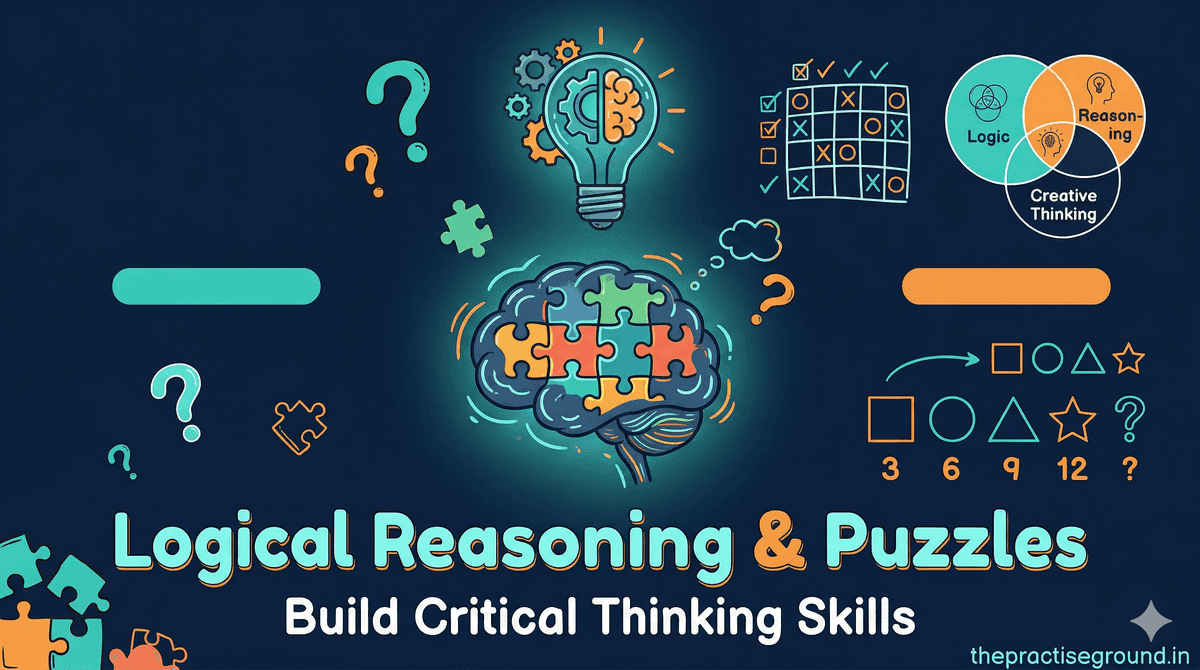
Logical reasoning is the ability to analyse information, identify patterns, and draw valid conclusions. It is essential for Olympiads, competitive exams, and everyday decision-making. Unlike maths, where you apply known formulas, reasoning requires you to discover the rule yourself. Here is how to get better at it.
Why Does Logical Reasoning Matter?
- Competitive exams — Many scholarship and Olympiad tests include a reasoning section
- Maths problem-solving — Reasoning helps you approach unfamiliar problems
- Science — Forming and testing hypotheses requires logical thinking
- Everyday life — From evaluating arguments to making decisions, reasoning is a life skill
Types of Logical Reasoning
1. Pattern Recognition
Find the pattern and predict what comes next:
Number pattern: 2, 6, 18, 54, ? Rule: Each number is multiplied by 3. Answer: 162. Letter pattern: A, C, F, J, ? Rule: The gaps increase by 1 (A+2=C, C+3=F, F+4=J, J+5=O). Answer: O.2. Number Series
These involve more complex relationships between numbers:
Series: 1, 1, 2, 3, 5, 8, 13, ? This is the Fibonacci sequence — each number is the sum of the two before it. Answer: 21. Series: 2, 5, 10, 17, 26, ? Differences: 3, 5, 7, 9 (increasing by 2 each time). Next difference: 11. Answer: 37.3. Logical Deductions
Given statements, draw valid conclusions:
"All roses are flowers. All flowers need water." Conclusion: All roses need water. (Valid — the chain of logic holds.)
"Some students play cricket. All cricket players are athletes." Conclusion: Some students are athletes. (Valid.)
4. Grid Logic (Einstein Puzzles)
These puzzles give you clues to figure out a grid of relationships. For example:
Solution: Bala likes Science. Anya does not like Maths, so Anya likes English. Chen must like Maths.
Practice Puzzles
Puzzle 1: What is the next number? 3, 7, 15, 31, 63, ? Hint: Look at the pattern of doubling and adding. Puzzle 2: If A = 1, B = 2, C = 3... what does the word LOGIC equal when you add up the letter values? L(12) + O(15) + G(7) + I(9) + C(3) = ? Puzzle 3: In a row of 5 children, Priya is taller than Qasim but shorter than Ravi. Sara is the tallest. Tara is shorter than Qasim. Arrange them from shortest to tallest. Puzzle 4: A clock shows 3:15. What is the angle between the hour and minute hands? Hint: The hour hand moves too — it is not exactly on the 3. Puzzle 5: How many squares are there on a standard 8x8 chessboard? Hint: It is not 64. Count 1x1, 2x2, 3x3... squares.Solutions
Puzzle 1: Each number is doubled and then 1 is added: 3x2+1=7, 7x2+1=15, 15x2+1=31, 31x2+1=63, 63x2+1=127. Answer: 127. Puzzle 2: 12 + 15 + 7 + 9 + 3 = 46. Puzzle 3: From shortest to tallest: Tara, Qasim, Priya, Ravi, Sara. Puzzle 4: At 3:15, the minute hand is at 90 degrees (pointing at 3). The hour hand has moved 1/4 of the way from 3 to 4, which is 7.5 degrees past the 90-degree mark. So the angle is 7.5 degrees. Puzzle 5: 1x1: 64, 2x2: 49, 3x3: 36, 4x4: 25, 5x5: 16, 6x6: 9, 7x7: 4, 8x8: 1. Total: 204 squares.Key Takeaways
Frequently Asked Questions
How can I improve my logical reasoning skills?
Practice regularly with puzzles, brain teasers, and reasoning workbooks. Start with simpler patterns and progress to complex multi-step problems. Games like Sudoku, chess, and logic puzzles are excellent training tools. The key is consistent daily practice rather than occasional long sessions.
Are logical reasoning and maths the same thing?
They overlap but are not identical. Maths uses established formulas and procedures. Logical reasoning requires you to discover the rules yourself. However, strong reasoning skills make you better at maths (especially unfamiliar problems), and mathematical training strengthens your reasoning ability.
Which competitive exams test logical reasoning?
Science Olympiad, Maths Olympiad, NTSE, KVPY, and many scholarship exams include reasoning sections. Additionally, future exams like CAT (for MBA), GRE, and GMAT heavily test logical and analytical reasoning.
Challenge yourself with our Fun Quizzes including brain teasers and logic puzzles.
Taking a quick break? Test yourself!
Pause and try a quick Grade 6 Maths quiz — see how much you've picked up so far.