
Exam Prep illustration
Exam PrepGrade 8-10

Tips to Score High in English Exams: Class 10 and Beyond

✍️By The Practise Ground TeamπŸ“…21 February 2026⏱️9 min readShare
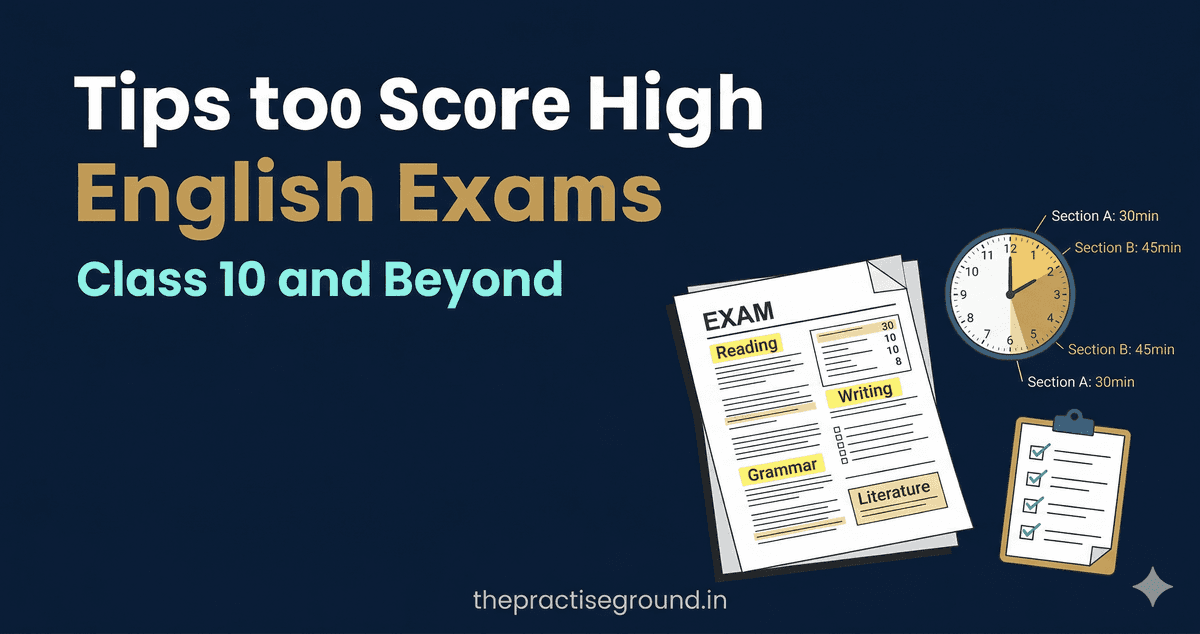
Score High in English Exams infographic showing exam sections and time allocation on dark navy background

English is one of the easiest subjects to score 90+ in, IF you have the right strategy. Many students lose marks due to poor planning, weak time management, or not understanding what examiners want. This guide reveals the secrets to scoring high!

Understanding English Exams Worldwide

While exam structures vary by curriculum, most English exams test similar skills:

  • Reading Comprehension (understanding written text)
  • Writing (creative and formal writing)
  • Grammar (language rules and structures)
  • Literature (analysis and understanding of texts)

Strategy 1: Master Reading Comprehension

Reading comprehension is easier than you think if you have a system.

Reading Passage Technique

Step 1: Quick Read (2 minutes) Read the passage once to understand the main idea. Don't worry about every word. Step 2: Question Analysis (2 minutes) Read all the questions before answering. This helps you focus on relevant information. Step 3: Answer Writing (6 minutes) Answer questions in your own words. Examiners reward your understanding, not copying.

Rules for Better Answers

  1. Answer in your own words - Don't copy sentences directly
  2. Be concise - Use as many words as needed, not more
  3. Include evidence - Reference the passage to support your answer
  4. Use proper grammar - Even in answer format

Common Reading Mistakes to Avoid

  • Copying entire sentences from the passage
  • Giving answers unrelated to the passage
  • Writing too much (wasting time)
  • Missing questions due to time pressure
  • Writing messy answers (hard for markers to read)
  • Vocabulary for Answers

    Instead of: "The boy was happy" Write: "The protagonist felt elated" or "delighted"

    Strong vocabulary in answers impresses examiners and scores better marks!

    Strategy 2: Excel in Creative Writing

    This section is where many students lose marks unnecessarily.

    Letter Writing Success

    Format is 50% of the marks! Rules:
  • Always include: Sender's address, date, recipient's address, subject, salutation, closing
  • Body should have 3-4 clear paragraphs
  • Each paragraph should focus on one idea
  • End with clear salutation
  • Content Tips:
  • Answer ALL points mentioned in the prompt
  • Be specific (not vague)
  • Use formal language for formal letters
  • Keep it relevant (no unnecessary information)
  • Notice and Email Writing

    Notice Format:
  • Header: "NOTICE"
  • Include: Date, place
  • Clear title
  • Body in bullet points (brief)
  • Maximum 50-75 words
  • Email Format:
  • Subject line (clear)
  • Salutation
  • Body (3 short paragraphs)
  • Professional closing
  • Strategy 3: Conquer Grammar

    Grammar questions seem scary but follow patterns.

    Editing

    Usually 10 errors in a passage. Errors are:

  • Verb tense mistakes
  • Subject-verb disagreement
  • Article errors
  • Preposition errors
  • Spelling mistakes
  • Editing Strategy:
  • Read sentence by sentence
  • Check for one type of error at a time
  • Don't change correct sentences
  • Write only the error and correction
  • Omission

    A passage with 10 blanks. Blanks test:

  • Articles (a, an, the)
  • Prepositions (in, on, at, etc.)
  • Conjunctions (and, but, because)
  • Verbs
  • Omission Strategy:
  • Read the full passage first
  • Analyze what word type is missing
  • Choose the most logical word
  • Check if it fits grammatically
  • Sentence Reordering

    A jumbled paragraph needs rearrangement. Usually 5 sentences, one is given.

    Reordering Strategy:
  • Identify the topic/main idea
  • Look for signal words (First, However, Therefore, Finally)
  • Find logical sequence
  • Check if new order makes sense
  • Signal Words Help:
  • Starting: First, Initially, Once, In the beginning
  • Continuing: Moreover, Furthermore, Additionally
  • Contrast: However, But, On the other hand
  • Conclusion: Therefore, Finally, In conclusion
  • Strategy 4: Ace Literature Questions

    Literature is about showing understanding, not memorization.

    Multiple Choice

  • Read the question carefully
  • Eliminate obviously wrong answers
  • Choose the best option
  • If unsure, pick the most literal/direct answer
  • Short Answer Questions

    Usually 4 questions, 2 marks each.

    Formula:
  • Paragraph 1: Direct answer (1-2 lines)
  • Paragraph 2: Explanation with evidence (2-3 lines)
  • Total: 5-7 lines
  • Long Answer Questions

    Usually 2 questions, 4 marks each.

    Structure:
  • Introduction (1 line): State what you'll discuss
  • Body (5-8 lines): Provide examples, quotes, explanations
  • Conclusion (1-2 lines): Summarize your point
  • Tips:
  • Use text evidence (quotes or references)
  • Show critical thinking
  • Connect to larger themes
  • Neat presentation matters
  • Strategy 5: Time Management During Exam

    Total Time: 3 hours (180 minutes)

    Suggested Time Distribution

    SectionMarksTimeMinutes/Mark
    Reading2030 min1.5 min
    Writing2035 min1.75 min
    Grammar1525 min1.67 min
    Literature3550 min1.43 min
    Review-10 min-
    Golden Rules:
  • Don't spend time on difficult questions initially. Mark and return later.
  • Handwriting matters. Neat writing gets higher marks. Write slowly and clearly.
  • Leave margins. Leave space for corrections and for markers to make comments.
  • Use the 10-minute buffer. Use last 10 minutes to:
  • - Review answers for spelling/grammar - Complete unanswered questions - Improve weak answers

    Strategy 6: Preparation Tips

    3-Month Preparation Plan

    Month 1: Foundation Building
  • Complete all topics once
  • Solve sample papers
  • Identify weak areas
  • Month 2: Practice and Refinement
  • Solve 5 full practice papers
  • Focus on weak topics
  • Time yourself
  • Month 3: Final Polish
  • Solve 5 more practice papers
  • Attempt previous years' papers
  • Focus on speed and accuracy
  • Weekly Study Plan

    5 days of studies, 2 days rest
  • Day 1: Literature revision (1 hour)
  • Day 2: Reading and writing practice (1 hour)
  • Day 3: Grammar practice (45 minutes)
  • Day 4: Full practice paper (2 hours)
  • Day 5: Revision of weak areas (1 hour)
  • Resources to Use

  • Sample Papers - Official patterns
  • Previous Years' Papers - Understand difficulty level
  • Textbooks - Core content
  • Our Quizzes - Targeted practice
  • Strategy 7: Exam Day Tips

    Day Before Exam

  • Revise quickly, don't study new topics
  • Sleep well (8 hours minimum)
  • Prepare all materials (pens, pencils, eraser)
  • Check exam timing and venue
  • Exam Day Morning

  • Eat a good breakfast
  • Reach exam center 15-20 minutes early
  • Stay calm and confident
  • Breathe deeply if nervous
  • During Exam

  • Read all questions before answering
  • Start with questions you're confident about
  • Don't get stuck on one question
  • Keep checking time
  • Write neatly
  • Answer all questions (even if incomplete)
  • Common Exam Mistakes to Avoid

  • Writing answers to the wrong questions
  • Forgetting to answer entire sections
  • Spending too much time on one question
  • Writing illegibly
  • Not reading questions fully
  • Panicking during the exam
  • Frequently Asked Questions

    How much should I study for English?

    1-2 hours daily is sufficient if done consistently. Quality beats quantity.

    Is English easy to score well in?

    Yes! It's one of the easiest subjects to score 90+ in. Just follow the format and answer what's asked.

    How can I improve my vocabulary quickly?

    Read daily (newspapers, stories) and use practice quizzes. Context-based learning is fastest.

    What if I don't know an answer?

    Write whatever you can logically think of. Partial answers get partial marks. Blank questions get zero.

    Should I memorize model answers?

    No! Understand concepts instead. Examiners can tell when answers are memorized and may mark them down.

    Can I get 95+ in English?

    Absolutely! With excellent vocabulary, neat handwriting, good comprehension, and proper format-following, 95+ is achievable.

    Your Success Story Starts Here

    Scoring high in English is about understanding what examiners want and delivering it perfectly. Follow this guide, practice regularly, manage your time wisely, and you'll absolutely achieve your target score!

    Conclusion

    English is a subject where consistent effort pays off immediately. Unlike other subjects, you'll see improvement within weeks of focused practice. Start your preparation now, follow the strategies in this guide, and step into your exam with confidence. You've got this!

    Remember: Perfect practice makes perfect. Not just practiceβ€”practice the right way, with full effort and attention to detail. Your high score in English is just around the corner!

    Found this helpful?

    Share it with your classmates and friends on WhatsApp β€” help them ace their English too!

    Related Posts

    Practice What You've Learned

    Ready to Practice?

    Test your skills with our free interactive quizzes. Over 23,400 questions covering English, Maths, Science and more.