
Want to test what you know?
Try our free Grade 5 English quiz — 25 questions, instant results, no sign-up.
Many students think studying means reading textbooks and memorizing rules. But research shows that practice quizzes are far more effective for learning grammar. Let's understand why consistent practice transforms your English skills.
The Science of Learning Grammar
How Your Brain Learns
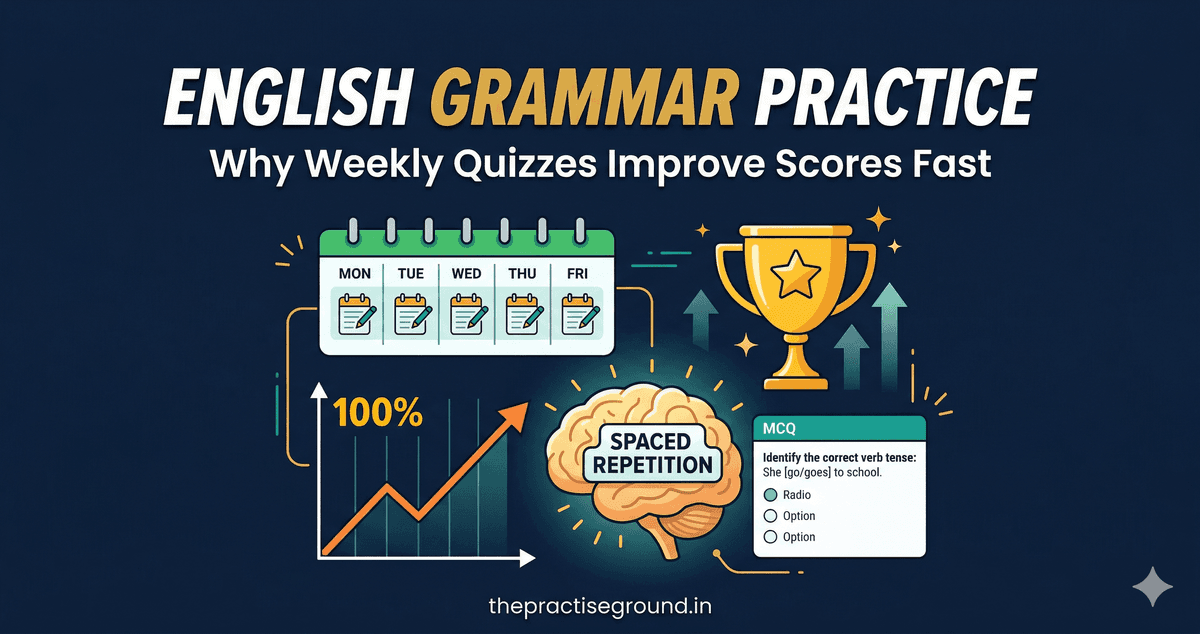
Your brain learns through retrieval practice—forcing yourself to remember and apply information. Reading alone is passive. Taking quizzes is active.
Research Finding: Students who take weekly quizzes score 20-30% higher on final exams than students who only read textbooks.Why? Because:
- Quizzes force your brain to recall information
- You identify gaps in your knowledge immediately
- Repeated practice strengthens neural pathways
- You learn from mistakes right away
Why Grammar Rules Are Hard to Remember
Grammar rules are abstract. Reading "Subject-verb agreement: A singular subject takes a singular verb" doesn't stick. But applying it in 10 quiz sentences? That sticks!
The Problem with Studying Grammar Rules Passively
When you passively read: "The plural subjects need plural verbs," your brain processes it once and forgets it.
When you actively answer: "The group of students is/are coming," you:
How Weekly Quizzes Accelerate Learning
Spaced Repetition
Reviewing the same concept across multiple weeks is far more effective than cramming once.
Research: If you learn something:Immediate Feedback
Quiz apps and online platforms give instant feedback. You know immediately whether your answer is correct and why.
This is powerful because:
Building Confidence
Each correct answer builds confidence. After 10 quizzes on verb tenses, you feel confident about tenses. This confidence carries to your board exams!
Benefits of Regular English Grammar Quizzes
1. Identifies Weak Areas
Quizzes show you exactly what you don't know.
If you score:
This targeted learning is far more efficient than general study!
2. Builds Long-Term Memory
A single study session creates short-term memory. Weekly quizzes over months create long-term memory.
By your exam, grammar rules aren't something you "remember"—they're something you know instinctively.
3. Increases Exam Readiness
Quiz format mirrors exam format. When you take your exam, you're already comfortable with:
4. Reduces Exam Anxiety
Familiarity breeds confidence. After 20+ grammar quizzes, exam grammar questions don't scare you anymore. You've seen variations and know how to handle them.
5. Provides Accountability
Regular quizzes create a commitment to learning. You're more likely to study consistently if you know a quiz is coming next week.
The Optimal Quiz Schedule
Weekly vs. Other Frequencies
Sample Study Schedule
Week 1: Tenses Quiz → Score: 65%What Makes a Good Grammar Quiz
Not all quizzes are equally effective. Good quizzes have these qualities:
1. Variety of Question Types
This variety keeps learning fresh and covers different skills.
2. Progressive Difficulty
Start with basics, move to tricky cases.
Easy: "She go/goes to school." (present tense basics) Medium: "The group of students is/are coming." (collective nouns) Hard: "If I knew/had known, I would have helped." (conditional perfects)3. Immediate, Detailed Feedback
Good quizzes don't just say "Wrong!" They explain:
4. Relevance to Your Level
A quiz for Grade 5 students should differ from one for Grade 10 students. Appropriate difficulty is crucial for effective learning.
How to Maximize Quiz Learning
Before Taking the Quiz
While Taking the Quiz
After Taking the Quiz
Follow-Up Activities
Beyond Multiple Choice: Active Practice
While quizzes are excellent, they're most effective combined with:
1. Writing Practice
Take quiz concepts and write sentences.After learning about prepositions, write 10 sentences using different prepositions.
2. Speaking Practice
Speak quiz answers aloud.Say: "The group of students is coming" 5 times aloud. This strengthens the memory!
3. Real-World Application
Use grammar in actual writing.Write an email using present perfect tense, then check your usage against quiz rules.
Tracking Progress with Quizzes
Create a progress tracker:
| Week | Quiz | Score | Topics to Review | Next Week's Focus |
|---|---|---|---|---|
| 1 | Tenses | 65% | Past Perfect, Future Perfect | More tense practice |
| 2 | Tenses | 78% | Future Perfect | Articles |
| 3 | Articles | 60% | Using "a" vs "an" | Prepositions |
| 4 | Prepositions | 72% | Place prepositions | Review all weak areas |
Common Mistakes When Using Quizzes
Mistake 1: Only Taking the Quiz Once
Right after learning a concept, your score might be 70%. But taking the same quiz again next week measures real learning.
Mistake 2: Not Reading Explanations
Getting an answer right is good, but understanding why is better.
Spend 30 seconds reading the explanation for each answer. This 30-second investment pays off!
Mistake 3: Rushing Through Quizzes
Quizzes aren't speed tests. They're learning tools. Take time to think.
Mistake 4: Guessing Rather Than Learning
If you don't know the answer, guessing won't help. Read the explanation and learn.
Mistake 5: Taking Quizzes But Not Studying Weak Areas
A quiz identifies problems. But you must solve them by studying!
Quiz → Identify Weakness → Study → Quiz Again
This cycle is where learning happens.
The Long-Term Impact of Regular Quiz Practice
After 4 Weeks
After 8 Weeks
After 12 Weeks (3 Months)
By Exam Time
Our Recommendation for Optimal Learning
We suggest following a 12-week quiz progression:
This progression ensures you're always challenged appropriately and learning effectively.
Start Your Quiz Journey Today
The most successful English learners aren't those who study the hardest—they're those who study the smartest. Regular quizzes are smart studying.
Begin with our English quizzes this week. Next week, take another. Track your progress, review wrong answers thoroughly, and watch your English improve dramatically.
Your exam success starts with consistent weekly practice!
FAQ: Quiz Learning Questions
Will taking too many quizzes hurt my learning?
1-2 quizzes per week is ideal. More than that may cause fatigue. Quality beats quantity.
Should I retake the same quiz or try new quizzes?
Mix both! Retake to measure improvement on the same material. Try new quizzes to learn new content. Ideal ratio: 60% new, 40% repeated.
How long should each quiz be?
20-30 minutes is perfect. Long enough to be meaningful, short enough to maintain focus.
Can quizzes replace textbook study?
No. Use quizzes to practice, but read textbooks to understand concepts first. Quizzes reinforce learning, not replace it.
Conclusion
Weekly grammar quizzes are backed by science and proven to work. They're not busywork—they're the most effective way to learn grammar. Start this week, commit to weekly practice, and witness the transformation in your English skills. Your success in English starts with a single quiz. Take that first step today!
Your success story: Beginning now with regular practice quizzes!Taking a quick break? Test yourself!
Pause and try a quick Grade 5 English quiz — see how much you've picked up so far.