
Want to test what you know?
Try our free Grade 9 Maths quiz — 25 questions, instant results, no sign-up.
Trigonometry sounds intimidating. But here's the secret: it's just about describing the relationships between angles and sides in right-angled triangles. Once you understand this, trigonometry becomes remarkably practical.
Let's break it down together.
What is Trigonometry?
Trigonometry (from Greek "trigon" = triangle, "metry" = measurement) is the study of relationships between sides and angles of triangles.
The main use: If you know one angle and one side of a right triangle, you can find any other side.
This is incredibly useful for:
- Calculating heights of buildings without measuring them
- Navigation and surveying
- Engineering and architecture
- Physics and astronomy
Right Triangle Basics
Before we learn trigonometric ratios, let's name the sides of a right triangle.
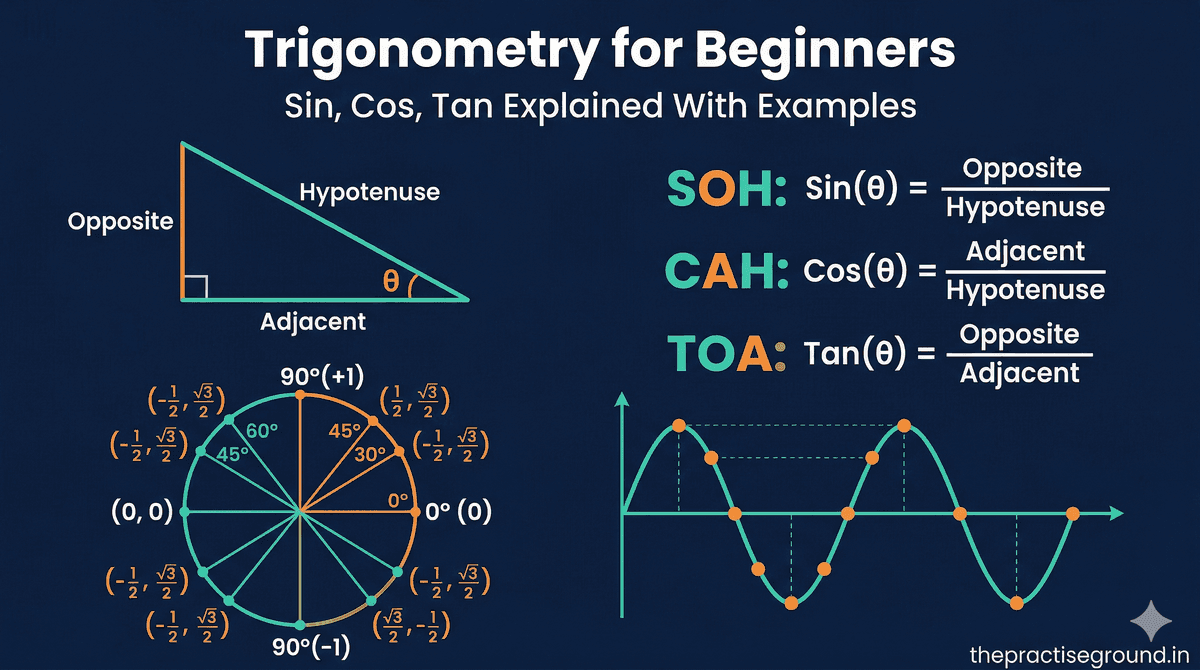
Consider a right triangle with an angle θ (theta, meaning "angle"):
CODEBLOCK0 Hypotenuse: The longest side, opposite the right angle Opposite: The side opposite to angle θ Adjacent: The side next to angle θ (not the hypotenuse)The Three Main Trigonometric Ratios
Now here comes the magic:
SINE (sin θ) = Opposite / Hypotenuse
COSINE (cos θ) = Adjacent / Hypotenuse
TANGENT (tan θ) = Opposite / Adjacent
Memory Trick: SOHCAHTOA S — Sine = Opposite / Hypotenuse C — Cosine = Adjacent / Hypotenuse T — Tangent = Opposite / AdjacentIf you remember SOHCAHTOA, you'll never forget these ratios!
Numerical Example
Consider a right triangle:
The 3-4-5 Triangle (and other Common Ratios)
The 3-4-5 triangle is famous in trigonometry because:
Standard Angle Values You Should Know
These appear constantly in exams:
| Angle | sin | cos | tan |
|---|---|---|---|
| 0° | 0 | 1 | 0 |
| 30° | 1/2 | √3/2 | 1/√3 |
| 45° | 1/√2 | 1/√2 | 1 |
| 60° | √3/2 | 1/2 | √3 |
| 90° | 1 | 0 | ∞ |
For angles 30°, 45°, 60°:
The pattern is: √1/2, √2/2, √3/2 for sine values!
Practical Problem: Finding Heights
Scenario: You're standing 50 meters from a building. You look up at a 30° angle to see the roof. How tall is the building? CODEBLOCK1You have:
The building is approximately 28.9 meters tall!
Finding Angles (Inverse Trigonometry)
What if you know the sides and need the angle?
Use inverse functions:
The base distance is √(5² - 4²) = 3 m
sin θ = opposite / hypotenuse = 4/5 = 0.8 θ = sin⁻¹(0.8) ≈ 53.13°
Trigonometry in Real Life
Architecture and Construction
Buildings use trigonometry for:Navigation
Ships and planes use trigonometry:Engineering
Bridges, dams, and structures rely on trigonometric calculations for angles and forces.Astronomy
Calculating distances to stars and predicting celestial events uses trigonometry extensively.Surveying
Land surveyors use trigonometry to measure distances and create accurate maps.Trigonometry in Different Curricula
CBSE & ICSE: Focus on basic ratios, standard angles, and applications to right triangles Cambridge IGCSE: Includes graphs of trigonometric functions and more complex applications IB: Extends to unit circles, radian measure, and trigonometric equationsThe foundational understanding remains the same across all curricula—master these basics first!
Important Relationships (Beyond SOHCAHTOA)
Reciprocal Functions
Trigonometric Identity
sin²θ + cos²θ = 1This fundamental identity is always true for any angle θ.
Common Mistakes in Trigonometry
Mistake 1: Confusing which side is opposite/adjacentPractice on The Practise Ground
Trigonometry mastery requires solving diverse problems. Our Grade 9-10 quizzes include:
Start practicing and build your trigonometry confidence!
FAQ
Why do we need three trigonometric functions? Why not just one?
Different situations give you different information. If you know the hypotenuse, use sine or cosine. If you know only the two legs, use tangent. Flexibility is powerful!
How important are these standard angle values?
Very important for exams and quick mental calculations. Spend time memorizing them—they appear constantly.
Will we use trigonometry after Grade 10?
Absolutely! Trigonometry appears in Grade 11-12 (advanced trigonometric equations, trigonometric identities), physics, engineering, and countless real-world applications.
How do I remember SOHCAHTOA?
Make it a silly sentence! "Some Old Hippie Caught Another Hippie Tripping On Acid" or create your own. Silly sentences stick in memory better.
Taking a quick break? Test yourself!
Pause and try a quick Grade 9 Maths quiz — see how much you've picked up so far.