
Want to test what you know?
Try our free Grade 8 Maths quiz — 25 questions, instant results, no sign-up.
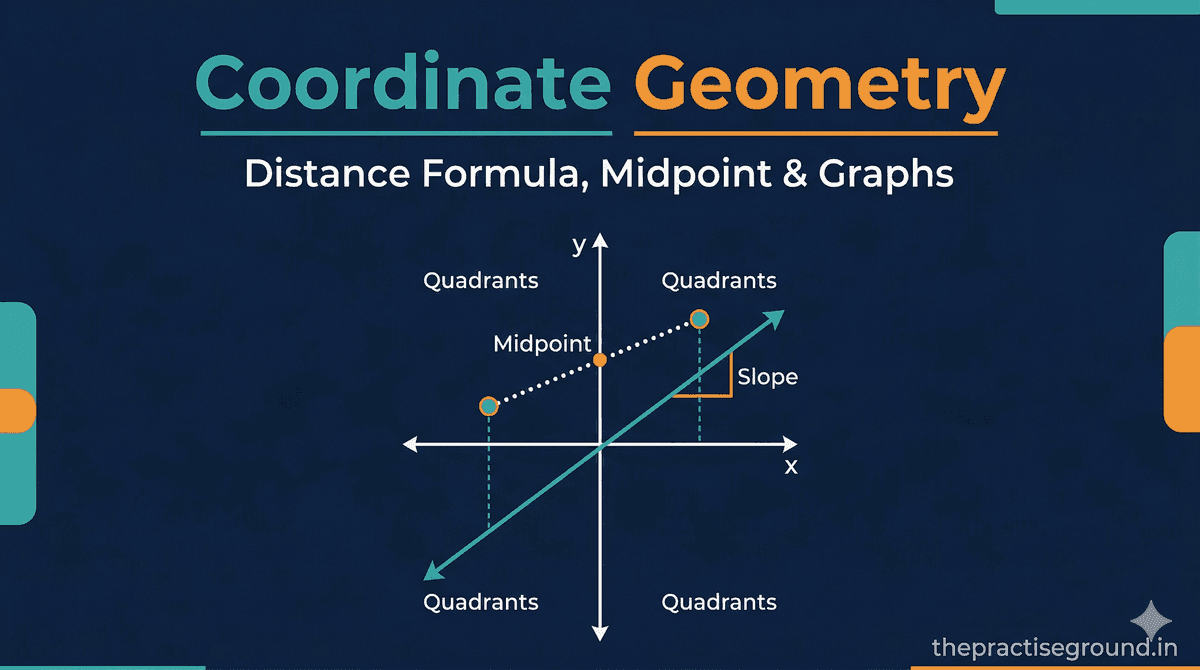
Coordinate geometry is where algebra meets geometry. Instead of just describing shapes with words or equations, we can plot them on a grid, visualize them, and work with them mathematically.
This skill is crucial for physics (motion graphs), economics (supply-demand curves), engineering (design), and data visualization.
The Coordinate System
The Cartesian Plane
The Cartesian plane (named after René Descartes) consists of:
- X-axis: Horizontal line
- Y-axis: Vertical line
- Origin: Point (0,0) where axes intersect
- Quadrants: Four regions created by the axes
Coordinates (x, y)
Every point on the plane is defined by two numbers:
Plotting Points
To plot point (3, 4):
- Start at origin (0, 0)
- Move 3 units right along X-axis
- Move 4 units up parallel to Y-axis
- Mark the point
Practice: Try plotting (4, -3), (-1, 2), (0, 5), (-4, 0)
Distance Formula
The distance between two points P(x₁, y₁) and Q(x₂, y₂) is:
d = √[(x₂ - x₁)² + (y₂ - y₁)²]This comes from the Pythagorean theorem!
Example 1: Find distance between (1, 2) and (4, 6)
Example 2: Find distance between (-3, 2) and (2, -1)
Application: Maps and Navigation
On a map with coordinates:
Distance = √[300² + 400²] = √[90,000 + 160,000] = √250,000 = 500 km
This is the straight-line distance (as the crow flies).
Midpoint Formula
The midpoint between two points P(x₁, y₁) and Q(x₂, y₂) is:
M = [(x₁ + x₂)/2, (y₁ + y₂)/2]The midpoint is simply the average of the coordinates!
Example 1: Find midpoint of (2, 6) and (8, 2)
This point (5, 4) is exactly halfway between the two points.
Example 2: Find midpoint of (-2, 3) and (4, -1)
Application: Finding the Center
If you know the endpoints of a diameter of a circle:
Straight Lines: The Equation y = mx + c
A straight line can be represented as: y = mx + c
Where:
Understanding Slope
Slope represents how much y changes when x increases by 1.
m = (y₂ - y₁)/(x₂ - x₁)Example 1: Find slope of line through (1, 2) and (3, 6)
For every 1 unit right, the line goes 2 units up.
Example 2: Find slope of line through (2, 5) and (4, 1)
Negative slope: line goes down-right.
Types of Slopes
Positive slope (m > 0): Line goes up from left to right Zero slope (m = 0): Horizontal line Negative slope (m < 0): Line goes down from left to right Undefined slope: Vertical lineFinding the Equation of a Line
Given: Two points (1, 3) and (3, 7)Step 1: Find slope
Step 2: Use y = mx + c and substitute one point
Step 3: Write equation
Verification: Check with second point (3, 7)
Special Lines
Parallel Lines
Lines with the same slope never meet.
Example: y = 2x + 1 and y = 2x - 3Perpendicular Lines
If one line has slope m, a perpendicular line has slope -1/m.
Example:Graphing: Bringing It All Together
To graph a line y = 2x + 1:
To graph a circle:
Equation: (x - h)² + (y - k)² = r²Plot center, then mark points 3 units away in all directions.
Real-World Applications
Physics: Motion Graphs
Distance vs. Time graph:
Economics: Supply and Demand
Engineering: Design
Coordinate geometry helps design buildings, bridges, circuits, and more. Every blueprint uses coordinates.
Data Visualization
Scatter plots, line graphs, and charts all use coordinate geometry to represent data relationships visually.
Common Mistakes in Coordinate Geometry
Mistake 1: Confusing coordinatesPractice on The Practise Ground
Master coordinate geometry through interactive visualizations:
See geometry come alive!
FAQ
Why is coordinate geometry important?
It bridges algebra and geometry. It's used in physics, engineering, economics, computer graphics, and GPS technology. Essential modern skill.
How do I remember the distance formula?
It's the Pythagorean theorem! The distance is the hypotenuse of a right triangle with legs (x₂ - x₁) and (y₂ - y₁).
Is the slope formula always (y₂ - y₁)/(x₂ - x₁)?
Yes, always! Remember: rise over run. Rise is the change in y (vertical), run is the change in x (horizontal).
How are coordinate geometry and vectors related?
Vectors use coordinates too! A vector from (1, 2) to (4, 6) is (3, 4). Coordinate geometry is the foundation for vector mathematics.
Universal Application Across All Curricula
Coordinate geometry is a cornerstone of mathematics education worldwide. CBSE and ICSE emphasize practical applications and problem-solving. Cambridge IGCSE extends into more complex transformations and vectors. IB programmes integrate coordinate geometry with calculus and analytical thinking. Despite different approaches, the fundamental concepts—points, distances, lines, and relationships—are identical across all systems. Master them once, and you're prepared for any curriculum.
Taking a quick break? Test yourself!
Pause and try a quick Grade 8 Maths quiz — see how much you've picked up so far.