
Want to test what you know?
Try our free Grade 8 Physics quiz — 25 questions, instant results, no sign-up.
Newton's 3 Laws of Motion Explained With Real-Life Examples
Newton's laws of motion are the foundation of classical mechanics. They explain how objects move and interact with forces. Whether you're studying for your CBSE board exams, ICSE, Cambridge IGCSE, or IB Physics, these three laws are essential.
In this guide, we'll break down each law with practical examples, numericals, and exam-style questions you'll definitely encounter.
What Are Newton's Laws of Motion?
Sir Isaac Newton published his three laws of motion in 1687. These laws describe the relationship between forces and motion:
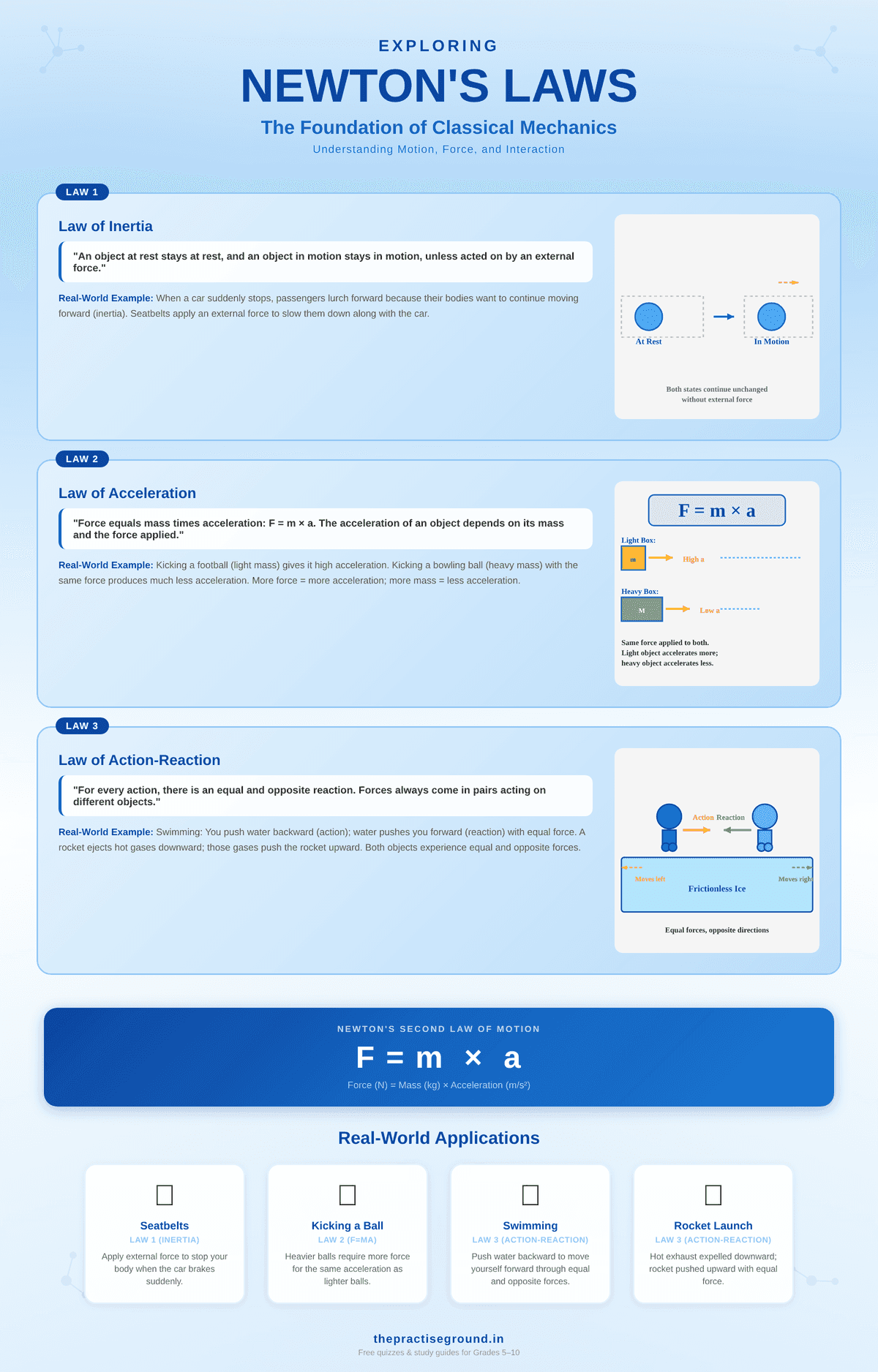
- First Law (Law of Inertia): An object at rest stays at rest, and an object in motion stays in motion unless acted upon by an external force.
These aren't just theoretical—they govern everything from why you lurch forward when a car brakes suddenly to how rockets launch into space.
First Law of Motion: The Law of Inertia
Understanding Inertia
Inertia is the tendency of an object to resist change in its state of motion. Objects naturally want to stay as they are—moving objects want to keep moving, and stationary objects want to stay put.
The first law states: An object will remain at rest or in uniform motion in a straight line unless acted upon by an external force.
Real-Life Examples of the First Law
Cricket Ball and the Fielder: When a cricket ball is moving toward you at high speed, it doesn't stop just because you're in its way. You need to exert a force (catching it) to stop its motion. This is why catching a fast ball hurts if you don't use proper technique—you're trying to overcome the ball's inertia. Seatbelts in Cars: When a car brakes suddenly, your body wants to continue moving forward due to inertia. This is why seatbelts are crucial—they provide the force needed to stop your forward motion. Dusting a Carpet: When you hit a carpet with a stick, dust particles are loosely held. The carpet suddenly accelerates (due to the force from the stick), but the dust particles have inertia and continue moving in their original direction, thus separating from the carpet. Sliding on Ice: On a frictionless (or nearly frictionless) surface like ice, an object slides much farther than on rough ground. With less friction force acting on it, the object maintains its motion longer.What About Zero Velocity?
An object at rest is also in a state of uniform motion (velocity = 0). So the first law also means: a stationary object will remain stationary unless a force acts on it.
Example: A book on your desk stays at rest because the normal force from the desk balances the gravitational force. No net force = no motion.Second Law of Motion: F = ma
The Equation and Its Meaning
The second law is quantitative. It tells us exactly how forces and motion are related:
CODEBLOCK0Where:
This means:
Understanding the Relationship
Think of pushing different objects with the same effort:
Real-Life Applications
Acceleration in Vehicles: A car's acceleration depends on the engine force and the car's mass. A lighter sports car accelerates faster than a heavy truck with the same engine force. Kicking a Football: When you kick a football, the force from your foot accelerates it. A harder kick (more force) means faster acceleration. A heavier ball would accelerate less for the same kick. Throwing a Cricket Ball vs. a Javelin: Even if you apply the same force, the cricket ball (lighter) accelerates more than the javelin (heavier).Practice Numericals
Problem 1: A force of 100 N is applied to a box of mass 50 kg. Calculate the acceleration. Solution: CODEBLOCK1 Problem 2: A car of mass 1000 kg accelerates at 5 m/s². What is the net force acting on it? Solution: CODEBLOCK2 Problem 3: A force of 250 N acts on an object, producing an acceleration of 5 m/s². What is the mass of the object? Solution: CODEBLOCK3Third Law of Motion: Action and Reaction
The Principle
The third law states: For every action, there is an equal and opposite reaction.
This means forces always come in pairs. When object A exerts a force on object B, object B simultaneously exerts an equal and opposite force on object A.
Important: These action-reaction forces act on different objects, so they don't cancel out.Real-Life Examples of the Third Law
Swimming: When you push water backward (action), the water pushes you forward (reaction) with equal force. This is how you move through water. Walking: When you push the ground backward (action), the ground pushes you forward (reaction). Without this reaction force, you couldn't walk. Jumping: You push the ground downward (action). The ground pushes you upward (reaction) with equal force. The upward force accelerates you into the air. Rocket Launch: The rocket expels hot gases downward (action). The gases push the rocket upward (reaction) with equal and opposite force. This is why rockets can move in the vacuum of space—they don't need air to push against. Bouncing Ball: When a ball hits the ground, it exerts a downward force (action). The ground exerts an upward force (reaction). If the collision is elastic, the ball bounces back. Bird Flying: Birds push air downward and backward (action). The air pushes the bird upward and forward (reaction), allowing it to fly.Why Don't Action-Reaction Forces Cancel?
This is a common misconception! Action-reaction forces don't cancel because:
Common Exam Questions
CBSE/ICSE Pattern
Q1: A 10 kg object experiences a net force of 50 N. What is its acceleration?A: F = ma → 50 = 10 × a → a = 5 m/s²
Q2: Explain why astronauts feel weightless in a spacecraft orbiting Earth.A: The spacecraft and astronauts are in free fall toward Earth. Both experience the same gravitational acceleration, so there's no normal force between the astronaut and the spacecraft. The astronaut experiences no force, so feels "weightless" (they're actually still being pulled by gravity, but the spacecraft is falling at the same rate).
Q3: Give three examples of Newton's third law from everyday life.A: Walking, swimming, rocket propulsion, bird flight, bouncing, etc.
Q4: A cricket ball of mass 0.16 kg is hit by a bat and accelerates at 500 m/s². Calculate the force exerted by the bat.A: F = ma = 0.16 × 500 = 80 N
Cambridge IGCSE/IB Questions
Q5: Two ice skaters push off from each other. Skater A (mass 50 kg) moves at 2 m/s. Skater B (mass 60 kg) moves at what velocity? (Assume initial momentum is zero)A: Using conservation of momentum (derived from Newton's third law): m₁v₁ = m₂v₂ 50 × 2 = 60 × v₂ v₂ = 1.67 m/s (in opposite direction)
Quick Recap: Key Takeaways
| Law | Statement | Example |
|---|---|---|
| First | Object at rest stays at rest unless force acts | Seatbelts in cars |
| Second | F = ma; force causes acceleration | Harder kick = faster ball |
| Third | Action = Reaction (opposite directions) | Swimming pushes water backward |
Try This: Practice Problems
FAQ: Newton's Laws of Motion
Q: Why do we need three laws when they all describe forces?A: Each law describes a different aspect. The first explains how objects behave without forces (inertia). The second quantifies the relationship between force, mass, and acceleration. The third describes interactions between objects.
Q: Can something have zero force acting on it?A: Yes! An object moving at constant velocity in a straight line has zero net force (first law). Also, objects at rest have zero net force. Multiple forces can act on an object while the net force remains zero.
Q: Is weight the same as mass?A: No. Mass is the amount of matter (constant everywhere). Weight is the gravitational force (F = mg), which varies with gravity. On the Moon, you weigh less but have the same mass.
Q: How do Newton's laws apply to circular motion?A: In circular motion, an object is constantly accelerating (changing direction). Newton's second law still applies: the centripetal force causes this acceleration toward the center of the circle.
Q: Why don't action-reaction forces cancel out?A: Because they act on different objects. If you push a wall, the wall pushes back on your hand (not on you as a whole system), so these forces don't cancel—they both exist but on different objects.
Next Steps
Now that you understand Newton's laws, explore related topics:
Master Newton's laws, and you'll unlock the entire foundation of classical mechanics. These concepts appear in almost every physics chapter you'll study. Good luck with your exams!
Taking a quick break? Test yourself!
Pause and try a quick Grade 8 Physics quiz — see how much you've picked up so far.