
Want to test what you know?
Try our free Grade 8 Physics quiz — 25 questions, instant results, no sign-up.
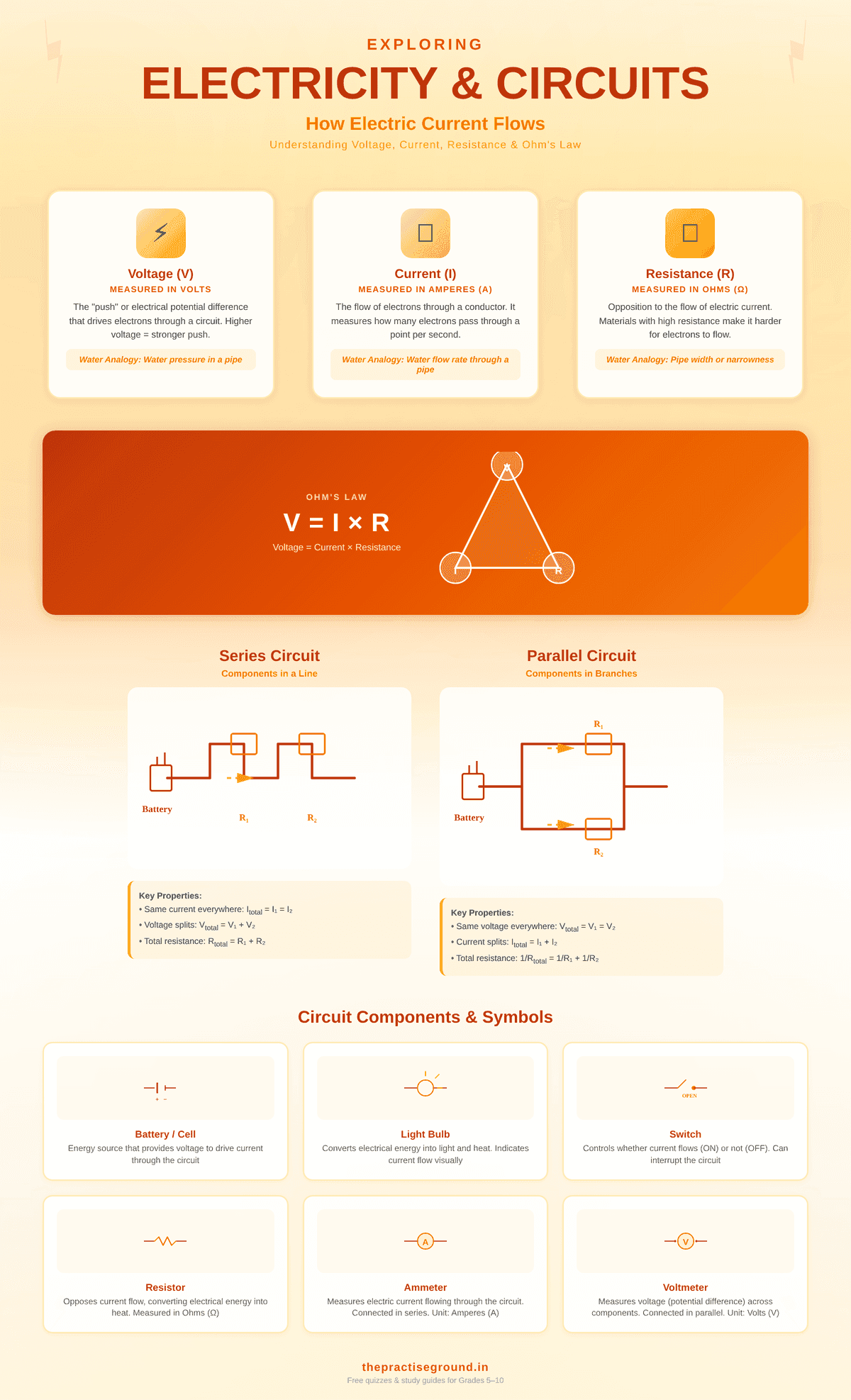
Electricity & Circuits: Ohm's Law, Series & Parallel — Explained Simply
Electricity powers everything in your life—from your phone to your lights. Understanding how electricity flows and how to calculate currents and voltages is essential for CBSE, ICSE, and IB physics.
In this guide, we'll explore electrical fundamentals, Ohm's law, and the differences between series and parallel circuits with practical examples and numericals.
Electrical Fundamentals: Charge, Current, and Voltage
Before diving into circuits, let's establish core concepts.
Electric Charge (Q)
Definition: The property of matter that causes electrical effects.- Symbol: Q
- Unit: Coulomb (C)
- Two types: Positive (+) and Negative (-)
- Law: Like charges repel, opposite charges attract
Electric Current (I)
Definition: The flow of electric charge through a conductor.Potential Difference / Voltage (V)
Definition: The difference in electrical potential between two points.Electric Resistance (R)
Definition: The opposition to current flow through a conductor.Ohm's Law: The Foundation of Circuit Analysis
Ohm's Law states: The current through a conductor is directly proportional to the voltage across it and inversely proportional to its resistance.The Equation
CODEBLOCK0Where:
Rearranging Ohm's Law
From V = IR, we can derive:
Understanding Ohm's Law Intuitively
Ohm's Law Triangle Memory Trick
CODEBLOCK1Practice Numericals Using Ohm's Law
Problem 1: A 10Ω resistor has a voltage of 50V across it. Calculate the current. Solution: CODEBLOCK2 Problem 2: A light bulb draws 0.5A of current from a 230V source. Calculate its resistance. Solution: CODEBLOCK3 Problem 3: A 100Ω resistor carries a current of 2A. Calculate the voltage. Solution: CODEBLOCK4Series Circuits: Resistors in a Line
In a series circuit, components are connected end-to-end in a single loop. Current flows through each component one after another.
Characteristics of Series Circuits
- Single path: Current has only one route
- Same current: Current is the same through all components
- Voltage divides: Voltage drops across each resistor
- Total resistance: Sum of individual resistances
Series Circuit Rules
CODEBLOCK5Visual Example
CODEBLOCK6 Analysis:Disadvantage of Series Circuits
Problem: If one component fails (breaks), the entire circuit stops. This is why series circuits aren't used for home electrical systems.Parallel Circuits: Resistors with Multiple Paths
In a parallel circuit, components are connected across the same two points, creating multiple paths for current.
Characteristics of Parallel Circuits
Parallel Circuit Rules
CODEBLOCK7Visual Example
CODEBLOCK8 Analysis:Advantage of Parallel Circuits
Benefit: If one component fails, others continue working. This is why homes use parallel circuits.Series vs. Parallel: Comparison
| Aspect | Series | Parallel |
|---|---|---|
| Paths | Single | Multiple |
| Current | Same everywhere | Divides at junctions |
| Voltage | Divides | Same everywhere |
| Resistance | R_total = R₁+R₂+... | 1/R = 1/R₁+1/R₂+... |
| If one fails | All stop | Others work |
| Used for | Decorative lights (old) | Home appliances |
| Total R | Highest | Lowest |
Real-World Applications
Indian Electrical Systems
Power and Energy
Electrical Power (P)
Definition: Rate at which electrical energy is consumed or produced.Electrical Energy (E)
Quick Recap: Key Formulas
| Formula | Meaning |
|---|---|
| V = IR | Ohm's Law |
| R = ρL/A | Resistance calculation |
| R_s = R₁+R₂+R₃ | Series resistance |
| 1/R_p = 1/R₁+1/R₂+1/R₃ | Parallel resistance |
| P = VI | Power |
| E = Pt | Energy |
Try This: Circuit Problems
Exam Questions: CBSE/ICSE Pattern
Q1: State Ohm's Law.A: The current through a conductor is directly proportional to the voltage across it and inversely proportional to its resistance. V = IR
Q2: Three resistors of 4Ω, 6Ω, and 12Ω are connected in parallel. Calculate the equivalent resistance.A: 1/R = 1/4 + 1/6 + 1/12 = 3/12 + 2/12 + 1/12 = 6/12 = 1/2 R = 2Ω
Q3: Why are household appliances connected in parallel and not in series?A: In parallel, each appliance works independently. If one fails, others continue. In series, if one fails, all stop. Also, in parallel, each appliance gets the full voltage for optimal operation.
Q4: A bulb rated 60W is used for 8 hours daily. Calculate monthly energy consumption (assume 30 days).A: E = Pt = 60 × 8 × 30 = 14,400 Wh = 14.4 kWh
Q5: Draw circuit diagrams for series and parallel resistor arrangements.A: [Students should draw: Series as single loop, Parallel as multiple paths]
FAQ: Electricity and Circuits
Q: Why does a light bulb get hot?A: Because electrical energy is converted to heat and light. The filament has resistance, and P = I²R means energy is dissipated as heat.
Q: What's the difference between AC and DC current?A: DC (direct current) flows in one direction (batteries). AC (alternating current) changes direction (mains supply, India uses AC). AC is used for long-distance transmission because voltage is easily changed with transformers.
Q: Why do electricians use copper wires instead of iron?A: Copper has lower resistivity than iron. Lower resistance means less heat loss and energy waste. Also, copper is more ductile (can be drawn into wires).
Q: What's a fuse and how does it work?A: A fuse is a safety device with a wire that melts if current exceeds a safe limit. When current is too high, heat generated (P = I²R) melts the wire, breaking the circuit and preventing fire.
Q: Why does adding more resistors in parallel decrease total resistance?A: Adding another parallel path gives current more routes to flow. More paths = less opposition = lower total resistance.
Next Steps
Now that you understand circuits, explore related topics:
Electricity and circuits are everywhere. Understanding them opens doors to engineering, electronics, and power systems. Master this topic, and you'll see the electrical world with new understanding. Good luck with your exams!
Taking a quick break? Test yourself!
Pause and try a quick Grade 8 Physics quiz — see how much you've picked up so far.