
Want to test what you know?
Try our free Grade 6 English quiz — 25 questions, instant results, no sign-up.
English grammar is the foundation of good communication. Class 6-7 students who master grammar early enjoy better writing skills, higher exam marks, and confidence in speaking English. Yet grammar often feels abstract and tedious. How can you make it stick?
The answer lies in systematic practice combined with understanding the "why" behind grammar rules.
The CBSE Grammar Syllabus for Class 6-7
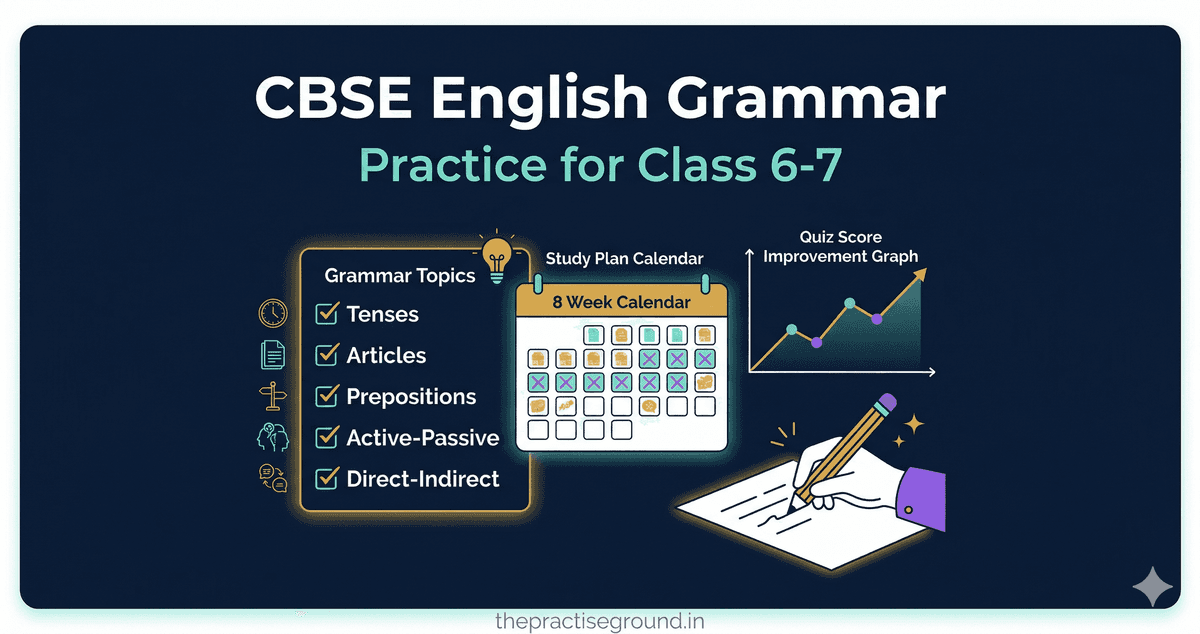
The CBSE curriculum emphasizes these core grammar topics:
- Tenses (Simple, Continuous, Perfect)
- Articles (A, An, The)
- Prepositions (In, On, At, By, etc.)
- Active and Passive Voice
- Parts of Speech (Nouns, Verbs, Adjectives, Adverbs)
- Subject-Verb Agreement
- Pronouns and Pronoun Cases
- Word Formation (Prefixes, Suffixes)
Understanding Key Grammar Topics
1. Tenses: The Foundation
Tenses are often the biggest sticking point for young learners.
Simple Tense describes habitual actions or general truths.2. Articles: A, An, The
A/An for indefinite nouns (one among many):3. Prepositions: Expressing Relationships
Prepositions show location, time, direction, and relationship.
Location: In, On, At, By4. Active and Passive Voice
Active Voice: Subject performs the action.Why Traditional Grammar Learning Fails
Memorization Without Context: Learning "Past Perfect is formed with had + past participle" without examples makes it meaningless. Lack of Repetition: Reading a grammar rule once doesn't encode it in memory. Spaced repetition through practice does. No Immediate Feedback: When you write an essay, you might not know if your tense usage is correct until the teacher marks it weeks later. Overwhelming Volume: Trying to study all grammar topics simultaneously leads to confusion.The Power of Systematic Practice
Step 1: Learn the Concept Read an explanation (from textbook or online) and see 3-4 examples. Step 2: Attempt Guided Quizzes Solve basic fill-in-the-blank or multiple-choice questions on that specific topic. Step 3: Review Mistakes For every wrong answer, understand the rule you broke. Step 4: Spaced Repetition Return to that topic after a week, then again after a month. This solidifies memory. Step 5: Mixed Practice Combine multiple grammar topics in one quiz. This mimics real writing challenges.How Free Online Grammar Quizzes Accelerate Learning
Platforms like The Practise Ground offer free English grammar quizzes for Class 6-7 covering:
The gamified nature of quizzes (accuracy percentage, time spent, streak tracking) makes grammar feel less tedious and more engaging.
Practical Study Plan for CBSE Grammar Mastery
Week 1: Focus on Simple Tenses and Articles (15 min daily) Week 2: Add Continuous Tenses and Prepositions (20 min daily) Week 3: Introduce Perfect Tenses (20 min daily) Week 4: Learn Active and Passive Voice (20 min daily) Week 5-6: Mixed grammar quizzes combining all topics (25 min daily) Week 7-8: Revision and speed practice under timed conditionsCommon Grammar Mistakes to Watch Out For
- Tense Inconsistency: "She goes to school and plays cricket." (correct—both simple present)
- Article Misuse: "I saw an movie." (wrong—movie starts with consonant sound). Correct: "I saw a movie."
- Preposition Errors: "I am good in Maths." (wrong). Correct: "I am good at Maths."
- Subject-Verb Disagreement: "The students is here." (wrong). Correct: "The students are here."
- Voice Confusion: "The house was built yesterday by workers." (awkward). Better: "Workers built the house yesterday."
Conclusion
English grammar for Class 6-7 is learnable and mastery is within reach. Combine clear concept understanding with consistent, feedback-based practice through online quizzes. Start with one grammar topic, build confidence, then expand systematically. Use The Practise Ground's free Class 6-7 English grammar quizzes to practice daily, track progress, and identify gaps.
Your writing will become clearer, your exam marks will improve, and—most importantly—you'll communicate with confidence. Begin today.
Frequently Asked Questions
Which English grammar topics should Class 6-7 students learn first?
Start with tenses (simple present, past, future) and articles (a, an, the). These appear in nearly every exam question and form the foundation for all other grammar topics. Once these are solid, move to prepositions, then active-passive voice.
How often should my child practise grammar to see improvement?
Fifteen to twenty minutes of daily grammar practice produces visible results within 3-4 weeks. Consistency matters more than duration. A daily 15-minute quiz habit is far more effective than a weekly 2-hour grammar session.
Is there a difference between CBSE and ICSE grammar requirements for Class 6-7?
The core grammar topics are identical — tenses, articles, prepositions, active-passive voice, and direct-indirect speech. ICSE tends to include more composition and letter-writing, while CBSE focuses more on gap-filling and transformation exercises. The underlying grammar knowledge is the same.
My child speaks English well but makes grammar mistakes in writing. Why?
Spoken English is more forgiving — listeners fill in gaps naturally. Written English requires precise grammar because there are no contextual cues. The fix is targeted written practice: fill-in-the-blanks, sentence correction, and paragraph writing with grammar feedback.
Taking a quick break? Test yourself!
Pause and try a quick Grade 6 English quiz — see how much you've picked up so far.