Want to test what you know?
Try our free Grade 8 English quiz — 25 questions, instant results, no sign-up.
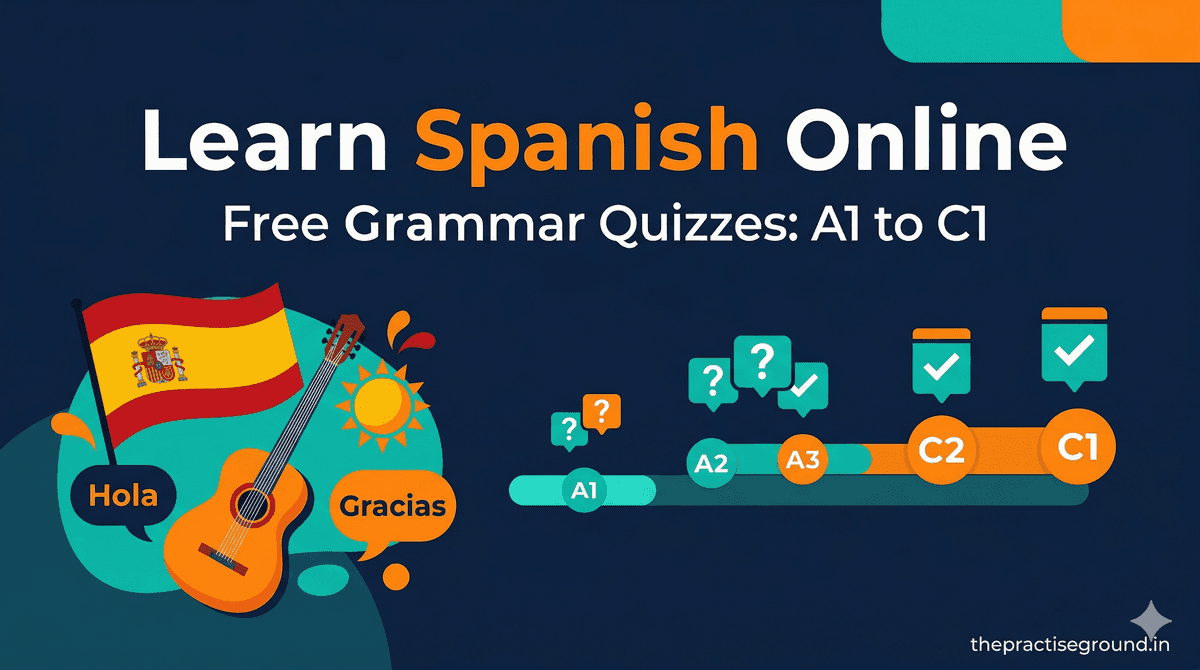
Spanish is spoken by over 500 million people worldwide, making it one of the most useful languages to learn. Its grammar is more regular than English in many ways, and with structured practice, you can build strong grammar skills quickly. The Practise Ground offers 52 weeks of free quizzes at A1, B1, and C1 CEFR levels.
What Does Each CEFR Level Cover in Spanish?
A1 — Beginner Spanish
- Present tense of regular (-ar, -er, -ir) and key irregular verbs
- Ser vs estar (the two verbs for "to be")
- Articles and noun gender (el/la, un/una)
- Basic adjective agreement (gender and number)
- Question words (que, quien, donde, cuando, como, por que)
- Basic prepositions (a, de, en, con, por, para)
B1 — Intermediate Spanish
C1 — Advanced Spanish
The Biggest Challenge: Ser vs Estar
Both "ser" and "estar" mean "to be" in English, but they are used in different contexts:
| Use Ser For | Use Estar For |
|---|---|
| Identity (Soy profesor — I am a teacher) | Location (Estoy en casa — I am at home) |
| Nationality (Es espanol — He is Spanish) | Temporary states (Estoy cansado — I am tired) |
| Physical description (Es alto — He is tall) | Emotions (Estoy feliz — I am happy) |
| Time and dates (Son las tres — It is three o'clock) | Progressive tenses (Estoy comiendo — I am eating) |
| Material (Es de madera — It is made of wood) | Result of action (La puerta esta abierta — The door is open) |
Why the Subjunctive Matters
The subjunctive mood is one of the most important features of Spanish grammar. English barely uses it, so it requires a shift in thinking. The subjunctive is used for:
Our B1 and C1 quizzes provide extensive subjunctive practice because mastering it is what separates intermediate from advanced Spanish speakers.
How to Use the Spanish Quizzes Effectively
- Start at A1 even if you know some Spanish — it fills gaps you might not know you have
- Complete quizzes in order within each level, as topics build on each other
- Aim for 3-4 quizzes per week for steady progress
- When you move to B1, revisit A1 topics occasionally to maintain them
- Use wrong answers as learning opportunities — each quiz shows the correct answer immediately
Key Takeaways
Frequently Asked Questions
Is Spanish easier to learn than French or German?
For English speakers, Spanish pronunciation is generally easier than French, and its grammar is simpler than German (no cases). The US Foreign Service Institute rates Spanish as a Category I language (easiest for English speakers), requiring approximately 600 hours of study to reach professional proficiency.
When should I start learning the subjunctive?
Start at B1 level, after you have a solid grasp of present, past, and future indicative tenses. Trying to learn the subjunctive too early can be confusing because it builds on your understanding of other tenses. Our quiz structure introduces it at the right point in your learning journey.
How important is the difference between preterite and imperfect?
It is fundamental to speaking Spanish correctly. The preterite describes completed past actions (Ayer comi pizza — Yesterday I ate pizza). The imperfect describes ongoing or habitual past actions (Cuando era nino, comia pizza cada viernes — When I was a child, I used to eat pizza every Friday). Our B1 quizzes provide extensive practice on this distinction.
Start learning Spanish today: A1 Beginner | B1 Intermediate | C1 Advanced
Taking a quick break? Test yourself!
Pause and try a quick Grade 8 English quiz — see how much you've picked up so far.