Want to test what you know?
Try our free Grade 8 English quiz — 25 questions, instant results, no sign-up.
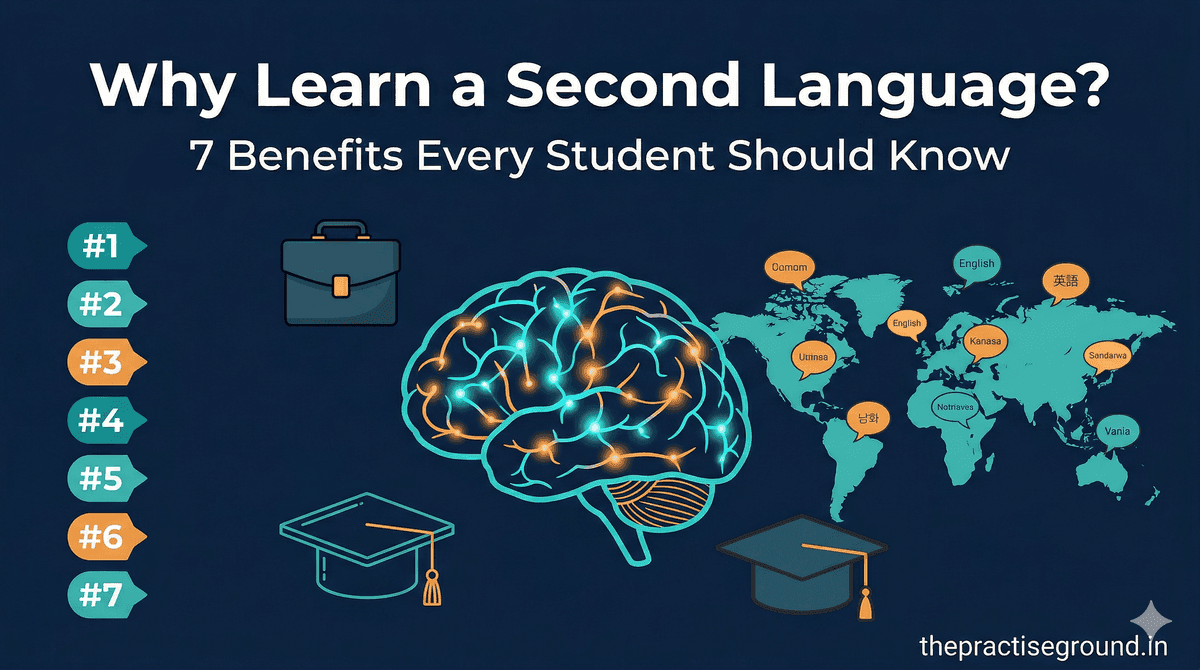
Learning a second language is one of the most valuable skills a student can develop. Beyond the obvious ability to communicate with more people, research shows that bilingualism improves cognitive function, academic performance, and career prospects. Here are seven evidence-backed reasons to start learning a language today.
1. Improved Memory and Cognitive Function
Learning a language exercises your brain like a workout exercises your body. Studies have shown that bilingual individuals have better working memory, stronger attention control, and improved ability to switch between tasks. The constant mental effort of managing two language systems strengthens neural pathways.
2. Higher Scores on Standardised Tests
Research consistently shows that students who study a foreign language score higher on standardised tests, including in subjects that seem unrelated to language. Students of foreign languages tend to outperform their monolingual peers on verbal and mathematical sections of standardised tests.
3. Better Understanding of Your First Language
Learning a second language makes you more aware of grammar, sentence structure, and vocabulary in your first language. When you study French verb conjugation, for example, you develop a deeper understanding of how English verbs work too.
4. Enhanced Problem-Solving Skills
Bilingual students develop stronger analytical and problem-solving abilities. The process of switching between languages and choosing the right word in context trains the brain to evaluate options, make decisions, and think creatively — skills that transfer to maths, science, and everyday life.
5. Career Advantages
In an increasingly globalised economy, language skills are a significant career advantage. Professionals who speak multiple languages often have access to more job opportunities, higher salaries, and the ability to work internationally.
6. Cultural Understanding and Empathy
Language and culture are deeply connected. Learning a language exposes you to different ways of thinking, different customs, and different worldviews. This builds empathy and cultural intelligence — increasingly valued skills in diverse workplaces and communities.
7. Delayed Cognitive Decline
Long-term studies have found that bilingualism can delay the onset of cognitive decline and dementia by several years. While this benefit is more relevant for adults, starting language learning early builds habits that protect brain health throughout life.
How to Get Started
The best time to start learning a language is now. You do not need to commit hours every day — even 15-20 minutes of daily practice can build strong foundations over time.
The Practise Ground offers free grammar quizzes for three languages:
- French quizzes — from A1 beginner to C1 advanced
- German quizzes — from A1 beginner to C1 advanced
- Spanish quizzes — from A1 beginner to C1 advanced
Key Takeaways
Frequently Asked Questions
What is the best age to start learning a second language?
The earlier the better for developing native-like pronunciation, but there is no age limit for successful language learning. Adults actually learn grammar and vocabulary faster than children because they can understand abstract rules. The most important factor is consistent practice, not age.
Which language should I learn first?
It depends on your goals. Spanish is considered the easiest for English speakers. French is widely used in international organisations. German is valuable for engineering and science careers. Choose a language that motivates you — motivation is the best predictor of success.
Can I learn a language just from quizzes?
Quizzes are excellent for building grammar knowledge and vocabulary through active recall. For full language proficiency, you should also practise listening (podcasts, videos), speaking (conversation partners), and reading (books, articles). Quizzes form the grammatical foundation that makes all other practice more effective.
Start your language learning journey: French | German | Spanish
Taking a quick break? Test yourself!
Pause and try a quick Grade 8 English quiz — see how much you've picked up so far.