
Want to test what you know?
Try our free Grade 8 English quiz — 25 questions, instant results, no sign-up.
Mathematics is full of surprises that can make even people who think they dislike maths stop and think. These 25 facts and puzzles reveal the beautiful, strange, and downright surprising side of numbers. See how many you already knew.
Amazing Number Facts
1. The 1089 Trick
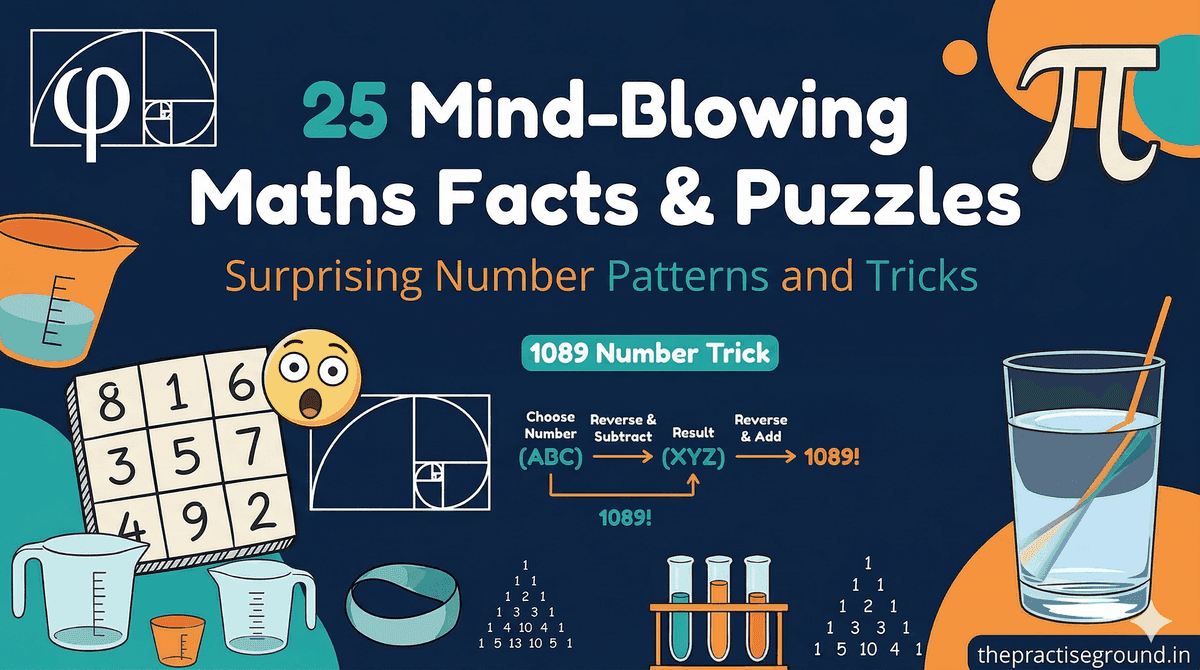
Take any three-digit number where the first digit is larger than the last (e.g., 732). Reverse it (237). Subtract the smaller from the larger (732 - 237 = 495). Reverse the result (594). Add them together (495 + 594 = 1089). You will always get 1089, no matter which three-digit number you start with.2. Kaprekar's Constant (6174)
Take any four-digit number with at least two different digits. Arrange the digits in descending and ascending order. Subtract the smaller from the larger. Repeat with the result. You will always reach 6174 within 7 steps. For example: 3524 → 5432 - 2345 = 3087 → 8730 - 0378 = 8352 → ... → 6174.3. Multiplying by 9
The digits of any multiple of 9 always add up to 9 (or a multiple of 9). For example: 9 x 7 = 63, and 6 + 3 = 9. Also: 9 x 123 = 1107, and 1 + 1 + 0 + 7 = 9.4. 111,111,111 x 111,111,111
The answer is 12,345,678,987,654,321 — a perfect numerical palindrome that counts up and back down.5. The Number 142,857
This is a cyclic number. Multiply it by 1 through 6 and you get the same digits rearranged: 142857 x 1 = 142857 142857 x 2 = 285714 142857 x 3 = 428571 142857 x 4 = 571428 142857 x 5 = 714285 142857 x 6 = 857142Patterns in Nature
6. Fibonacci Everywhere
The Fibonacci sequence (1, 1, 2, 3, 5, 8, 13, 21, 34, 55...) appears throughout nature: the number of petals on most flowers follows Fibonacci numbers (lilies have 3, buttercups 5, daisies 34 or 55). Pinecone spirals, sunflower seed patterns, and nautilus shells all follow this sequence.7. The Golden Ratio
When you divide consecutive Fibonacci numbers, the ratio approaches 1.618... (called the golden ratio or phi). This ratio appears in art (the Mona Lisa), architecture (the Parthenon), and even the proportions of the human face.8. Hexagons in Nature
Bees build hexagonal honeycomb cells because hexagons are the most efficient shape for covering an area with the least material. This was mathematically proved in 1999 (the honeycomb conjecture).Mind-Bending Puzzles
9. The Birthday Problem
In a room of just 23 people, there is a greater than 50 percent chance that two people share the same birthday. With 70 people, the probability rises to 99.9 percent. This seems impossible because there are 365 days in a year, but the maths works because you are comparing every possible pair of people, not just one person against the rest.10. The Monty Hall Problem
You are on a game show with three doors. Behind one door is a car; behind the other two are goats. You pick a door. The host (who knows what is behind the doors) opens another door to reveal a goat. Should you switch your choice? Yes — switching gives you a 2/3 chance of winning, while staying gives only 1/3.11. The Missing Dollar Puzzle
Three friends pay Rs 30 for a hotel room (Rs 10 each). The manager realises the room costs only Rs 25 and sends a bellboy with Rs 5 change. The bellboy keeps Rs 2 and gives back Rs 1 to each friend. Now each friend paid Rs 9, totalling Rs 27, plus the Rs 2 the bellboy kept = Rs 29. Where is the missing rupee? The trick is in the misleading arithmetic — you should not add the Rs 2 to the Rs 27 (the Rs 2 is already included in it).12. Infinite Hotel Paradox
Imagine a hotel with infinitely many rooms, all occupied. A new guest arrives. Can they be accommodated? Yes — move every guest from room n to room n+1. Room 1 is now free. Even an infinite bus with infinitely many new passengers can be accommodated using a clever numbering trick.Quick Maths Tricks
13. Squaring Numbers Ending in 5
To square any number ending in 5, multiply the first digit by (first digit + 1), then put 25 at the end. Example: 35² = 3 x 4 = 12, then 25 → 1225. Works for 45² (4 x 5 = 2025), 65² (6 x 7 = 4225), etc.14. Multiplying by 11
To multiply any two-digit number by 11, add the two digits and place the sum between them. Example: 36 x 11 = 3(3+6)6 = 396. If the sum exceeds 9, carry the 1.15. Divisibility by 3
A number is divisible by 3 if the sum of its digits is divisible by 3. For example, 456: 4+5+6 = 15, which is divisible by 3, so 456 is divisible by 3.Historical Maths Facts
16. Zero Was Invented in India
The concept of zero as a number (not just a placeholder) was developed by Indian mathematicians, notably Brahmagupta in the 7th century CE. Before this, civilisations had no way to represent nothing as a number.17. Srinivasa Ramanujan's Taxi Number
The number 1729 is known as the Hardy-Ramanujan number. When mathematician G.H. Hardy mentioned his taxi number was 1729 (seemingly dull), Ramanujan instantly replied that it was the smallest number expressible as the sum of two cubes in two different ways: 1729 = 1³ + 12³ = 9³ + 10³.Key Takeaways
- Mathematics is full of surprising patterns and elegant tricks
- Numbers like 1089, 6174, and 142857 have magical properties
- Fibonacci numbers and the golden ratio appear throughout nature
- Probability puzzles like the birthday problem challenge our intuitions
- India's contribution to mathematics includes the revolutionary concept of zero
Frequently Asked Questions
Why do these tricks work?
Most number tricks work because of the properties of our base-10 number system. The 1089 trick, for example, works because of how carrying and borrowing interact with three-digit numbers. Understanding why tricks work is even more interesting than knowing them.
Are these puzzles tested in school exams?
While the specific puzzles are not usually tested, the mathematical thinking behind them is. Pattern recognition (Fibonacci), probability (birthday problem), and number properties (divisibility rules) are all part of school curricula. These puzzles make those concepts memorable.
Where can I find more maths puzzles?
Our Fun Quizzes section includes brain teasers and number puzzles. For daily practice, try our Maths quizzes covering problem-solving for all grades.
Explore more: Fun Quizzes | Maths Quizzes
Taking a quick break? Test yourself!
Pause and try a quick Grade 8 English quiz — see how much you've picked up so far.