
Want to test what you know?
Try our free Grade 5 English quiz — 25 questions, instant results, no sign-up.
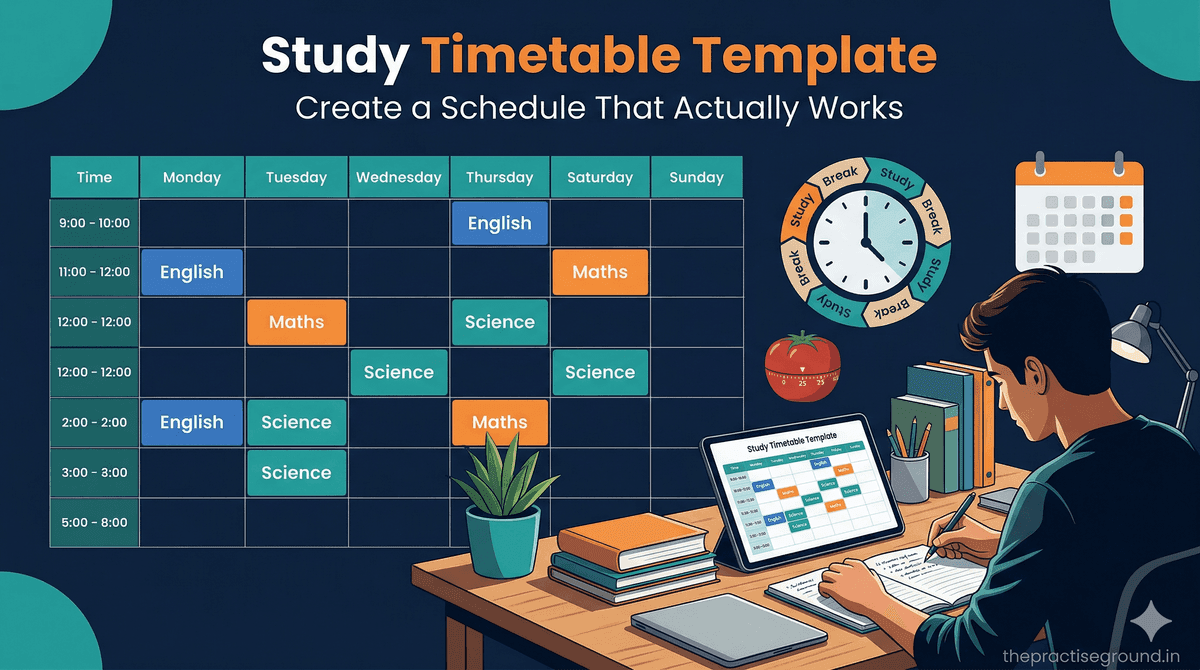
Most study timetables fail within a week because they are unrealistic. A timetable that works is not about studying more hours — it is about studying the right things at the right times with built-in flexibility. Here is how to create one that you will actually follow.
Why Most Timetables Fail
The three biggest reasons study timetables fail:
- Too ambitious — Scheduling 10 hours of study on a school day is not sustainable
- No breaks — Your brain cannot focus for hours without rest
- No flexibility — Life happens; a rigid schedule breaks at the first disruption
The Pomodoro Technique for Students
The Pomodoro Technique is a time management method that breaks study time into focused intervals:
| Component | Duration |
|---|---|
| Study block (1 Pomodoro) | 25 minutes of focused study |
| Short break | 5 minutes (stretch, water, move around) |
| Long break (after 4 Pomodoros) | 15-20 minutes |
Adapting for Different Ages
Sample Weekday Timetable (School Days)
| Time | Activity |
|---|---|
| After school (4:00-4:30 PM) | Snack + rest + casual reading |
| 4:30-5:00 PM | Homework — Subject 1 (hardest subject first) |
| 5:00-5:05 PM | Short break |
| 5:05-5:30 PM | Homework — Subject 2 |
| 5:30-5:35 PM | Short break |
| 5:35-6:00 PM | Revision or quiz practice |
| 6:00-7:00 PM | Free time (sports, hobbies, screen time) |
| 7:00-7:25 PM | Light revision or reading |
| After 7:30 PM | Family time, dinner, relaxation |
Sample Weekend Timetable
| Time | Activity |
|---|---|
| 9:00-9:30 AM | Revision — Subject 1 (weakest subject) |
| 9:30-9:35 AM | Short break |
| 9:35-10:05 AM | Revision — Subject 2 |
| 10:05-10:20 AM | Long break (snack, stretch) |
| 10:20-10:50 AM | Practice problems or quizzes |
| 10:50-10:55 AM | Short break |
| 10:55-11:25 AM | Revision — Subject 3 |
| 11:25 AM onwards | Free time for rest of the day |
How to Integrate Quiz Practice
Online quizzes are an excellent way to use active recall (testing yourself), which is far more effective than passive re-reading. Schedule 15-20 minutes of quiz practice daily:
Quizzes work especially well as the last study activity of the day because they consolidate what you studied earlier.
Subject Rotation Strategy
Do not study the same subject every day at the same time. Rotate to prevent boredom and build connections across subjects:
| Day | Slot 1 (hardest) | Slot 2 | Slot 3 (lightest) |
|---|---|---|---|
| Monday | Maths | Science | English quiz |
| Tuesday | Science | English | Maths quiz |
| Wednesday | English | Maths | Science quiz |
| Thursday | Maths | Science | English quiz |
| Friday | Revision of weakest topic | Free choice | Fun quiz |
Exam Season Adjustments
During exam preparation, increase study time gradually:
Key Takeaways
Frequently Asked Questions
How many hours should I study per day outside of school?
For Grades 5-7: 1-1.5 hours. For Grades 8-10: 2-2.5 hours. For Grades 11-12: 3-4 hours. These are guidelines — quality of study matters more than quantity. If you are fully focused during study blocks, even shorter sessions are highly effective.
Should I study every day including weekends?
Consistency is more important than intensity. Studying 5-6 days a week with one rest day is ideal for most students. The rest day prevents burnout and actually helps your brain consolidate what you learned during the week.
What should I do if I fall behind my timetable?
Do not try to catch up by cramming everything into one day. Instead, adjust your timetable for the rest of the week. Move the missed topic to a weekend slot or swap it with a lighter topic. A flexible timetable is a sustainable timetable.
Is it better to study in the morning or at night?
Research shows that most people concentrate better in the morning, especially for difficult subjects. However, some students are genuinely more alert at night. Experiment with both and stick with what works for you. The most important factor is consistency.
Taking a quick break? Test yourself!
Pause and try a quick Grade 5 English quiz — see how much you've picked up so far.