
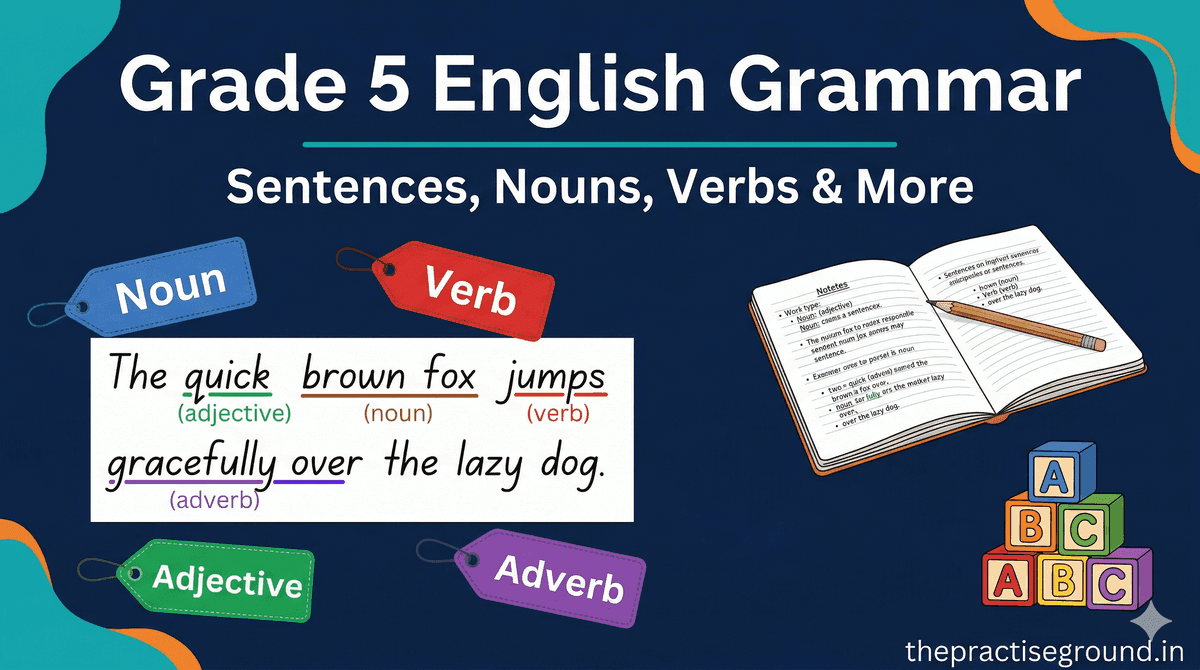
Want to test what you know?
Try our free Grade 5 English quiz — 25 questions, instant results, no sign-up.
English grammar is the set of rules that helps us write and speak clearly. In Grade 5, you learn the building blocks that make your writing stronger and your reading easier. This guide covers the most important grammar topics you will study this year.
What Are the Four Types of Sentences?
Every sentence you write falls into one of four categories:
| Type | Purpose | Punctuation | Example |
|---|---|---|---|
| Declarative | Makes a statement | Full stop (.) | The cat sat on the mat. |
| Interrogative | Asks a question | Question mark (?) | Where is the library? |
| Imperative | Gives a command or request | Full stop (.) or exclamation mark (!) | Please close the door. |
| Exclamatory | Expresses strong feeling | Exclamation mark (!) | What a beautiful day! |
What Are Nouns?
A noun is a word that names a person, place, thing, or idea. There are several types:
- Common nouns name general things: dog, school, book, city
- Proper nouns name specific things and start with capital letters: Rohan, Mumbai, Monday, January
- Collective nouns name groups: a flock of birds, a pack of wolves, a team of players
- Abstract nouns name things you cannot see or touch: happiness, courage, friendship, knowledge
Quick Test
Can you spot all the nouns in this sentence? "The children at Delhi Public School showed great courage during the annual sports day."Answer: children (common), Delhi Public School (proper), courage (abstract), sports day (common).
What Are Verbs?
A verb is a word that shows an action or a state of being.
Every sentence needs at least one verb. Without a verb, you do not have a complete sentence.
What Are Adjectives and Adverbs?
Adjectives describe nouns. They answer the questions: What kind? How many? Which one?Many adverbs are formed by adding -ly to an adjective: slow becomes slowly, careful becomes carefully, happy becomes happily.
What Are Prepositions?
A preposition shows the relationship between a noun and another word in the sentence. Common prepositions include: in, on, at, under, between, behind, beside, through, during, before, after.
Examples:
Key Takeaways
Frequently Asked Questions
How do I know if a word is a noun or a verb?
The same word can sometimes be both. For example, "play" can be a noun (The play was wonderful) or a verb (I play cricket). Look at how the word is used in the sentence — if it names something, it is a noun. If it shows an action, it is a verb.
What is the difference between adjectives and adverbs?
Adjectives describe nouns (the tall girl), while adverbs describe verbs (she runs quickly). An easy test: if the word describes a thing, it is an adjective. If it describes an action, it is an adverb.
Do I need to memorise all the prepositions?
You do not need to memorise a list. Instead, learn to recognise them in sentences. If a small word tells you where, when, or how something relates to something else, it is probably a preposition.
Practise Grade 5 English grammar with our free Grade 5 English quizzes — 52 weeks of questions covering all grammar topics.
Taking a quick break? Test yourself!
Pause and try a quick Grade 5 English quiz — see how much you've picked up so far.