Want to test what you know?
Try our free Grade 8 English quiz — 25 questions, instant results, no sign-up.
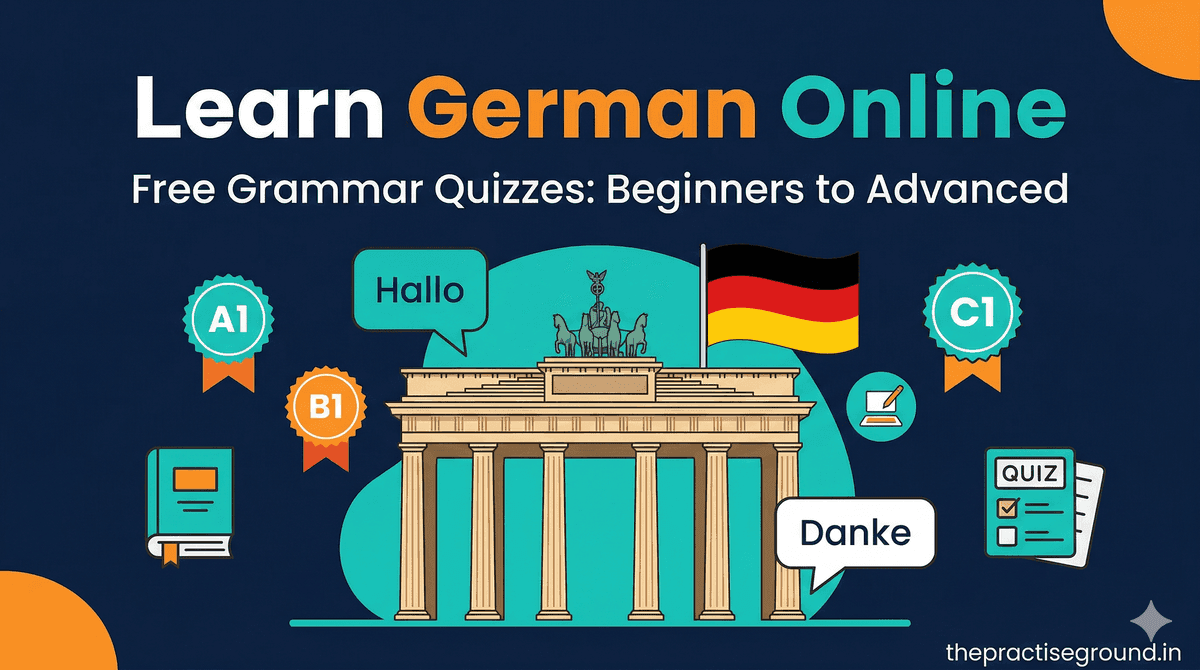
German is a systematic language with clear rules — which means that once you understand the grammar patterns, progress becomes predictable. The Practise Ground offers 52 weeks of free German grammar quizzes at A1, B1, and C1 levels to take you from beginner to advanced.
What Makes German Grammar Unique?
German has several features that are different from English:
- Four grammatical cases (Nominativ, Akkusativ, Dativ, Genitiv) that change article and adjective forms
- Three genders (der, die, das) for nouns
- Verb-second rule in main clauses (the conjugated verb is always the second element)
- Separable prefix verbs (aufstehen = to get up, where auf separates in main clauses)
What Does Each Level Cover?
A1 — Beginner German
B1 — Intermediate German
C1 — Advanced German
Understanding German Cases — Simplified
| Case | Function | Example | Article (masculine) |
|---|---|---|---|
| Nominativ | Subject of the sentence | Der Mann liest. (The man reads.) | der |
| Akkusativ | Direct object | Ich sehe den Mann. (I see the man.) | den |
| Dativ | Indirect object | Ich gebe dem Mann ein Buch. (I give the man a book.) | dem |
| Genitiv | Possession | Das Buch des Mannes. (The man's book.) | des |
How to Progress Through the Quizzes
- Take the A1 quizzes first, even if you have some German knowledge — they build the foundation
- Complete at least 2-3 quizzes per week for steady progress
- When you score consistently above 80 percent at one level, move to the next
- Review wrong answers carefully — German grammar rewards understanding patterns, not memorisation
Key Takeaways
Frequently Asked Questions
Is German grammar harder than French grammar?
They are different rather than harder. German has cases (which French does not) but has more regular verb conjugation patterns. German spelling is more phonetic than French. Most learners find German word order the biggest challenge, while French learners struggle more with pronunciation and verb tenses.
Do I need to memorise all the case endings?
Yes, but it happens naturally with practice rather than rote memorisation. Our quizzes expose you to case endings in context, which is how native speakers learn them. Focus on Nominativ and Akkusativ first, then add Dativ, and finally Genitiv.
How long does it take to learn German to B1 level?
The Goethe-Institut estimates approximately 350 hours of study to reach B1. With daily practice of 30-60 minutes, this translates to roughly 12-18 months. Consistent quiz practice can accelerate this by providing structured active recall.
Start learning German today: A1 Beginner | B1 Intermediate | C1 Advanced
Taking a quick break? Test yourself!
Pause and try a quick Grade 8 English quiz — see how much you've picked up so far.