
Want to test what you know?
Try our free Grade 8 Physics quiz — 25 questions, instant results, no sign-up.
Light: Reflection & Refraction — Mirror & Lens Formulas Made Easy
Light behaves in predictable ways. Understanding reflection (bouncing off mirrors) and refraction (bending through lenses) is crucial for CBSE, ICSE, and IB physics, and explains how mirrors and glasses work.
In this guide, we'll master the laws of reflection and refraction, formula application, and sign conventions that often confuse students.
Part 1: Reflection of Light
Law of Reflection
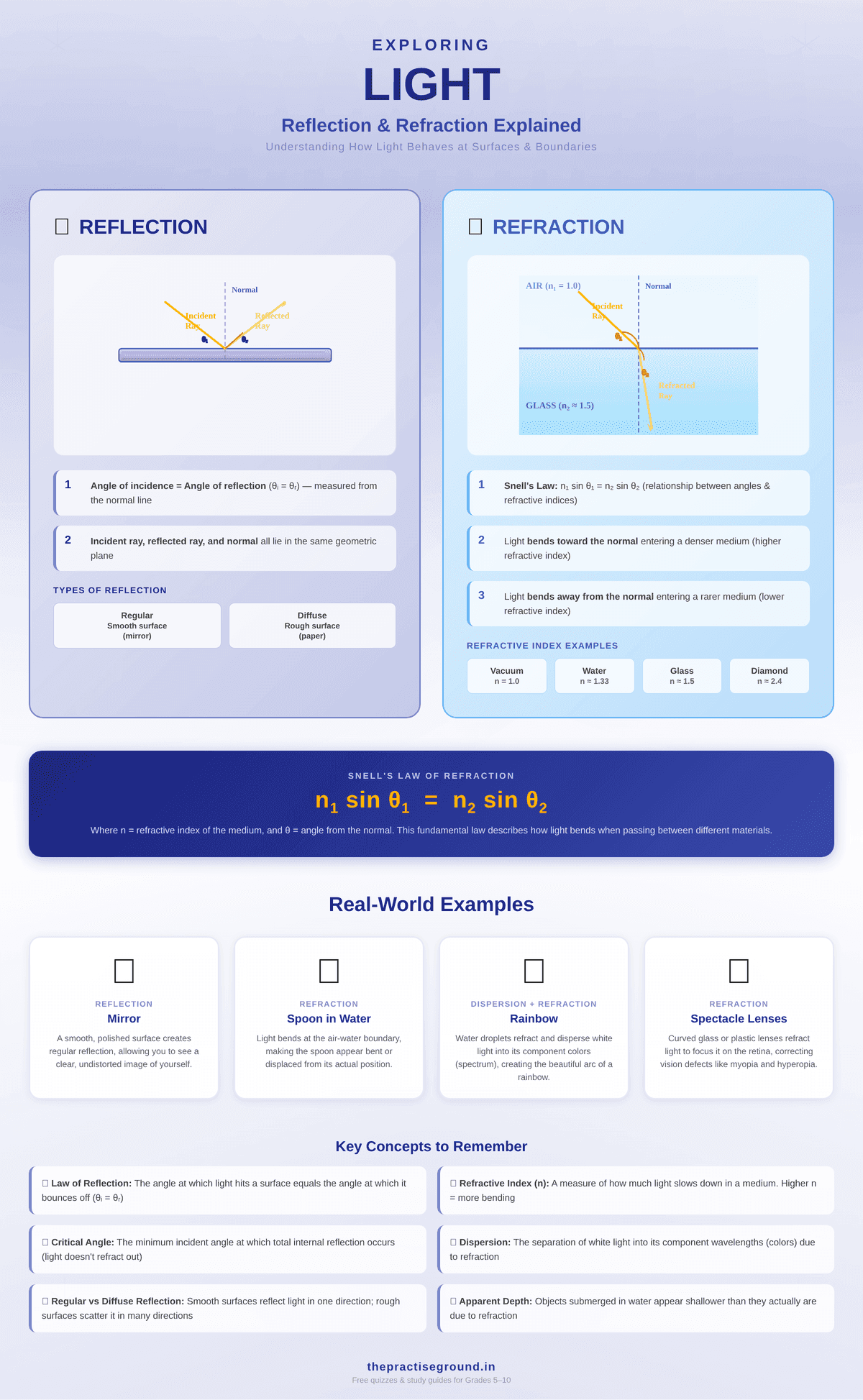
The law of reflection states: The angle of incidence equals the angle of reflection, and both lie in the same plane as the normal.
Key terms:- Incident ray: Light approaching the mirror
- Reflected ray: Light bouncing off the mirror
- Normal: Perpendicular line to the mirror surface
- Angle of incidence (i): Angle between incident ray and normal
- Angle of reflection (r): Angle between reflected ray and normal
Types of Mirrors
1. Plane Mirrors (Flat)
Image characteristics:2. Concave Mirrors (Curved inward)
Converging mirror – Reflects light toward a single point (focus). Key points:3. Convex Mirrors (Curved outward)
Diverging mirror – Reflects light away from a point. Key characteristics:Sign Convention for Mirrors (Detailed)
CODEBLOCK2 Memory tip: In front of mirror = positive (real), Behind mirror = negative (virtual)Mirror Formula Examples
Example 1: Concave MirrorObject 30 cm in front of concave mirror with f = 10 cm. Find image position and nature.
Solution: CODEBLOCK3 Example 2: Convex MirrorObject 15 cm in front of convex mirror with f = -10 cm. Find image.
Solution: CODEBLOCK4Part 2: Refraction of Light
Law of Refraction (Snell's Law)
Refraction is the bending of light when passing from one medium to another.
Snell's Law: CODEBLOCK5 Key terms:Understanding Refraction
Critical Angle and Total Internal Reflection
When light travels from a denser to less dense medium at a steep angle, it may undergo total internal reflection (bounces back completely).
Critical angle (C): CODEBLOCK6If angle of incidence > critical angle, total internal reflection occurs.
Examples:Part 3: Lenses
Types of Lenses
1. Convex Lens (Converging)
Thicker in the middle, brings light rays together.
Focal length (f): Positive Focal point: Where parallel rays meet Uses: Magnifying glass, camera lens, microscope objective2. Concave Lens (Diverging)
Thinner in the middle, spreads light rays apart.
Focal length (f): Negative Virtual focal point: Where diverging rays appear to come from Uses: Spectacles for myopia (short-sightedness)Lens Formula
The lens formula is identical to mirror formula:
CODEBLOCK7 Sign Convention for Lenses:Lens Formula Example
Convex lens with f = 15 cm, object 45 cm away: CODEBLOCK8Power of a Lens
Power (P): Ability of lens to converge or diverge light. CODEBLOCK9 Example: A +2 D lens has f = 0.5 m = 50 cm (convex, converging) Uses: Spectacle prescriptions are written in diopters.Ray Diagrams: Visual Method
For mirrors and lenses, ray diagrams show image formation graphically.
Three Principal Rays for Convex Lens
- Ray parallel to axis: Passes through focus F
- Ray through focus F: Becomes parallel to axis
- Ray through center O: Passes straight (undeviated)
Three Principal Rays for Concave Mirror
Quick Recap: Formulas and Signs
| Element | Convex | Concave |
|---|---|---|
| Mirror | f = + (converging) | f = - (diverging) |
| Lens | f = + (converging) | f = - (diverging) |
| Object | u = - (in front) | u = - (in front) |
| Real Image | v = + (in front) | v = + (in front of mirror/opposite of lens) |
| Virtual Image | v = - (behind) | v = - (behind mirror/same side of lens) |
Real-World Applications
Mirrors
Lenses
Refraction Applications
Try This: Practice Problems
Exam Questions: CBSE/ICSE Pattern
Q1: State the law of reflection.A: Angle of incidence = Angle of reflection, both measured from normal, in same plane.
Q2: A mirror forms a real, inverted, enlarged image. What type of mirror is it?A: Concave mirror with object between F and C.
Q3: Derive the mirror formula: 1/f = 1/u + 1/vA: [Using similar triangles and geometry of ray diagrams]
Q4: What is refractive index? Name a material with n > 1.33 (water).A: Refractive index is the ratio of speed of light in vacuum to speed in the medium. Glass (n ≈ 1.5), diamond (n ≈ 2.4).
Q5: A convex lens of power +2D is used. Find its focal length.A: P = 1/f → 2 = 1/f → f = 0.5 m = 50 cm
FAQ: Light, Reflection and Refraction
Q: Why do objects underwater appear closer than they actually are?A: Light refracts when moving from water to air. The apparent position is different from actual position due to refraction.
Q: Why does a diamond sparkle more than glass?A: Diamond's higher refractive index (2.4 vs 1.5) causes more refraction and total internal reflection, creating more sparkle.
Q: Can a concave lens form a real image?A: No, concave (diverging) lenses always form virtual, erect, diminished images. Real images require converging lenses (under normal conditions).
Q: What's the difference between a real and virtual image?A: Real images can be projected on a screen; virtual images cannot. Real images are inverted; virtual images are erect.
Q: Why do swimming pools look shallower than they actually are?A: Due to refraction of light at the water surface. Light bends as it exits water, making objects underwater appear closer to the surface.
Next Steps
Now that you understand light, explore related topics:
Light is one of the most fascinating topics in physics. Understanding reflection and refraction opens the door to understanding optical instruments, mirages, rainbows, and the behavior of light itself. Master these concepts, and you'll see the world with new clarity. Good luck with your exams!
Taking a quick break? Test yourself!
Pause and try a quick Grade 8 Physics quiz — see how much you've picked up so far.