
Want to test what you know?
Try our free Grade 8 Physics quiz — 25 questions, instant results, no sign-up.
How to Solve Physics Numericals: The Complete Step-by-Step Guide
Physics numericals are often the most feared part of the exam. Students worry they'll choose the wrong formula or make a calculation error. But here's the truth: physics numericals follow a predictable pattern. Once you learn the system, you can solve any numerical—even ones you've never seen before.
In this comprehensive guide, we'll break down the exact methodology successful physics students use. We'll cover a powerful 5-step method, common mistakes to avoid, and provide solved examples you can learn from.
Why Physics Numericals Matter
In CBSE Class 10 Science, physics accounts for about one-third of your marks. Numericals typically contribute 40-50% of the physics paper. That means mastering numericals directly impacts your overall board exam score.
Beyond exams, numericals teach you something crucial: how to apply formulas to real-world situations. This is the essence of physics—not just knowing equations, but understanding when and how to use them.
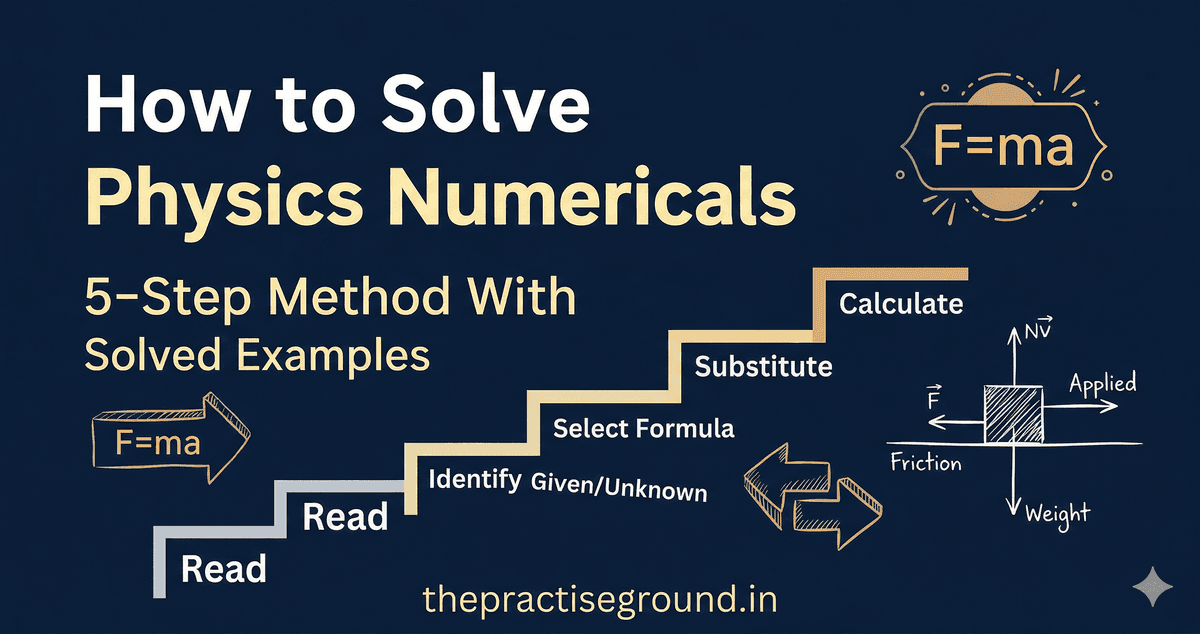
The 5-Step Method for Solving Physics Numericals
Every numerical can be solved using this framework:
Step 1: Read Carefully and Write Given Information
Don't rush. Read the problem twice.
What to extract:- The physical quantity being asked for
- All given values
- The situation described (is the object moving, accelerating, stationary?)
Note: Half the battle is won when you've correctly identified what's given and what's being asked.
Step 2: Identify the Concept and Choose the Right Formula
This is where most students struggle. With many formulas available, how do you know which one to use?
Ask yourself these questions:
The relevant equation of motion is: INLINECODE0
Why this formula? Because it connects all four variables we care about.
Step 3: Perform Unit Conversion
This step prevents silly mistakes. Ensure all quantities are in the same unit system (preferably SI units).
Common conversions:All units are consistent. Proceed to step 4.
Step 4: Substitute and Calculate
Write out the formula with the values substituted. This makes it easy to spot errors and shows your work to examiners (important for CBSE).
For our example: INLINECODE1 INLINECODE2 INLINECODE3 INLINECODE4 INLINECODE5 INLINECODE6Step 5: Check Your Answer
Does your answer make physical sense?
For acceleration, 12 m/s² is reasonable (similar to gravity's acceleration). The units are correct (m/s²). The magnitude isn't absurdly large or small.
If the answer seems wrong, revisit steps 1-4 to find the error.
Solved Examples: Motion, Electricity, and Light
Example 1: Motion (Kinematics)
Problem: A bus traveling at 15 m/s brakes with uniform deceleration. It comes to rest after 5 seconds. Find the deceleration and distance traveled. Step 1 - Given Information:For acceleration: INLINECODE7 INLINECODE8 INLINECODE9
(Negative indicates deceleration)
For distance: INLINECODE10 INLINECODE11 INLINECODE12 INLINECODE13
Step 5 - Check: The bus decelerates at 3 m/s² and stops after traveling 37.5 m. Physically sensible. ✓Example 2: Electricity (Ohm's Law)
Problem: A resistor of 10 Ω is connected to a 5V battery. Calculate the current flowing through it and the power dissipated. Step 1 - Given Information:For current: INLINECODE14 → INLINECODE15 INLINECODE16
For power: INLINECODE17 INLINECODE18
(Alternative: INLINECODE19)
Step 5 - Check: Current and power values are reasonable for a 5V circuit. ✓Example 3: Light (Lens Formula)
Problem: An object is placed 30 cm from a convex lens of focal length 10 cm. Find the image distance and magnification. Step 1 - Given Information:Lens formula: INLINECODE22 INLINECODE23 INLINECODE24 INLINECODE25 INLINECODE26
(Positive v means real image)
Magnification: INLINECODE27 INLINECODE28
Step 5 - Check: Real, inverted, diminished image. Makes sense for this object position. ✓Common Mistakes to Avoid
Mistake 1: Forgetting Sign Conventions
In optics, distances have signs:
Forgetting this gives wrong answers. Always write the signs.
Mistake 2: Unit Inconsistency
If you mix cm and meters, your answer will be wrong. Convert everything to SI units at the start.
Wrong: Distance in cm, velocity in m/s, acceleration in m/s² Right: Convert all to SI (meters, seconds, kg) before substitutingMistake 3: Wrong Formula Selection
Choosing the wrong formula wastes time and gives wrong answers. Always identify the concept first (acceleration, force, energy, etc.) and then select the appropriate formula.
Keep a formula sheet organized by topic, not alphabetically.
Mistake 4: Calculation Errors
Use a calculator for complex arithmetic. Double-check multiplication and division.
Tip: Recalculate using a different method if possible. For example, calculate power as both P = VI and P = I²R to verify.Mistake 5: Not Showing Work
CBSE awards partial marks for correct methodology even if the final answer is wrong. Always write:
Dimensional Analysis: A Quick Validation Tool
Dimensional analysis checks if your formula is dimensionally correct.
Example: Is INLINECODE29 correct?If dimensions don't match, your formula is wrong.
Physics Formula Quick-Reference by Topic
Motion (Kinematics)
Forces and Newton's Laws
Electricity
Heat and Thermodynamics
Light and Optics
Building Your Numericals Practice Schedule
Week 1: Learn the 5-step method with 3-4 easy numericals Week 2: Practice medium-difficulty problems from your textbook Week 3: Attempt harder numericals; identify weak topics Week 4: Solve previous year board exam numericals Week 5 onwards: Revise weak areas and practice timed numericalsUse The Practise Ground physics quizzes to test your understanding of concepts before attempting numericals—strong conceptual knowledge makes formula selection easier.
FAQs
Which topics have the most numericals in CBSE Class 10?
Motion, force, electricity, and light. These four topics account for about 70% of numerical questions. Practice these intensively.
How should I manage time during the exam?
Numericals typically take 2-3 minutes each. Read quickly, identify the formula, and calculate. If stuck, move on and return later.
Can I use approximations during calculations?
Be careful. Small approximations are fine (9.8 ≈ 10 m/s² for gravity), but major approximations change your answer significantly. Stick to the values given unless instructed otherwise.
What if I get the formula wrong but my calculation is correct?
CBSE gives partial marks. If your methodology is clear and calculations correct, you'll receive marks even if the final answer is wrong.
How do I avoid calculation mistakes?
Write each step clearly. Use a calculator. Double-check your arithmetic. Practice mental math for simple calculations to build speed and accuracy.
Wrapping Up
Physics numericals aren't about memorizing formulas—they're about understanding when and how to apply them. The 5-step method transforms numericals from scary unknowns into solvable problems.
Start with one topic (motion) and master it completely before moving to the next. With consistent practice, you'll develop the intuition to identify the right approach instantly. That's when numericals stop being a weakness and become your highest-scoring section.
Your next step? Grab a previous year CBSE paper and solve 5-10 numericals using this method. You'll be surprised at how quickly your confidence grows.
Taking a quick break? Test yourself!
Pause and try a quick Grade 8 Physics quiz — see how much you've picked up so far.