
Want to test what you know?
Try our free Grade 5 Maths quiz — 25 questions, instant results, no sign-up.
Here's a painful truth: most students study maths inefficiently. They read the textbook, take notes, and hope it sticks. When exam day arrives, knowledge has vanished.
The problem isn't their effort—it's their strategy.
Let's explore the science behind why practice quizzes are genuinely the most effective way to learn maths, and how to use them strategically.
The Problem with Passive Reading
When you passively read a maths textbook or watch explanations:
- Your brain feels like it's learning (this feeling is called "fluency illusion")
- Information goes into short-term memory but quickly fades
- You recognize solutions but can't generate them independently
- When exams ask slightly different problems, you freeze
The Power of Active Recall
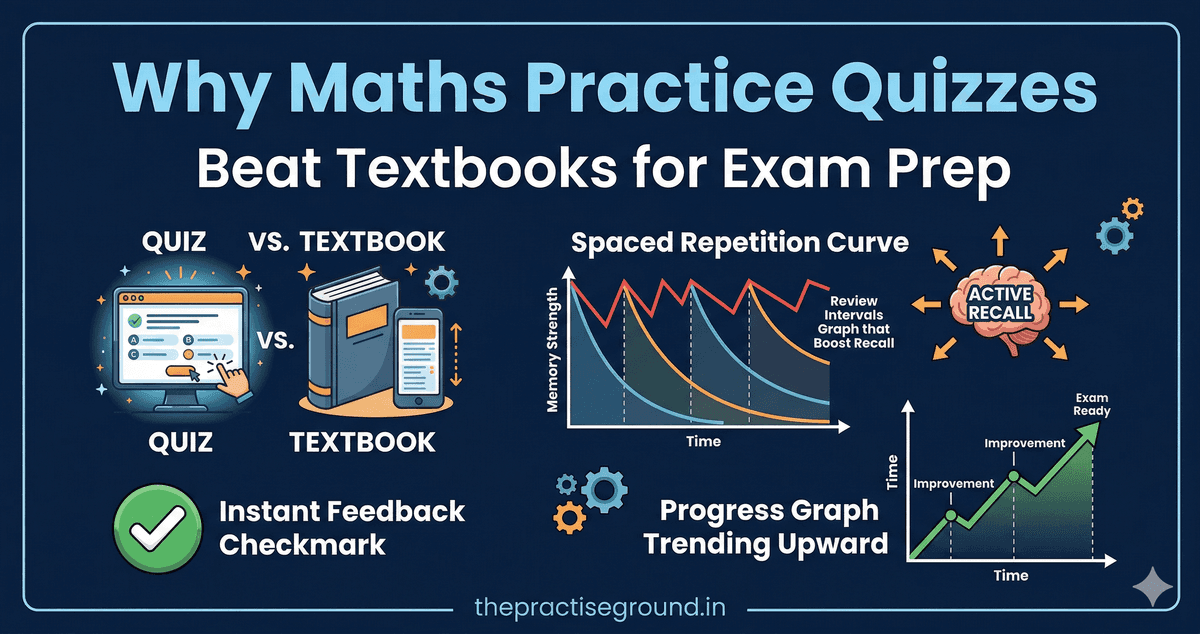
Active Recall means retrieving information from memory, rather than simply seeing it.Why It Works
When you answer a quiz question:
- Your brain retrieves the relevant concept from memory
- This retrieval strengthens the neural pathways associated with that concept
- Stronger pathways = more durable, accessible knowledge
- Over time, retrieval becomes automatic
Spaced Repetition: The Timing Secret
Spaced Repetition means revisiting material at increasing intervals, right when you're about to forget it.The Forgetting Curve
Hermann Ebbinghaus discovered that we forget information predictably:
BUT: Each time you recall information, the forgetting curve flattens. Information is remembered longer.
Optimal Spacing Schedule
For durable learning, revisit material:
How Practice Quizzes Transform Learning
1. Immediate Feedback
Unlike textbooks, quizzes tell you instantly:
This feedback directs your study effort efficiently.
2. Exposure to Variations
A textbook shows one example. Good practice quizzes show problems from different angles:
This helps you recognize patterns, not just memorize solutions.
3. Confidence Building
Each quiz you succeed at builds confidence:
4. Exam Simulation
Practice quizzes familiarize you with:
When exam day arrives, the format isn't shocking. You've practiced repeatedly.
5. Identifying Knowledge Gaps
Quizzes reveal exactly what you don't know:
The Research Evidence
Study 1: Roediger & Karpicke (2006)
Students who took practice tests retained 80% of information. Students who restudied retained only 35%.Study 2: Dunlosky et al. (2013)
Ranking learning strategies by effectiveness:Passive strategies (highlighting, rereading) ranked lowest. Active quiz-based learning ranked highest.
Study 3: Karpicke & Roediger (2008)
Students who took quizzes forgot only 10-25% over a week. Students who restudied forgot 50-80% over the same week.Strategic Use of Practice Quizzes
Phase 1: Learning (Immediate Quizzes)
After learning a new concept:Phase 2: Strengthening (Daily Quizzes)
In the days following learning:Phase 3: Maintenance (Weekly Quizzes)
Once you feel confident:How The Practise Ground Leverages This Science
Our platform is designed around these research findings:
Spaced Repetition Algorithm: Our system tracks your progress and suggests quizzes at optimal timing intervals. Variation in Problems: Each quiz includes similar problems with different numbers, contexts, and formats. Difficulty Progression: Quizzes start easy, gradually increasing difficulty as you master concepts. Immediate Feedback: Every answer includes detailed explanations showing you exactly why it's correct or incorrect. Targeted Practice: Weak areas are identified and repeatedly practiced at appropriate intervals.Building Your Quiz Strategy
For Exam Preparation (1-2 months away)
For Long-term Mastery
For Different Curricula
CBSE: Our quizzes align with NCERT patterns. Start quizzing immediately after textbook chapters. ICSE: Our quizzes match ICSE exam formats. Use them for weekly assessment and final exam prep. Cambridge IGCSE: Extended topics need extended practice windows. Quiz consistently across the 2-year course. IB: Conceptual understanding is crucial. Quizzes help cement abstract concepts.Overcoming Common Misconceptions
"I'll just study harder the night before the exam"Your Path Forward
Start using practice quizzes strategically:
Track your progress. Celebrate improvements. Trust the science.
FAQ
How often should I take quizzes on the same topic?
Immediately after learning, then 1 day later, 3 days later, 1 week later, and 2 weeks later. After that, monthly maintenance is sufficient.
Is quiz performance a reliable indicator of exam readiness?
Yes. Quiz difficulty should match exam difficulty. If you consistently score 85%+ on quizzes, you're ready for exams.
Can I overdo quiz practice?
It's hard to. Overconfidence from quizzes is unlikely if you're honest about mistakes. Continuous quiz practice prevents forgetting.
Should I read solutions after quizzes?
Absolutely. Reading solutions after attempting problems activates learning even more effectively than just taking the quiz.
Aligned with CBSE, ICSE, Cambridge, and IB Standards
Whether your curriculum is CBSE, ICSE, Cambridge IGCSE, or IB, our quiz platform follows the same science-backed principles:
CBSE Focus: Our quizzes mirror NCERT patterns and CBSE exam formats, helping students specifically excel in board examinations. ICSE Emphasis: We emphasize problem-solving and applications valued in ICSE assessments, with questions that develop deeper conceptual understanding. Cambridge IGCSE: Extended topics receive extended practice windows, ensuring international students master concepts required for IGCSE examinations. IB Curriculum: Our quizzes develop the mathematical reasoning and conceptual rigor needed for IB programmes worldwide.Taking a quick break? Test yourself!
Pause and try a quick Grade 5 Maths quiz — see how much you've picked up so far.