
Want to test what you know?
Try our free Grade 5 Maths quiz — 25 questions, instant results, no sign-up.
Every student makes maths mistakes. But the difference between strong and weak performers is simple: strong students identify their mistakes and prevent repetition.
Let's examine the 10 most common mistakes and concrete strategies to avoid them.
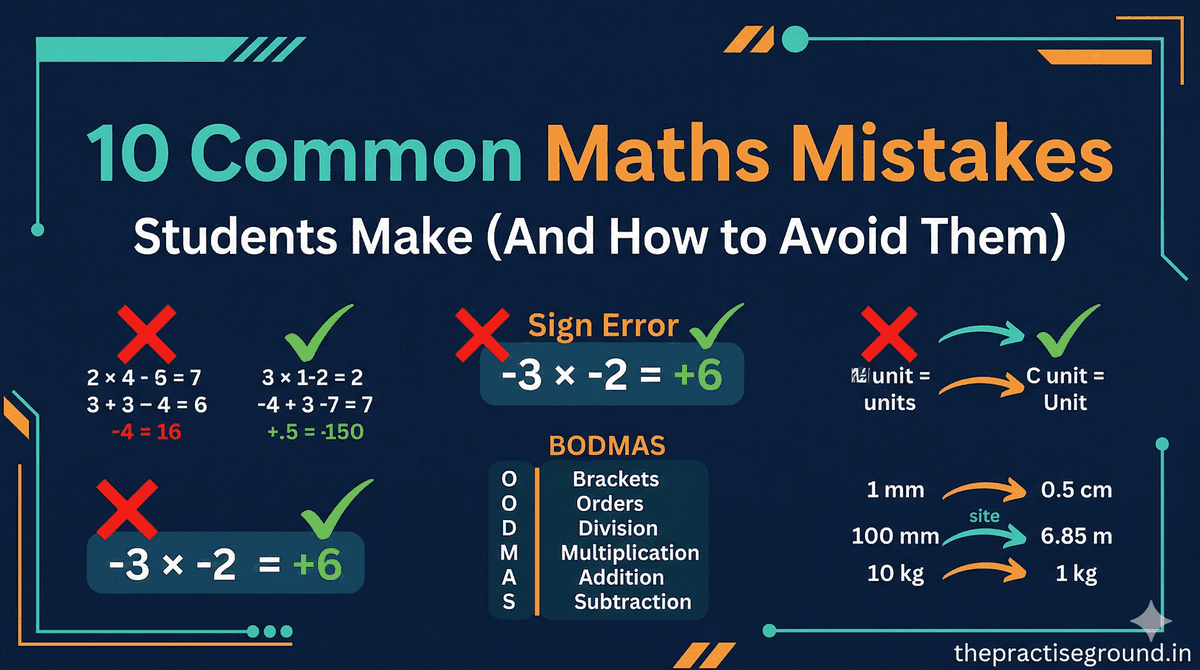
Mistake 1: Sign Errors
The Problem
Working with negative numbers leads to sign confusion:- -5 - 3 = -2 (WRONG! It's -8)
- -4 × -3 = -12 (WRONG! It's +12)
- 2 - (-5) = -3 (WRONG! It's +7)
Why It Happens
Sign rules aren't always taught with clear understanding. Students "memorize" rules without intuitive understanding.How to Avoid It
For addition and subtraction with negatives: Think of a number line. Start at the first number, then move.Mistake 2: Order of Operations (BODMAS/PEMDAS)
The Problem
2 + 3 × 4 = 14 (WRONG! It's 14, but students calculate 5 × 4 = 20) 10 - 2 × 3 = 24 (WRONG! It's 4)How to Avoid It
BODMAS/PEMDAS (Brackets, Orders, Division/Multiplication, Addition/Subtraction): Steps:- Simplify inside Brackets first
- Calculate Orders (powers, roots)
- Division and Multiplication (left to right, same priority)
- Addition and Subtraction (left to right, same priority)
Mistake 3: Fraction Errors
The Problem
1/2 + 1/3 = 2/5 (WRONG! It's 5/6) (1/2) / (1/3) = 1/6 (WRONG! It's 3/2)How to Avoid It
Addition/Subtraction: Find common denominatorMistake 4: Distributing Incorrectly
The Problem
2(3 + 4) = 6 + 4 = 10 (WRONG! It's 14) 3(x - 2) = 3x - 2 (WRONG! It's 3x - 6) -(a + b) = -a + b (WRONG! It's -a - b)How to Avoid It
Distributive Property: a(b + c) = ab + acYou must multiply EVERY term inside the brackets.
Example 1: 2(3 + 4) = 2(3) + 2(4) = 6 + 8 = 14 ✓ Example 2: 3(x - 2) = 3(x) + 3(-2) = 3x - 6 ✓ Example 3: -(a + b) = -1(a + b) = -1(a) + -1(b) = -a - b ✓ Strategy: Use different colors for each distribution. Visually separate which term is being multiplied.Mistake 5: Unit Conversion Errors
The Problem
2 km = 2 m (WRONG! It's 2,000 m) 5 hours = 5 minutes (WRONG! It's 300 minutes) 100 cm² = 1 m² (WRONG! It's 0.01 m²)Why It's Tricky
Units for area and volume convert differently than linear units:How to Avoid It
Linear conversions (length, distance, time):Mistake 6: Rounding Errors
The Problem
3.67 rounded to 1 decimal place = 3.6 (WRONG! It's 3.7) 0.0456 rounded to 1 significant figure = 0.04 (WRONG! It's 0.05)How to Avoid It
Rounding rule: Look at the digit you're rounding to, then look at the NEXT digit.Mistake 7: Algebra Errors - Moving Terms
The Problem
x + 5 = 12, solved as x = 12 + 5 = 17 (WRONG! It's 7) 3x = 15, solved as x = 15 - 3 = 12 (WRONG! It's 5)How to Avoid It
Golden Rule: Whatever operation moved the term to the other side, that's the OPPOSITE operation. Term moved (+5 to the right): Subtract 5 from both sidesMistake 8: Exponent Errors
The Problem
2³ × 2² = 2⁶ (WRONG! It's 2⁵) (2³)² = 2⁵ (WRONG! It's 2⁶) 2³ + 2² = 2⁵ (WRONG! It's 12)How to Avoid It
Rules:Mistake 9: Percentage Errors
The Problem
"25% of 80 is 105" (WRONG! It's 20) "80 increased by 25% is 80 + 25 = 105" (WRONG! It's 100)How to Avoid It
Percentage of a number: 25% of 80 = (25/100) × 80 = 0.25 × 80 = 20 ✓ Percentage increase: 80 increased by 25% = 80 + (25% of 80) = 80 + 20 = 100 ✓ (NOT: 80 + 25) Percentage decrease: 80 decreased by 25% = 80 - (25% of 80) = 80 - 20 = 60 ✓ Strategy: Always calculate the percentage amount first, then add or subtract from the original number.Mistake 10: Misreading the Question
The Problem
Question: "What is the remainder when 47 is divided by 5?" Student answers: "9" (which is the quotient) Correct answer: "2" (the remainder)How to Avoid It
Quick Reference Checklist
Before submitting an exam, verify:
Practice on The Practise Ground
Our quizzes highlight common errors with detailed feedback:
Every mistake is a learning opportunity!
FAQ
How can I ensure I don't repeat mistakes?
Keep a "mistake journal." Write each mistake, why you made it, and the correct method. Review monthly. This prevents pattern errors.
Which mistake is most common among competitive exam takers?
Sign errors and order-of-operations mistakes. These cost millions of marks annually!
How much time should I spend checking my work?
In exams, allocate 10-15% of time to checking. A quick review catches half of all mistakes.
Are these mistakes relevant across CBSE, ICSE, and Cambridge?
Yes! These are universal mathematical principles. Sign errors, unit mistakes, and BODMAS errors occur across all curricula.
Taking a quick break? Test yourself!
Pause and try a quick Grade 5 Maths quiz — see how much you've picked up so far.