Exam season brings anxiety. But here's the good news: anxiety decreases dramatically when you're well-prepared.
The question isn't "how do I reduce test anxiety?" It's "how do I prepare so thoroughly that I don't doubt myself?"
Let's explore evidence-based strategies that work across CBSE, ICSE, Cambridge, IB, and competitive exams.
The Exam Preparation Timeline
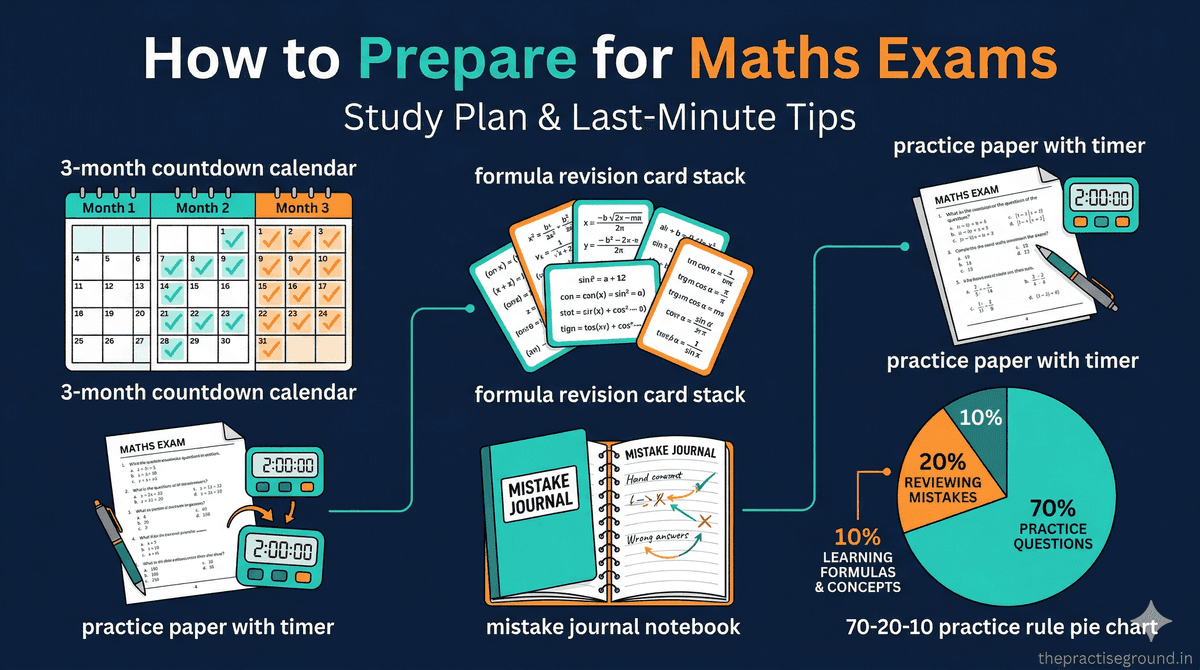
3 Months Before Exam: Foundation Phase
Goal: Learn all content thoroughly
Weekly routine:
- Attend classes (or watch explanations) for new concepts
- Take notes using the Cornell note-taking method:
- Divide page: left 1/3 for questions, right 2/3 for notes
- After class, write questions in left column addressing your notes
Solve 10-15 problems on each concept immediately (active recall!)
Revise previous week's concepts for 30 minutes daily
Common mistake: "I'll learn everything now and revise later."
This doesn't work. Learning and revision are parallel processes.
2 Months Before Exam: Deepening Phase
Goal: Build mastery and identify weak areas
Weekly routine:
Take 1-2 diagnostic quizzes on topics learned that week
Spend 40% of study time on weak areas, 20% on strong areas
Attempt mixed-topic problem sets (jumbled, not organized by chapter)
Solve previous year exam questions if available
Join study groups to explain concepts to others (teaching is learning!)
Why mixed-topic problems: They simulate real exam conditions where problems aren't organized by chapter.
1 Month Before Exam: Intensive Phase
Goal: Build speed and accuracy
Weekly routine:
Solve 2-3 full-length practice exams under timed conditions
Review every mistake thoroughly (this is critical!)
For each mistake, determine:
- Conceptual error? (you misunderstood something)
- Calculation error? (arithmetic mistakes)
- Strategy error? (chose wrong method)
- Careless error? (knew the concept but rushed)
Spend extra time on error patterns, not random topics
Timed conditions matter: This trains you for exam day pacing and pressure.
Final 2 Weeks: Polish Phase
Goal: Consolidate knowledge and build confidence
Weekly routine:
Solve 1-2 practice exams
Quick daily reviews of weak topics (15 minutes, not 2 hours)
Maintain confidence through achievable goals
Sleep well, exercise, eat properly (this is preparation too!)
Review exam structure, marking scheme, question formats
What NOT to do: Don't suddenly learn new topics. This creates panic.
Time Management During Exam Prep
The Effective Study Schedule
Formula: Quality > Quantity
2 hours of focused study beats 6 hours of distracted studying.
Daily Study Schedule (for Grade 8-10)
CODEBLOCK0
Pomodoro Technique
Many students benefit from:
25 minutes focused work
5 minutes break
After 4 cycles: 15-minute break
Find what works for you, but maintain consistency.
Revision Techniques (Science-Backed)
Technique 1: Spaced Repetition
Principle: Revise material at optimal intervals.
Schedule:
First revision: 1 day after learning
Second revision: 3 days later
Third revision: 1 week later
Fourth revision: 2 weeks later
Monthly thereafter
This prevents the "forget-relearn" cycle.
Technique 2: Interleaving
Principle: Mix different types of problems, not separated by chapter.
Wrong: Learn chapter 1 → Do all chapter 1 problems → Learn chapter 2 → Do all chapter 2 problems
Right: Mix chapter 1 and 2 problems randomly, forcing your brain to:
Identify which concept applies
Choose the appropriate method
Execute the solution
This matches real exam conditions!
Technique 3: Self-Testing
Principle: Frequent testing reveals gaps immediately.
Take quizzes weekly
Attempt previous year papers
Solve mock exams
Self-quiz using flashcards of formulas
Each test is a learning opportunity, not just an assessment.
Technique 4: Elaboration
Principle: Explain concepts in your own words.
After learning, teach it to an imaginary student
Write a brief summary (2-3 lines) of each concept
Create visual mind maps
Record yourself explaining concepts and listen
Teaching forces deep understanding.
Technique 5: Concrete Examples
Principle: Abstract concepts need concrete grounding.
Don't just learn "quadratic equations." Learn:
Why they appear (projectile motion, areas)
When to use them (vs. linear equations)
Multiple solution methods
Real examples from physics, geometry, economics
Exam Day Strategies
Before the Exam (Night Before)
Review formulae once (don't learn new content!)
Prepare your exam materials: pens, pencils, erasers, calculator, compass
Eat a proper dinner (not heavy, not light)
Sleep 7-8 hours (this is crucial!)
Avoid studying 2-3 hours before bed
Morning of the Exam
Wake up early with light exercise (boosts confidence)
Eat a proper breakfast (glucose powers the brain)
Don't study new content
Arrive 15 minutes early (reduces anxiety)
Do calming breathing: 4 seconds in, 4 seconds out
During the Exam: Time Allocation
If you have 3 hours and 75 marks:
- 5 minutes (4%): Read all questions carefully
- Circle key words
- Note mark allocations
- Identify difficult questions
2 hours 20 minutes (77%): Solve problems
- Start with easier problems (build confidence)
- Leave very difficult problems for later
- Allocate time per mark: typically 1 min per mark
25 minutes (14%): Review and check
- Verify calculations
- Ensure all questions attempted
- Check for silly errors
Question Selection Strategy
Start easy, end hard:
Solve all 1-mark questions (confidence boost)
Solve all 2-3 mark questions you're confident about
Attempt longer questions
Return to difficult problems if time remains
This strategy prevents getting stuck on one problem and losing time.
Handling Panic During Exam
If you forget a formula or concept mid-exam:
Don't panic. Panic wastes time and cognition.
Skip it. Move to the next question.
Return later. Your relaxed brain may recall it.
Derive it. Sometimes you can derive what you forgot.
Partial credit. Show your work for partial marks.
Checking Your Work (Critical!)
Don't just re-read. Actively verify:
For each problem:
✓ Did I understand the question?
✓ Did I identify all given information?
✓ Did I apply the correct concept?
✓ Is my calculation correct? (spot-check multiplications, divisions)
✓ Have I stated the final answer clearly?
✓ Does the answer make logical sense?
Exam Anxiety Management
Understanding Test Anxiety
A little anxiety is helpful (motivates you). Excessive anxiety impairs performance.
Strategies to Manage Anxiety
1. Preparation: The best anxiety cure is thorough preparation. Period.
2. Breathing exercises: When anxious, practice:
Slow breathing: 4 seconds in, 6 seconds out
This activates your parasympathetic nervous system (calming)
3. Positive self-talk:
"I'm prepared."
"I can solve this."
"If I'm stuck, I'll skip and return."
Avoid: "What if I fail?" or "This is too hard."
4. Visualization: Before the exam, visualize yourself:
Calmly reading questions
Solving problems with confidence
Checking your work
Leaving the exam satisfied
5. Exercise: Physical activity reduces anxiety dramatically.
Exercise 30-60 minutes 3x per week
Even 10 minutes on exam day helps
Curriculum-Specific Prep
For CBSE Exams
Align with NCERT content rigorously
Previous year CBSE papers are excellent resources
Board exams reward showing steps clearly
Allocate more time to descriptive answers
For ICSE Exams
ICSE emphasizes problem-solving applications
Practice word problems extensively
Marks distribution varies; study the scheme carefully
Practical geometry often appears
For Cambridge IGCSE
Extended papers require more conceptual depth
Graphical representations are important
More open-ended problem solving
Expect less calculation-heavy, more reasoning-heavy content
For IB Exams
Conceptual rigor is paramount
Proofs and derivations matter
Context-based problems (real-world applications)
"Show all work" is non-negotiable
Recovery from Mistakes
If you've failed an exam or done poorly:
Don't blame yourself harshly. Blame the strategy, not your ability.
Analyze what went wrong:
- Insufficient preparation?
- Poor exam strategy?
- Careless errors?
- Test anxiety?
Adjust your approach:
- More practice quizzes?
- Better time management?
- More careful checking?
Try again. Learning happens through iteration.
Practice on The Practise Ground
Our comprehensive resources support exam prep:
Full-length mock exams under timed conditions
Topic-wise quizzes for focused revision
Previous year exam questions
Detailed solutions showing all steps
Curriculum-specific prep for CBSE, ICSE, Cambridge, IB
Use them strategically across your 3-month prep timeline!
FAQ
How much time before the exam should I start preparing?
2-3 months for board exams. 4-6 months for competitive exams. Earlier is better, but late prep is possible with intense focus.
Should I solve all previous year papers?
Solve the last 5-10 years. This shows question patterns and trends. But don't memorize answers—understand approaches.
How often should I take practice exams?
Weekly in the final month, bi-weekly 2 months before, monthly 3 months before. More is okay if you learn from each attempt.
Is it okay to study with friends?
Yes, occasionally. Teaching each other is powerful. But ensure focused problem-solving, not chatting. 80% solo study, 20% group study is ideal.