
Want to test what you know?
Try our free Grade 5 Maths quiz — 25 questions, instant results, no sign-up.
The biggest myth about maths? That it has to be boring.
Grade 5 is a critical age. Kids are developing foundational skills in multiplication, division, fractions, and decimals. Yet many are turned off by maths before they even reach middle school because learning felt dull, abstract, or intimidating.
What if maths could feel like play?
Why Engagement Matters in Grade 5 Maths
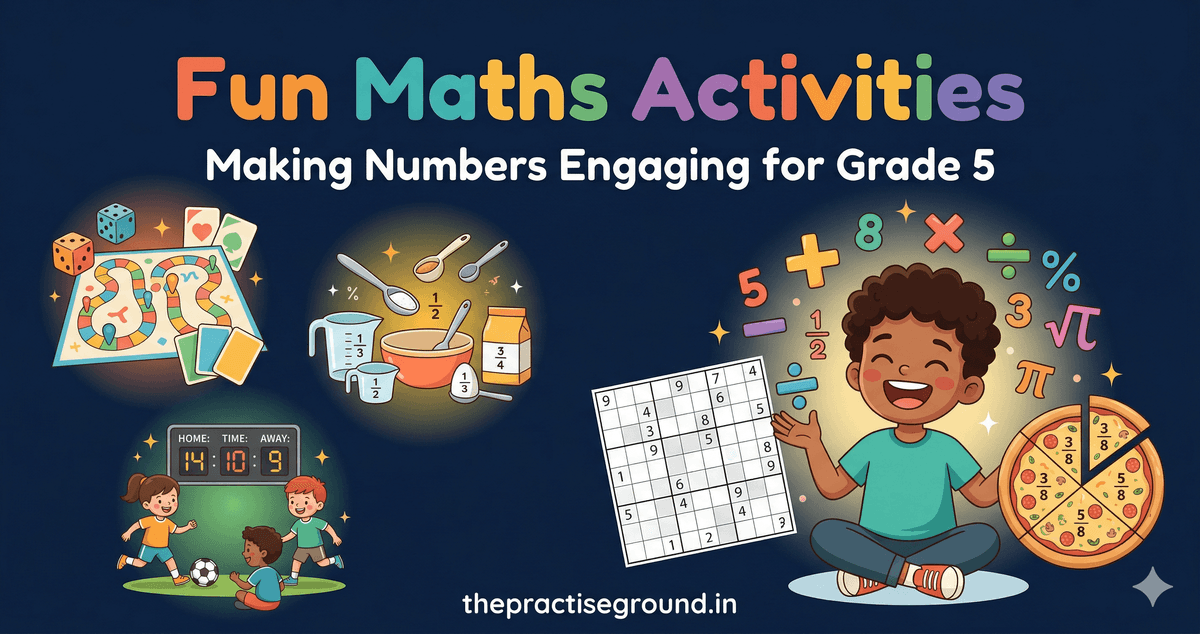
Neurologically, the brain learns better when emotionally engaged. A child solving a fun maths puzzle activates regions associated with curiosity and reward, not just logic. Psychologically, early positive experiences with maths predict future success. A Grade 5 student who thinks "maths is fun" is far more likely to pursue it in higher grades. Practically, engaged learners practice more voluntarily. Instead of forcing practice, kids naturally want to solve another puzzle or attempt another quiz.Activity 1: Maths-Based Games & Puzzles
Multiplication Games
Race to 100: Use dice or a spinner. Each player rolls and multiplies the result by a set number (e.g., by 7). First to reach 100 wins.- Why it works: Multiplication feels like a race, not memorization. Kids naturally repeat tables while having fun.
Division & Fraction Games
Fair Sharing: Give kids items (candies, blocks, cards) and ask them to divide equally among friends. "You have 24 blocks. How many does each person get if 6 friends share?"Logic & Problem-Solving Puzzles
Sudoku for Kids: Simple 4×4 or 6×6 grids (not the standard 9×9). Kids fill numbers so each row, column, and box has different numbers.Activity 2: Real-World Connections
Money & ShoppingActivity 3: Visual & Manipulative Learning
Use Concrete MaterialsActivity 4: Weekly Quiz Practice—Gamification That Works
Here's something powerful: online quiz platforms gamify learning naturally.
Instead of "Do 20 maths problems as homework," imagine "Earn points by solving maths quizzes. Improve your weekly streak."
How Quiz Platforms Engage Grade 5 Kids:Platforms like The Practise Ground offer free Grade 5 maths quizzes covering:
A 15-minute daily quiz session builds fluency without feeling like traditional homework.
Activity 5: Story-Based Problems
Create a Context Instead of "12 × 4 = ?", tell a story: "You're opening a lemonade stand. You make 12 glasses per batch. If you plan 4 batches, how many glasses total?" Role-PlayingCommon Mistakes to Avoid
Overcomplication: Not every activity needs to be elaborate. A simple dice game is enough. Forcing Fun: If something feels forced, kids sense it. Let activities be genuinely enjoyable. Ignoring Struggle: Some frustration during problem-solving is healthy. Don't remove all challenge. Comparison & Pressure: Never compare kids or make maths competitive in a way that discourages struggling students.A Weekly Schedule for Fun Maths
Monday: Game day (multiplication race, Sudoku, magic square) Tuesday: Real-world activity (cooking, shopping, sports stats) Wednesday: Hands-on materials (blocks, fractions, drawing) Thursday: Daily quiz practice on The Practise Ground (15 min) Friday: Story-based problems or role-playing Weekend: Flexible—revisit favorite activity or explore a new puzzleConclusion
Grade 5 maths can feel like drudgery or delight—the difference is engagement. Combine games, real-world connections, hands-on learning, and gamified quizzes to show kids that maths is everywhere and actually fun.
Your Grade 5 child doesn't need hours of practice. They need varied, enjoyable, and meaningful practice. Start this week. Pick one game, one real-world activity, and use The Practise Ground's free Grade 5 quizzes for 15 minutes daily. Watch your child's confidence and curiosity grow.
Maths can be genuinely fun. Let's make it so.
Frequently Asked Questions
How much daily maths practice does a Grade 5 student need?
Fifteen to twenty minutes of focused practice is enough at this age. Short, consistent sessions are far more effective than long weekend cramming. The key is variety — alternate between games, real-world activities, and quiz practice to keep it engaging.
Can games and activities really teach maths as well as textbook exercises?
Yes, and often better. Research shows that game-based learning improves conceptual understanding and retention because students are motivated and actively engaged. Textbook drills build speed, but games build understanding. The ideal approach combines both.
What should I do if my Grade 5 child says they hate maths?
Start with activities that do not feel like maths — cooking measurements, sports statistics, or board games involving numbers. Once the child experiences success and enjoyment, gradually introduce more structured practice. Never force extended study sessions, as this reinforces negative associations.
Are online maths quizzes suitable for young children?
For Grade 5 students (age 10-11), yes. Online quizzes with instant feedback are highly effective because children see results immediately and can correct mistakes in real time. Limit screen-based practice to 15-20 minutes and combine it with hands-on activities for the best results.
Taking a quick break? Test yourself!
Pause and try a quick Grade 5 Maths quiz — see how much you've picked up so far.