Want to test what you know?
Try our free Grade 8 English quiz — 25 questions, instant results, no sign-up.
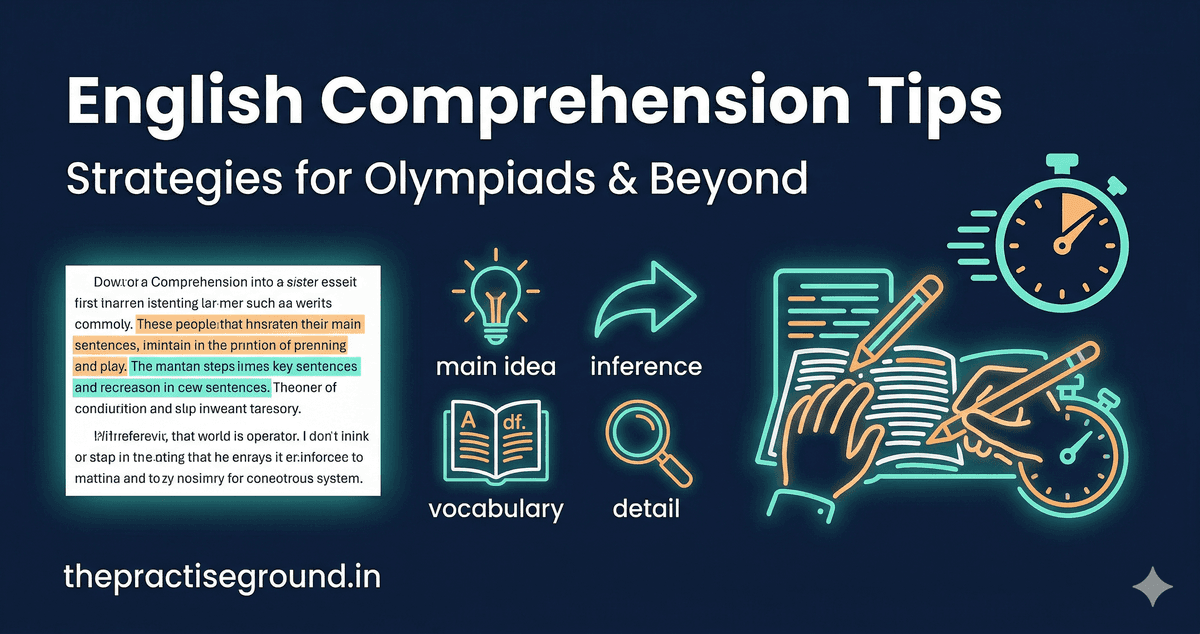
Reading comprehension is often the most feared section in competitive exams—from English Olympiads to scholarship entrance tests.
Why? Because comprehension isn't just about reading. It's about understanding, analyzing, inferring, and synthesizing information under time pressure. Many brilliant students struggle because they read passively instead of actively.
This guide breaks down proven strategies to transform your comprehension game.
Understanding What Competitive Exams Test
Competitive exams aren't asking "Did you read the passage?" They're asking:
- Can you identify main ideas vs. supporting details?
- Can you infer meaning from context?
- Can you analyze the author's tone and purpose?
- Can you distinguish between explicitly stated information and implied meaning?
- Can you apply information from the passage to new situations?
Question Types & Strategies
1. Explicit/Direct Questions
"According to the passage, what did X do?"These ask for information directly stated in the text.
Strategy:2. Inference Questions
"What can we infer about the character's motivation?"These require you to read between the lines.
Strategy:3. Vocabulary/Meaning Questions
"What does the word 'euphoria' mean in this context?"Context matters. The same word can mean different things in different passages.
Strategy:4. Main Idea Questions
"What is the primary purpose of this passage?"These ask for the overall theme or central message.
Strategy:5. Tone/Attitude Questions
"The author's tone toward the subject is best described as..."These test your ability to sense the writer's attitude.
Strategy:The Active Reading Method
Passive reading = skimming without thinking. It leads to forgetting details and misunderstanding main ideas.
Active reading = engaging with the text.Step 1: Preview (30 seconds)
Before reading deeply:Step 2: Read with Purpose (2-3 minutes for a typical passage)
Step 3: Pause & Paraphrase
After each paragraph, pause. Ask: "What did that paragraph say in my own words?" This forces comprehension.Step 4: Answer Questions Strategically (2-3 minutes)
Critical Strategies for Competitive Exams
Strategy 1: Master Vocabulary in Context
You won't know every word. But you can figure out meanings. Clue Types:Strategy 2: Identify Author's Purpose
Authors write for reasons:Identifying purpose helps you answer tone and main idea questions faster.
Strategy 3: Distinguish Fact vs. Opinion
Facts: Objective, verifiable statements ("The Nile is the longest river in Africa") Opinions: Subjective judgments ("The Nile is the most beautiful river")Competitive exams often ask: "Which statement is an opinion? Which is fact?" Master this distinction.
Strategy 4: Track Characters/Ideas Across Paragraphs
In longer passages, ideas or characters often reappear. Create a mental map:This helps you track complex passages and answer "How does the author develop idea X?" questions.
Strategy 5: Time Management in Exams
If you have 20 minutes for 3 passages and 12 questions:Practice Approach for Mastery
Week 1-2: Build SkillsPractice Resources
Free competitive exam comprehension passages are available through:
Aim for 15-20 minutes daily of active comprehension practice.
Common Mistakes to Avoid
1. Reading the Questions First Some suggest reading questions before the passage. This can work, but it often leads to tunnel vision—you only read for those specific questions and miss the overall context. 2. Over-Inferencing Not everything requires inference. Distinguish between "What does the text say?" and "What might this imply?" 3. Using Outside Knowledge Answer based on the passage, not general knowledge. Even if you know something differently in real life, the exam wants passage-based answers. 4. Ignoring Transition Words Words like "However," "Therefore," "In contrast," "Furthermore" signal the passage structure. They help you understand relationships between ideas. 5. Choosing Attractive Wrong Answers Tricky options might be true in general but wrong in context. Always verify against the passage.Conclusion
English comprehension in competitive exams is a skill, not a talent. You can dramatically improve with active reading, strategic question analysis, and consistent practice.
Start today. Use The Practise Ground's free English comprehension quizzes (aligned with olympiad and competitive exam patterns) to practice 15-20 minutes daily. Read actively, analyze question types, and learn from mistakes. Over 4-8 weeks, watch your accuracy and speed improve together.
Your competitive exam success starts with reading mastery. Let's get there.
Frequently Asked Questions
Should I read the passage first or the questions first in a comprehension exam?
Read the passage first — quickly but actively. Skim for structure, main idea, and tone. Then read the questions and go back to the passage for specific answers. Reading questions first often causes tunnel vision and wastes time on re-reading.
How can I improve my reading speed without losing comprehension?
Practice timed reading daily. Start with easy material and gradually increase difficulty. Avoid subvocalisation (silently mouthing words) and train your eyes to move in chunks rather than word by word. Speed improves naturally with volume — read more, read often.
What types of questions are hardest in competitive exam comprehensions?
Inference questions — where the answer is implied but not directly stated — are the trickiest. They require reading between the lines and understanding the author's tone. Practice these specifically by asking "What does the author suggest?" after each paragraph you read.
How much daily practice is needed to see improvement in comprehension?
Fifteen to twenty minutes of active comprehension practice daily produces measurable results within 4-6 weeks. Active means reading with a pencil, annotating key points, and attempting questions — not just passive reading.
Taking a quick break? Test yourself!
Pause and try a quick Grade 8 English quiz — see how much you've picked up so far.