
Want to test what you know?
Try our free Grade 7 Maths quiz — 25 questions, instant results, no sign-up.
Algebra is where many students hit a wall.
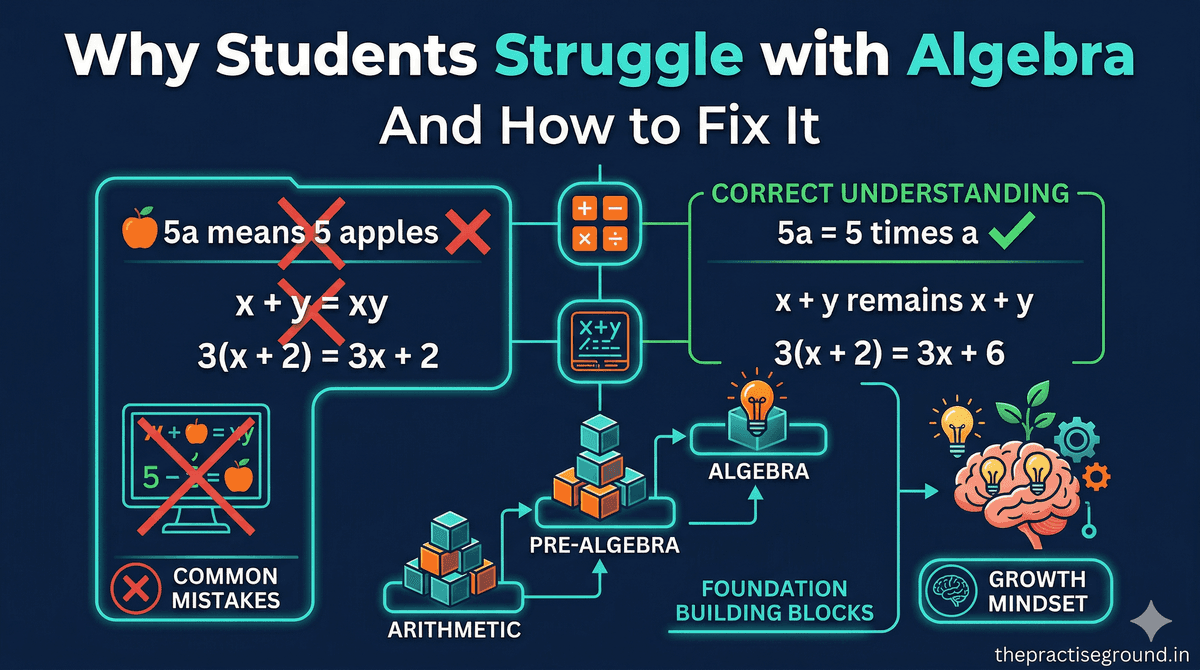
In Grades 7-10, arithmetic (basic calculations with numbers) suddenly becomes algebra (calculations with letters and variables). This shift confuses students who've been successful with concrete numbers for years. Letters feel abstract. Rules feel arbitrary. Everything becomes harder.
Yet algebra isn't harder—it's just different. And once you understand the core concepts, it becomes logical and even enjoyable.
The Root Causes of Algebra Struggles
1. Fundamental Misunderstanding of Variables
The Problem: Students think variables are mysterious unknowns instead of placeholders for numbers. Wrong Mindset: "x is some secret number I need to find. How do I know what it is?" Correct Mindset: "x is just a number I don't know yet. If I figure out that x = 5, I can verify by plugging it back in." Fix: Practice thinking of variables as numbers.- "If x = 7, what is 2x + 3?"
- "If y = 4, what is 3y - 5?"
2. Confusing Expressions and Equations
The Problem: Students treat expressions and equations the same way. Expression: A mathematical phrase without an equals sign (e.g., 2x + 3)3. Misapplying Order of Operations (BODMAS/PEMDAS)
The Problem: Students apply order of operations inconsistently, especially with negative numbers and distribution. Example Error: Solving 3(x + 2) = 154. Weak Understanding of Inverse Operations
The Problem: Students memorize steps instead of understanding why they work. Why Inverse Operations Matter:5. Sign Errors and Negative Numbers
The Problem: Working with negative numbers is confusing. Common Errors:6. Ignoring Verification
The Problem: Students solve an equation but never check if their answer is correct. Fix: After solving, always plug the answer back in.If verification fails, you caught an error. This is powerful.
The Step-by-Step Path to Algebra Mastery
Phase 1: Concrete to Abstract (Weeks 1-2)
Goal: Build comfort with variables.Phase 2: Simplification & Combining Like Terms (Weeks 3-4)
Goal: Manipulate algebraic expressions without solving.Phase 3: One-Step Equations (Weeks 5-6)
Goal: Solve equations using one inverse operation.Phase 4: Two-Step Equations (Weeks 7-8)
Goal: Combine multiple operations.Phase 5: Multi-Step Equations (Weeks 9-10)
Goal: Handle complex equations.Phase 6: Word Problems & Applications (Weeks 11-12)
Goal: Convert real-world scenarios into equations. Example: "Rahul is 5 years older than Priya. Together, they're 25 years old. How old is each?"The Importance of Deliberate Practice
Passive Reading ≠ Learning algebra. You must practice problems. Effective Practice Pattern:- Attempt a problem (even if you're unsure)
- Check your answer
- If wrong, understand the error (don't just move on)
- Solve a similar problem to verify you've learned
- Repeat the next day to reinforce
Using Online Quizzes for Algebra Mastery
Online platforms like The Practise Ground offer free algebra quizzes with:
A 20-minute daily quiz session on one algebra topic, combined with conceptual understanding, accelerates mastery dramatically.
Sample Week:Mindset Shifts That Help
From: "Algebra is just memorizing rules" To: "Algebra is logical. Every step has a reason." From: "I'm not a maths person" To: "Algebra is a skill I can develop with practice" From: "One wrong answer means I don't get it" To: "Mistakes are where I learn. Let me understand why"Students who adopt these mindsets improve faster. Growth mindset matters as much as method.
Red Flags & When to Get Help
You might be struggling with earlier foundations if:Conclusion
Algebra isn't harder than arithmetic—it's just a different language for expressing mathematical relationships. The struggle most students face isn't due to inability; it's due to weak foundations or misconceptions that compound.
Fix these foundations. Practice consistently. Use online quizzes daily. And—crucially—understand the why behind each step, not just the how.
Start with The Practise Ground's free Grade 7-10 algebra quizzes. Pick one topic, practice for 20 minutes daily, and track your progress. Within 12 weeks of deliberate practice, you'll move from confusion to genuine mastery.
Algebra awaits. You're ready.
Frequently Asked Questions
At what age or grade should students start learning algebra?
Algebraic thinking begins informally in Grade 4-5 with patterns and missing number problems. Formal algebra with variables and equations typically starts in Grade 6-7. If your child struggles, the issue is usually arithmetic foundations rather than readiness for algebra.
What is the most common mistake students make in algebra?
Treating variables as labels instead of numbers. Students write "5a" thinking it means "5 apples" rather than "5 times a." This single misconception causes cascading errors in simplification, equation solving, and factoring.
How long does it take to get comfortable with algebra?
With 20 minutes of focused daily practice, most students see significant improvement within 6-8 weeks. The key is consistent practice on one concept at a time rather than jumping between topics.
My child understands algebra in class but fails in exams. Why?
This usually indicates surface-level understanding without deep practice. Exam questions require applying concepts in unfamiliar contexts. The fix is solving varied problems — not just textbook exercises — and practicing under timed conditions.
Taking a quick break? Test yourself!
Pause and try a quick Grade 7 Maths quiz — see how much you've picked up so far.