
Want to test what you know?
Try our free Grade 8 Biology quiz — 25 questions, instant results, no sign-up.
How to Study Biology Effectively: Tips for Grades 8-10
Biology is one of the most fascinating subjects in your curriculum, but let's be honest—it can also feel overwhelming with all those diagrams, processes, and definitions to memorize. The good news? You don't need to memorize everything. With the right study strategies, you can actually understand and enjoy biology while scoring excellently in your exams.
In this guide, we'll share proven techniques that help students transition from mindless memorization to meaningful learning. Whether you're preparing for your CBSE board exams or building a strong foundation for higher studies, these tips will transform how you approach biology.
The Problem with Rote Learning in Biology
Many students fall into the trap of reading their biology textbook like a novel, hoping facts will stick. They highlight entire pages, make long lists of definitions, and wonder why they forget everything during exams.
The issue? Biology is about understanding processes and relationships, not just facts. Your body isn't just a collection of parts—it's an interconnected system. When you understand how digestion connects to respiration, or how mitosis ensures cell division properly, facts become sticky and memorable.
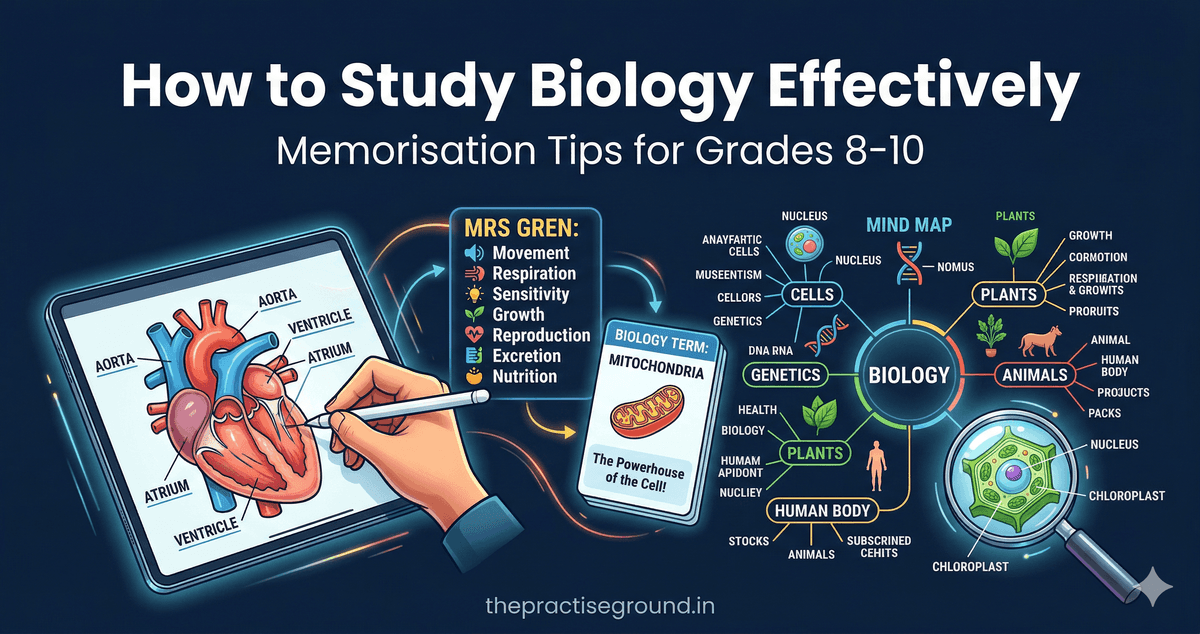
Strategy 1: Master the Art of Diagram Drawing
Biology is highly visual. From the human digestive system to plant cells and ecosystems, diagrams are everywhere. Here's how to truly master them:
The "Draw and Label" Practice Strategy
Instead of passively looking at diagrams in your textbook, follow this approach:
- Close your book and draw from memory - Attempt to redraw a diagram (like the human heart or flower structure) without looking at your textbook
- Check and correct - Open your book and see what you missed
- Add labels and annotations - Label each part with its function
- Repeat weekly - The spaced repetition technique makes diagrams stick permanently
Color-Coding for Visual Memory
Use colors strategically:
Strategy 2: The "Story Method" for Biological Processes
This is a game-changer for topics like digestion, respiration, and photosynthesis.
Instead of memorizing steps as isolated facts, turn each process into a story. Here's an example with Digestion:
"Food enters your mouth as a stranger at a party. Saliva greets it (chemical digestion), and teeth break it apart (mechanical digestion). It travels down the esophagus like a water slide, reaches the stomach where it's churned and mixed with acids (more chemical action), then moves to the small intestine where the real magic happens—nutrients are absorbed through the intestinal walls like guests entering different rooms. Whatever isn't absorbed continues to the large intestine where water is extracted, and finally, waste is eliminated."This narrative approach helps you:
Try this with photosynthesis, respiration, and the water cycle. You'll find you remember the steps much better.
Strategy 3: Create Comparison Tables for Complex Topics
Some topics demand comparison. Instead of reading separately about mitosis and meiosis (or photosynthesis and respiration), make a comprehensive comparison table:
| Aspect | Mitosis | Meiosis |
|---|---|---|
| Purpose | Growth and repair | Sexual reproduction |
| Number of divisions | One | Two |
| Daughter cells | 2 identical | 4 genetically different |
| Chromosome number | Maintained | Halved |
| Where it occurs | Somatic cells | Germ cells |
| Duration | Shorter | Longer |
Strategy 4: Use Mnemonics for Classification and Taxonomic Groups
The taxonomic classification system can feel like alphabet soup: Kingdom, Phylum, Class, Order, Family, Genus, Species.
Use the mnemonic: "King Philip Came Over For Good Spaghetti"
For reactivity series in chemistry adjacent topics, or other lengthy classifications, create mnemonics that are memorable and sometimes funny. The more absurd the mental image, the better it sticks.
For anatomy (like bone names, blood vessels), group similar items and create associations. Example: The carpal bones in your wrist—make a story about them rather than listing them.
Strategy 5: Master Long-Answer Biology Questions
CBSE board exams often include 5-mark questions that require detailed answers. Here's the winning formula:
The Structure for Long-Answer Questions:
CODEBLOCK0For example, if asked "Explain the process of photosynthesis":
Always include diagrams when explaining processes. Examiners give extra marks for well-drawn, labeled diagrams.
Strategy 6: Use Flowcharts to Connect Complex Topics
Some biology topics are interconnected. Create flowcharts that show relationships:
For the human body systems, create a flowchart showing how the digestive system breaks down food, how the circulatory system transports nutrients, and how the excretory system eliminates waste.
Flowcharts help you see the "big picture" instead of studying each system in isolation. This integrated understanding is what examiners test.
Strategy 7: The Annotation Technique
As you read, don't just highlight. Annotate with questions and observations:
This active engagement keeps your brain alert and helps you identify gaps in understanding.
CBSE-Specific Preparation Tips
If you're preparing for CBSE Class 10 Science:
Building Your Biology Study Schedule
Here's a practical weekly plan:
FAQs
How much time should I spend on biology daily?
For competitive exam preparation, 1.5-2 hours daily is ideal. Break it into 45-minute focused sessions with 15-minute breaks. Quality matters more than quantity.
Should I use multiple biology textbooks?
Your school textbook (NCERT for CBSE) is comprehensive. Use additional resources like The Practise Ground biology quizzes only to clarify doubts or for practice questions, not to learn new concepts.
How do I remember complex processes like blood circulation?
Draw the path step-by-step multiple times. Add colors for deoxygenated blood (blue) and oxygenated blood (red). Watch animated videos on YouTube after reading to solidify understanding. Combine visual learning with the story method.
What if I find a biology topic really boring?
Connect it to real-life examples. Studying respiration? Think about why athletes breathe hard. Learning about ecosystems? Look at your local environment. Biology is everywhere—make those connections and it becomes fascinating.
Final Thoughts
Biology mastery comes from understanding, not memorization. Use diagrams, tell stories, create comparisons, and practice actively. The strategies in this guide have helped thousands of students move from struggling with biology to scoring in the 90s.
Start with the "Draw and Label" strategy this week. Next week, try the "Story Method" on a process you're currently studying. Gradually integrate all these techniques, and you'll see remarkable improvement in both your understanding and your exam scores.
Ready to level up? Check out our Biology quizzes on The Practise Ground to practice applying these concepts—active recall is where the real learning happens.
Taking a quick break? Test yourself!
Pause and try a quick Grade 8 Biology quiz — see how much you've picked up so far.