Want to test what you know?
Try our free Grade 5 Biology quiz — 25 questions, instant results, no sign-up.
Human Digestive System: Organs, Functions & How Digestion Works
Every time you eat, your body performs an incredible feat of chemistry and mechanics. Food is broken down into molecules small enough to be absorbed and used for energy, growth, and repair.
Understanding the digestive system is crucial for CBSE, ICSE, and IB biology courses. In this guide, we'll journey through your digestive tract from mouth to anus, exploring each organ's role.
What Is the Digestive System?
The digestive system is a series of organs that work together to:
- Break down food (mechanically and chemically)
- Move food through the digestive tract (swallowing and peristalsis)
- Absorb nutrients (into the bloodstream)
- Eliminate waste (through feces)
Overview of the Digestive Tract
The main organs form a tube running from mouth to anus:
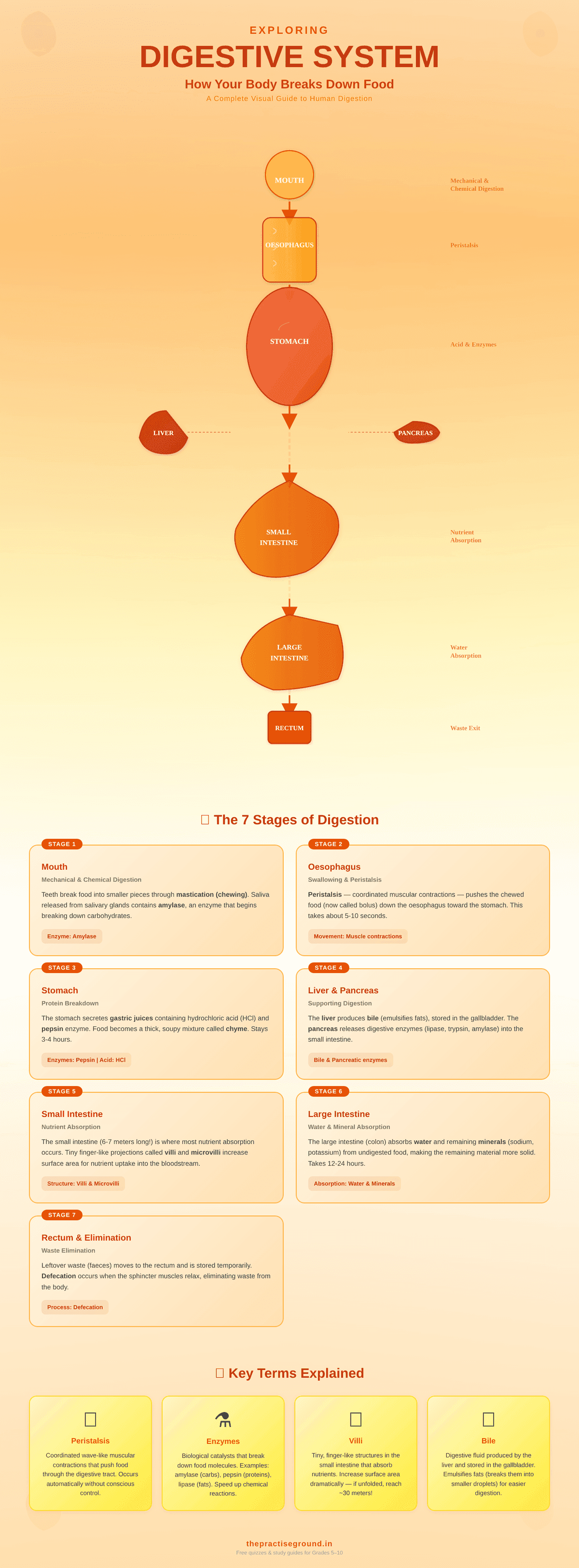
Mouth → Esophagus → Stomach → Small Intestine → Large Intestine → Rectum → AnusAlong the way, the liver, pancreas, and gallbladder provide crucial chemicals.
1. Mouth (Oral Cavity): The Beginning
Functions of the Mouth
Key Structures
Teeth:Chemical Reaction in the Mouth
CODEBLOCK0This is why if you chew bread for a long time, it starts to taste sweet—the amylase is breaking down starch!
2. Esophagus: The Food Tube
Functions
Important Feature: Peristalsis
Peristalsis is involuntary muscle contraction that moves food through the digestive tract. This is why you can swallow even while upside down!
How it works:3. Stomach: The Mixing Chamber
Functions
Stomach Structure
Gastric Juice Components
| Component | Function |
|---|---|
| Hydrochloric acid (HCl) | Denatures proteins, kills bacteria |
| Pepsin | Protein-digesting enzyme |
| Mucus | Protects stomach lining from acid |
| Gastric lipase | Breaks down some fats (minor role) |
Chemical Reaction in Stomach
CODEBLOCK1Chyme: The Stomach's Product
After 2-4 hours, food becomes a thick, pasty mixture called chyme (partially digested food). The stomach releases this slowly into the small intestine.
4. Small Intestine: The Main Absorption Site
Despite its name, the small intestine is the most important site for digestion and absorption. It's called "small" because of its diameter, not its length (it's actually 5-7 meters long!).
Functions
Three Regions
1. Duodenum (first 25 cm)Intestinal Walls: Villi and Microvilli
The small intestine has a huge surface area for absorption:
This enormous surface allows maximum nutrient absorption.
Digestion in the Small Intestine
Carbohydrate Digestion: CODEBLOCK2 Protein Digestion: CODEBLOCK3 Fat Digestion: CODEBLOCK4Important Juices in Small Intestine
Pancreatic Juice:5. Large Intestine (Colon): Water Absorption
Functions
Journey Through Large Intestine
Cecum: First part, receives chyme Colon: Absorbs water and electrolytes Rectum: Stores feces Anal canal & Anus: Exit pointWhat Happens to Undigested Food?
6. Accessory Organs: Liver, Pancreas, and Gallbladder
Liver
Functions:Pancreas
Functions:Gallbladder
Functions:Timeline of Digestion
| Organ | Time | What Happens |
|---|---|---|
| Mouth | 0-30 sec | Mechanical and chemical digestion begins |
| Esophagus | 30 sec-10 sec | Transport via peristalsis |
| Stomach | 2-4 hours | Mixing, protein digestion, acid production |
| Small Intestine | 3-5 hours | Most digestion and absorption |
| Large Intestine | 12-24+ hours | Water absorption, waste storage |
Quick Recap: Digestive Enzymes
| Enzyme | Source | Substrate | Product |
|---|---|---|---|
| Salivary amylase | Mouth | Starch | Maltose |
| Pepsin | Stomach | Protein | Peptides |
| Pancreatic amylase | Pancreas | Starch | Maltose |
| Pancreatic protease | Pancreas | Peptides | Amino acids |
| Pancreatic lipase | Pancreas | Fats | Fatty acids + Glycerol |
| Maltase | Small intestine | Maltose | Glucose |
| Peptidase | Small intestine | Peptides | Amino acids |
Try This: Digest Food Yourself!
Experiment: Enzyme ActionExam Questions: CBSE/ICSE Pattern
Q1: Name the enzyme secreted by salivary glands. What does it do?A: Salivary amylase. It breaks down starch into maltose (a simpler sugar).
Q2: Why is the small intestine called the main digestive and absorption organ?A: Because most chemical digestion occurs there (using enzymes from pancreas, liver, and intestinal glands), and most nutrients are absorbed through its large surface area (villi and microvilli).
Q3: Draw a diagram of the human digestive system and label the major organs.A: [Students should draw: Mouth → Esophagus → Stomach → Small intestine (duodenum, jejunum, ileum) → Large intestine → Rectum → Anus, plus Liver, Pancreas, Gallbladder]
Q4: What is the role of bile in digestion?A: Bile emulsifies (breaks apart) large fat droplets into smaller ones, increasing the surface area for pancreatic lipase to work efficiently. This speeds up fat digestion.
Q5: What happens in the large intestine?A: Water is absorbed, feces are formed, bacteria produce vitamins, and waste is stored until elimination.
FAQ: Digestive System
Q: Why do we need to chew food if the stomach can break it down?A: Chewing increases surface area for enzymes to work on. The more broken down food is, the faster and more complete digestion becomes. Also, saliva's enzymes can only work on food you've chewed.
Q: Can the stomach digest itself?A: Technically, yes—pepsin can digest protein, and the stomach lining is protein. But mucus protects the stomach lining. When this protection fails, ulcers can form.
Q: What's the difference between digestion and absorption?A: Digestion breaks down large molecules into smaller ones (chemical process). Absorption is when these small molecules enter the bloodstream (physical process across the intestinal wall).
Q: How long can you survive without eating?A: The body has glucose stores (glycogen) lasting hours and fat stores lasting weeks. However, protein deficiency becomes serious within days. Most people can survive 3-4 weeks without food.
Q: Are digestive enzymes broken down and absorbed too?A: Yes. Enzymes are proteins, so they're digested like other proteins into amino acids and absorbed. Your body continuously makes new enzymes.
Next Steps
Now that you understand digestion, explore related topics:
The digestive system is a marvel of engineering that processes thousands of meals in your lifetime. Understanding it helps you appreciate nutrition, health, and how your body works. Good luck with your exams!
Taking a quick break? Test yourself!
Pause and try a quick Grade 5 Biology quiz — see how much you've picked up so far.