Want to test what you know?
Try our free Grade 5 Biology quiz — 25 questions, instant results, no sign-up.
Cell Structure & Functions: Plant Cell vs Animal Cell Explained
The cell is the basic unit of life. Every living organism is made of cells, and understanding cell structure is fundamental to biology. Whether you're studying CBSE, ICSE, or IB biology, you'll encounter cells repeatedly.
In this guide, we'll explore cell structures, organelles, and the key differences between plant and animal cells with clear diagrams and explanations.
What Is a Cell?
A cell is the smallest unit of life that can function independently. All living things are made of one or more cells.
Cell Theory:- All living organisms are composed of cells
- The cell is the basic unit of life
- All cells come from pre-existing cells
Types of Cells
Prokaryotic Cells
No nucleus. Genetic material floats in cytoplasm. Examples: Bacteria, Cyanobacteria Size: 1-10 micrometersEukaryotic Cells
Have a nucleus. Genetic material is enclosed in nuclear membrane. Examples: Plant cells, Animal cells, Fungi, Protists Size: 10-100 micrometersThis guide focuses on eukaryotic cells (plant and animal).
Cell Membrane (Plasma Membrane)
The outermost layer of all cells.
Functions:Cytoplasm
The gel-like substance inside the cell (excluding nucleus).
Contains: Organelles, dissolved substances, cytosol (liquid portion) Functions:The Nucleus
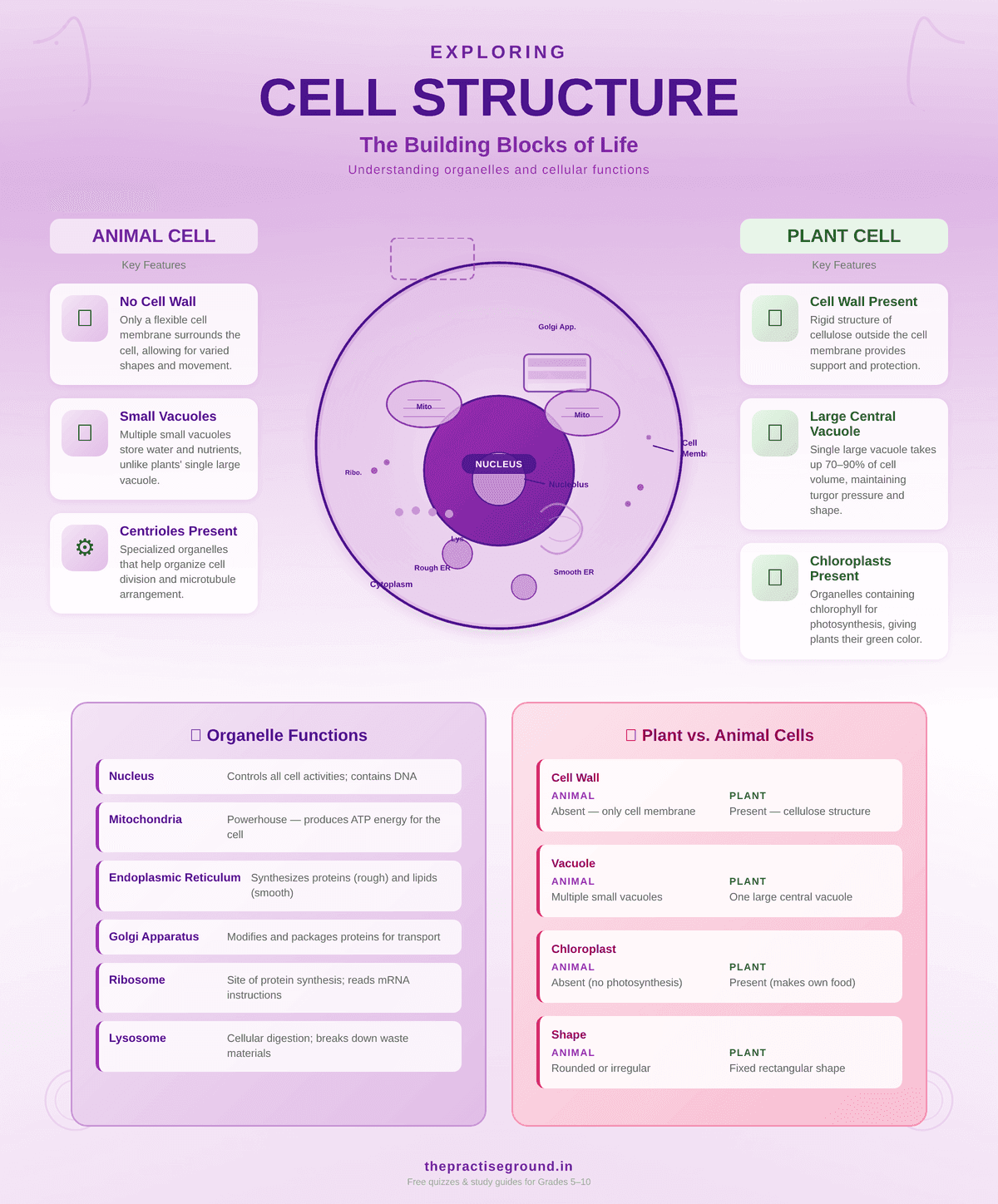
Present in: Eukaryotic cells (animal and plant) Functions:Organelles: The Cell's Specialized Structures
1. Ribosomes
Present in: All cells Structure: Made of ribosomal RNA and proteins Size: Smallest organelle Function: Protein synthesis (translation) Location: Free in cytoplasm or attached to endoplasmic reticulum2. Mitochondria
Present in: Animal and plant cells (more in animal) Shape: Rod or bean-shaped Structure: Double membrane with inner folds (cristae) Function: Energy production through ATP synthesis Why important: The more active the cell, the more mitochondria it has. Indian reference: Like the "powerhouse" of the cell (this term is commonly used)3. Endoplasmic Reticulum (ER)
Two types: a) Rough ER (RER)4. Golgi Apparatus (Golgi Body)
Structure: Stack of flattened sacs Functions:5. Lysosomes
Present in: Animal cells (rarely in plant cells) Contains: Digestive enzymes Functions:6. Centrosomes and Centrioles
Present in: Animal cells (absent in plant cells) Function: Organize microtubules during cell division Role in: Mitosis and meiosis7. Chloroplasts (Plant Cells Only)
Structure: Double membrane with stacked thylakoids (grana) Functions:8. Cell Wall (Plant Cells Only)
Present in: Plant cells, fungi, bacteria Absent in: Animal cells Composition: Cellulose (carbohydrate polymer) Functions:9. Large Central Vacuole (Plant Cells)
Present in: Plant cells (large), animal cells (small) Contains: Cell sap (water, dissolved substances) Functions:10. Plastids (Plant Cells)
Besides chloroplasts:
Chromoplasts: Store pigments (orange in carrots, red in tomatoes) Leucoplasts: Store starch, oils, proteins (colorless)Quick Recap: Organelle Functions
| Organelle | Present in | Function |
|---|---|---|
| Nucleus | All eukaryotes | Gene control, cell reproduction |
| Mitochondria | Both | ATP production (energy) |
| Rough ER | Both | Protein synthesis |
| Smooth ER | Both | Lipid synthesis, detoxification |
| Golgi | Both | Protein modification, packaging |
| Lysosomes | Animals mainly | Digestion of waste |
| Chloroplasts | Plants only | Photosynthesis |
| Cell Wall | Plants, fungi | Support, protection |
| Central Vacuole | Plants | Storage, turgor pressure |
| Centrioles | Animals | Cell division organization |
Animal Cell vs. Plant Cell: Complete Comparison
| Feature | Animal Cell | Plant Cell |
|---|---|---|
| Cell Wall | Absent | Present (cellulose) |
| Central Vacuole | Small | Large |
| Chloroplasts | Absent | Present |
| Centrioles | Present | Absent |
| Lysosomes | Present | Rarely |
| Shape | Round, irregular | Rectangular, fixed |
| Plastids | Absent | Present |
| Size | Smaller (10-30 μm) | Larger (10-100 μm) |
Cell Division
Purpose: Growth, repair, reproductionMitosis (Cell Division)
Produces: Two identical daughter cells Phases:Meiosis (Sex Cell Division)
Produces: Four non-identical sex cells (gametes) Unique feature: Genetic variation through crossing over Result: Haploid cells (half the chromosomes of parent)Cell Diversity
Different cells have structures suited to their functions:
Indian Cellular Context
Plant Cells in Indian Agriculture
Cellular Basis of Disease
Try This: Labeling Practice
Exam Questions: CBSE/ICSE Pattern
Q1: What is a cell? State the cell theory.A: A cell is the smallest unit of life. Cell Theory: (1) All organisms are made of cells (2) Cell is the basic unit of life (3) All cells come from pre-existing cells.
Q2: Name the organelle responsible for energy production in cells.A: Mitochondria. It synthesizes ATP through oxidative respiration.
Q3: Why do plant cells have cell walls while animal cells don't?A: Cell walls provide structural support and prevent water loss. Animals move and need flexibility, while plants are stationary and benefit from rigidity. Also, animals regulate water differently than plants.
Q4: Draw a plant cell and label the following: nucleus, cell wall, chloroplast, central vacuole, mitochondria.A: [Students should draw a rectangular plant cell with all labeled structures]
Q5: What is the function of the Golgi apparatus?A: The Golgi apparatus modifies proteins received from the ER, packages them into vesicles, and labels them for transport to their destination.
FAQ: Cell Structure and Functions
Q: Do all cells have a nucleus?A: No. Prokaryotic cells (bacteria) lack a nucleus. Eukaryotic cells (animals, plants, fungi) have nuclei. Also, mammalian red blood cells lose their nucleus as they mature.
Q: Why do plant cells need both mitochondria and chloroplasts?A: Chloroplasts make glucose from sunlight. Mitochondria break down this glucose to produce ATP for cellular energy. Both processes are necessary.
Q: Can animal cells photosynthesize?A: Some single-celled animals (like some protists) have chloroplasts, but typical animal cells cannot. Only plants and some microorganisms photosynthesize.
Q: What happens if a cell loses its nucleus?A: The cell loses genetic instructions and cannot divide or make new proteins. It will eventually die (except red blood cells, which don't need this for short lifespan).
Q: Why are cells so small?A: Cells have a surface-area-to-volume ratio that limits their size. Nutrients must reach the center, and waste must exit from the center. Larger cells would struggle to exchange materials efficiently.
Next Steps
Now that you understand cell structure, explore related topics:
Cells are the foundation of all biology. Understanding their structure and function is the key to comprehending how organisms grow, reproduce, and respond to their environment. Keep exploring, and you'll unlock deeper understanding of life itself. Good luck with your exams!
Taking a quick break? Test yourself!
Pause and try a quick Grade 5 Biology quiz — see how much you've picked up so far.