
Want to test what you know?
Try our free Grade 8 Chemistry quiz — 25 questions, instant results, no sign-up.
Chemistry Made Easy: How to Remember Reactions and Formulas
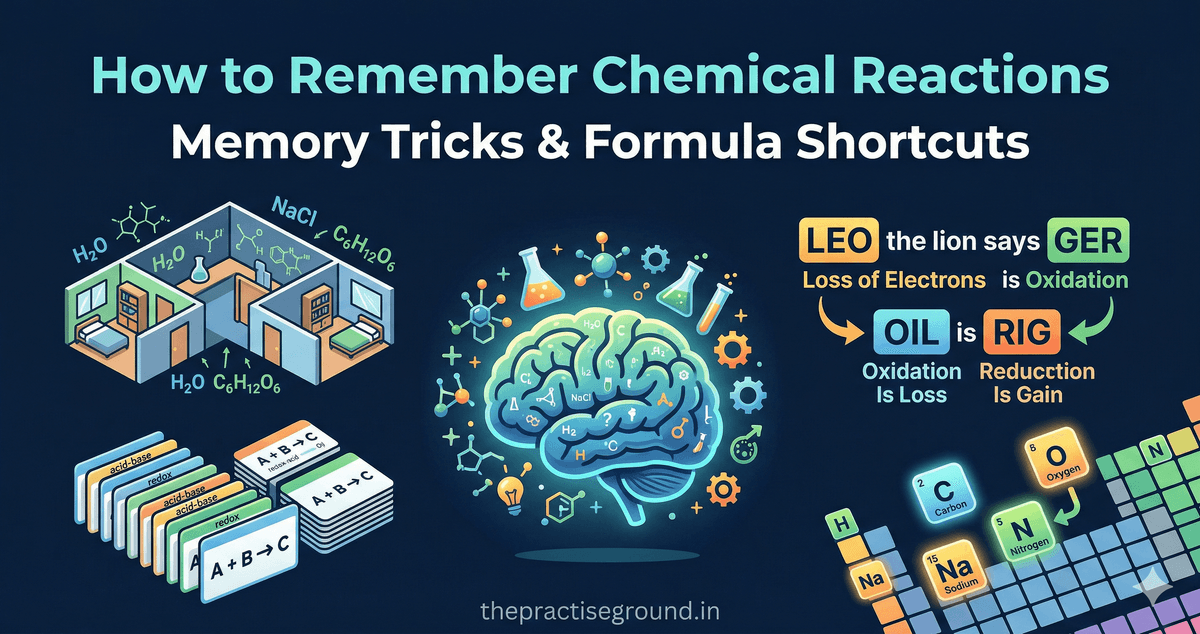
Chemistry gets a bad reputation for being "all memorization." But the truth? Chemistry is about patterns. Once you recognize the patterns, remembering reactions becomes effortless.
Instead of blindly memorizing 50 different reactions, you'll learn how all combination reactions follow the same pattern. You'll understand why certain elements react with oxygen. You'll predict reactions you've never seen before.
This guide reveals the pattern-based approaches that help students move from struggling with chemistry to confidently answering any reaction question.
The Truth About Chemical Reactions: It's All Patterns
Most chemistry students approach reactions like this:
- Read the reaction: H₂ + O₂ → H₂O
- Memorize it
- Forget it two weeks later
- Panic in the exam
Pattern 1: Combination Reactions
The Pattern: A + B → ABTwo substances combine to form one compound.
Examples:Pattern 2: Decomposition Reactions
The Pattern: AB → A + BOne compound breaks into two substances (opposite of combination).
Examples:Pattern 3: Displacement Reactions (Single Displacement)
The Pattern: AB + C → AC + BA more reactive element "displaces" a less reactive one.
This is where the Reactivity Series becomes crucial. Instead of memorizing it randomly, understand the order:
Reactivity Series Mnemonic (for metals): "Please Stop Calling My Dear Child At Night For Studying Copper, Silver, Gold"Zinc displaces copper because zinc is higher in the reactivity series.
Non-Metal Reactivity Series: Fluorine > Chlorine > Bromine > IodineMore reactive non-metals displace less reactive ones.
Pattern 4: Double Displacement (Acid-Base, Precipitation)
The Pattern: AB + CD → AC + BD Types: Acid-Base Reactions: Acid + Base → Salt + Water INLINECODE1The H⁺ from acid combines with OH⁻ from base to form water. Simple.
Precipitation Reactions: When two solutions mix and form an insoluble compound. Example: Silver Nitrate + Sodium Chloride → Silver Chloride (white precipitate) + Sodium Nitrate INLINECODE2 What to Remember:Learn these solubility rules, and you can predict precipitation reactions instantly.
The Art of Balancing Chemical Equations
Many students dread balancing equations. But it's just arithmetic with atoms.
The Basic Rule
In any chemical equation, the number of each type of atom must be equal on both sides.
The Step-by-Step Method
Example Problem: Balance the equation for combustion of ethanol. INLINECODE3 Step 1: Count atoms on each side.Left side: C=2, H=6, O=3 Right side: C=1, H=2, O=3
Step 2: Balance one element at a time. Start with the most complex molecule (usually the non-oxygen-containing one first, then oxygen, then hydrogen).Balance Carbon (C): INLINECODE4
Now: Left side: C=2 ✓, H=6, O=4 Right side: C=2 ✓, H=2, O=5
Step 3: Balance Hydrogen (H): INLINECODE5Now: Left side: C=2, H=6 ✓, O=7 Right side: C=2, H=6 ✓, O=7
Step 4: Balance Oxygen (O): INLINECODE6Check: Left side: C=2 ✓, H=6 ✓, O=2+6=8 Right side: C=2 ✓, H=6 ✓, O=4+3=7
Wait, that's not balanced. Let me recalculate...
INLINECODE7 Left: C=2, H=6, O=1+6=7 Right: C=2, H=6, O=4+3=7 ✓ Balanced equation verified!Balancing Shortcuts
Example: If you get INLINECODE8, multiply the whole equation by 2.
Example: In INLINECODE9, the NO₃⁻ ion appears on both sides, so treat it as one unit.
Common Chemistry Formulas: Memory Tricks
Instead of memorizing random formulas, understand why they have that formula:
For Ionic Compounds
The formula depends on the charge of each ion. Cross-cross the charges.
Example: Sodium has +1 charge, Oxide has -2 charge. INLINECODE10 → Cross the charges → INLINECODE11 Calcium and Chlorine: INLINECODE12 → Cross the charges → INLINECODE13Once you know the charges of common ions (look them up once, remember forever), you can write any ionic compound formula instantly.
Common Ionic Charges to Remember
Metals:Learn these handful of ions, and you can write formulas for hundreds of compounds.
Color-Coding Strategy for Learning Reactions
Create a color-coded chart for different types of reactions:
As you study, highlight reactions with these colors. Your brain processes colors faster than words, making learning faster and recall better.
Pattern Recognition Exercise
Look at these three reactions:
What's the pattern? All non-metals and metals combining with oxygen to form oxides. This is why non-metals like carbon, hydrogen, and magnesium all react similarly with oxygen.
Once you see this pattern, you don't need to memorize each reaction separately. You understand that elements in the same group often behave similarly with oxygen.
CBSE Chemistry Tips
FAQs
How many reactions do I need to memorize for CBSE Class 10?
About 25-30 reactions if you understand the patterns. But CBSE provides a list of reactions to be balanced. Master that list, understand the patterns, and you're set.
Why do I keep forgetting reactions?
Likely because you're memorizing instead of understanding. Understand the type of reaction, the reactivity of elements, and the pattern. The equation follows naturally.
How do I quickly decide how to balance an equation?
Identify the type of reaction first. Combination? Decomposition? Displacement? Once you know the type, balancing becomes systematic.
Are there reactions unique to CBSE, or are reactions universal?
Reactions are universal in chemistry. However, CBSE focuses on specific reactions relevant to Class 10 content (metals, non-metals, organic chemistry basics, etc.). Master the CBSE list, and you'll handle any chemistry problem.
Should I memorize the reactivity series?
Yes, but understand it. The series reflects periodic trends in the periodic table. Metals on the left of the periodic table are more reactive; elements on the right are less reactive.
Final Thoughts
Chemistry is the study of matter and change. Instead of seeing reactions as random facts to memorize, see them as patterns in how elements behave. Once you grasp the patterns—why sodium always reacts violently with water, why halogens react with metals, why acids and bases neutralize each other—chemistry becomes logical and memorable.
Start with one reaction type this week (let's say combination reactions). Understand the pattern. Write five examples. See how they all follow the same structure? That's the breakthrough moment. From there, tackle the other reaction types.
Use The Practise Ground chemistry quizzes to practice balancing equations and identifying reaction types. Active practice reinforces these patterns far better than passive reading.
Taking a quick break? Test yourself!
Pause and try a quick Grade 8 Chemistry quiz — see how much you've picked up so far.