Physics Numericals with Solutions
Formulas by topic, nine solved examples from easy to hard, and a free practice pack with answers. For Classes 9 to 12.
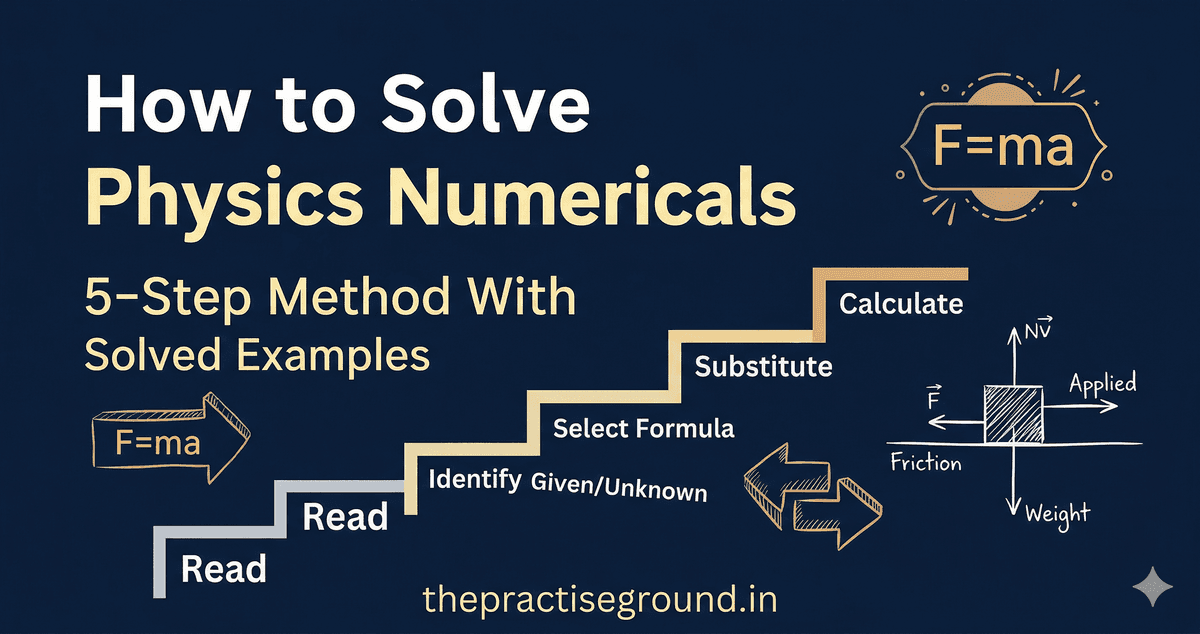
The 5-step method for any numerical
- Write what is given and what you must find, with units.
- Pick the formula that links them.
- Convert every unit to SI (metre, kilogram, second, ampere).
- Substitute the numbers and calculate.
- Check the unit, the sign and whether the size makes sense.
For the long version with common mistakes, read our guide: How to Solve Physics Numericals.
Physics formulas by topic
Pick a topic, then find the quantity you need. Each row shows the formula, its SI unit and when to use it.
Motion
Classes 9–11| To find | Formula | SI unit | When to use it |
|---|---|---|---|
| Average speed | speed = distance / time | m/s | Total distance divided by total time. |
| Final velocity | v = u + at | m/s | Use when displacement is not given. |
| Displacement | s = ut + ½at² | m | Use when final velocity is not given. |
| Velocity from distance | v² = u² + 2as | m/s | Use when time is not given. |
| Free fall | same equations with a = g | m/s² | Use g = 10 or 9.8 m/s² as your teacher specifies. |

Free Physics Numericals Practice Pack (PDF)
Seven pages, from simple to complex. A formula sheet comes first. Level 1 has ten one-formula questions (Classes 9 and 10). Level 2 has eight two-step problems (Classes 9 to 11). Level 3 has six multi-stage challenges (Classes 11 and 12). It also has three worked examples, a full answer key and a one-page poster.
Print the poster and pin it on your classroom or lab noticeboard. Students can scan its QR code to come back here for more practice.
Download the PDF Poster only (1 page)Solved physics numericals, easy to hard
Each example follows the 5-step method. Where a value of g is needed, we use g = 10 m/s² to keep the arithmetic simple.
Level 1 · Classes 9–10
1. Braking car (motion)
A car moving at 15 m/s brakes with a deceleration of 3 m/s² until it stops. Find the time taken and the stopping distance.
Givenu = 15 m/s, v = 0, a = −3 m/s²
Formulav = u + at and v² = u² + 2as
Solvet = (0 − 15) / (−3) = 5 s. s = (0 − 225) / (2 × −3) = 37.5 m.
CheckAverage speed 7.5 m/s × 5 s = 37.5 m. It matches.
Level 1 · Classes 9–10
2. Falling ball (free fall)
A ball is dropped from a height of 45 m. How long does it take to land and how fast is it moving just before impact?
Givenu = 0, s = 45 m, a = g = 10 m/s²
Formulas = ½gt² and v = gt
Solvet² = 2 × 45 / 10 = 9, so t = 3 s. v = 10 × 3 = 30 m/s.
Checkv² = 2gs = 900, so v = 30 m/s. It matches.
Level 2 · Classes 9–11
3. Force with friction
A 1500 kg car is driven with a force of 4500 N. Resistance is 1500 N. Find its acceleration.
Givenm = 1500 kg, driving force 4500 N, resistance 1500 N
FormulaNet force = 4500 − 1500 = 3000 N, then F = ma
Solvea = 3000 / 1500 = 2 m/s².
CheckUse the net force, not the driving force alone.
Level 2 · Class 10
4. Bulb rating (electricity)
A bulb is rated 100 W, 220 V. Find the current it draws and its resistance.
GivenP = 100 W, V = 220 V
FormulaP = VI and R = V² / P
SolveI = 100 / 220 = 0.45 A. R = 220² / 100 = 484 Ω.
CheckV = IR = 0.4545 × 484 = 220 V. It matches.
Level 2 · Class 10
5. Electricity bill
A 2 kW heater runs for 3 hours every day. Find the cost for 30 days at Rs 8 per unit.
GivenP = 2 kW, t = 3 h per day, Rs 8 per kWh
FormulaE = P × t, and 1 kWh = 1 unit
Solve2 × 3 = 6 kWh per day. 30 days: 180 kWh. Cost = 180 × 8 = Rs 1,440.
CheckPower is in kW and time in hours, so no conversion is needed.
Level 2 · Class 10
6. Convex mirror (light)
A convex mirror has a focal length of 10 cm. An object is 20 cm in front of it. Find the image position and the magnification.
Givenf = +10 cm, u = −20 cm
Formula1/v + 1/u = 1/f and m = −v/u
Solve1/v = 1/10 + 1/20 = 3/20, so v = +6.67 cm. m = −(6.67)/(−20) = +0.33.
CheckA convex mirror always gives a virtual, erect, smaller image behind the mirror.
Level 3 · Class 11
7. Projectile
A ball is thrown at 20 m/s at 45° above the horizontal. Find the time of flight, the maximum height and the range.
Givenu = 20 m/s, θ = 45°, g = 10 m/s²
FormulaT = 2u sin θ / g, H = u² sin² θ / 2g, R = u² sin 2θ / g
SolveT = 2 × 20 × 0.707 / 10 = 2.83 s. H = 400 × 0.5 / 20 = 10 m. R = 400 × 1 / 10 = 40 m.
CheckAt 45° the range is the maximum for this speed.
Level 3 · Classes 11–12
8. Collision (momentum)
A 2 kg trolley moving at 6 m/s hits a stationary 4 kg trolley and they stick together. Find their speed and the kinetic energy lost.
Givenm₁ = 2 kg, u₁ = 6 m/s, m₂ = 4 kg, u₂ = 0
Formulam₁u₁ = (m₁ + m₂)v, and KE = ½mv²
Solvev = 12 / 6 = 2 m/s. KE before = 36 J, after = 12 J, so 24 J is lost.
CheckMomentum is conserved. Kinetic energy is lost as heat and sound.
Level 3 · Class 12
9. Cell with internal resistance
A cell of emf 9 V and internal resistance 0.5 Ω is connected to a 4 Ω resistor. Find the current and the terminal voltage.
GivenE = 9 V, r = 0.5 Ω, R = 4 Ω
FormulaI = E / (R + r) and V = E − Ir
SolveI = 9 / 4.5 = 2 A. V = 9 − 2 × 0.5 = 8 V.
CheckV = IR = 2 × 4 = 8 V. It matches.
Five mistakes that cost marks
- Forgetting to convert units (km/h, g, cm, minutes) before substituting.
- Wrong signs in mirror and lens problems. Fix the sign convention first.
- Mixing up mass (kg) and weight (newton). Weight = mass × g.
- Using g = 10 in one step and 9.8 in the next. Pick one and keep it.
- Not checking the final unit and whether the size of the answer is sensible.
Keep going
Physics numericals: frequently asked questions
What is a numerical in physics?
A numerical is a problem that asks you to calculate a value, such as speed, force, current or image distance, using given numbers and a physics formula.
How do I solve a physics numerical step by step?
Write what is given and what is asked, with units. Pick the formula that links them. Convert every unit to SI. Substitute and calculate. Finally check the unit, the sign and whether the answer is sensible.
Which formulas matter most for Class 9 and Class 10?
Speed, v = u + at, s = ut + ½at², F = ma, W = Fs, P = W/t, density, pressure, V = IR, P = VI, series and parallel resistance, and the mirror and lens formulas cover most board numericals.
Why is my answer wrong even though I used the right formula?
The usual causes are unconverted units (km/h, g, cm, minutes), wrong signs in mirror and lens problems, mixing up mass and weight, and using g = 10 in one step and 9.8 in another.
Should I use g = 9.8 or g = 10 m/s²?
Use the value your question or teacher specifies. If nothing is stated, 9.8 m/s² is the exact value and 10 m/s² is a common simplification. Write down the value you use and keep it the same throughout.
How do I decide the signs in mirror and lens numericals?
Use the Cartesian sign convention. Measure distances from the pole or optical centre. Distances in the direction of the incident light are positive and distances against it are negative. A concave mirror has a negative focal length and a convex lens has a positive one.
Are SI units compulsory?
Using SI units (metre, kilogram, second, ampere) avoids mistakes because the formulas are written for them. If you work in other units, make sure they are consistent, and convert the final answer to the unit asked.
Where can I get physics numericals with answers as a PDF?
Download the free practice pack on this page. It has 24 questions in three levels, worked examples, a full answer key and a one-page poster you can print for your classroom.