
Want to test what you know?
Try our free Grade 8 English quiz — 25 questions, instant results, no sign-up.
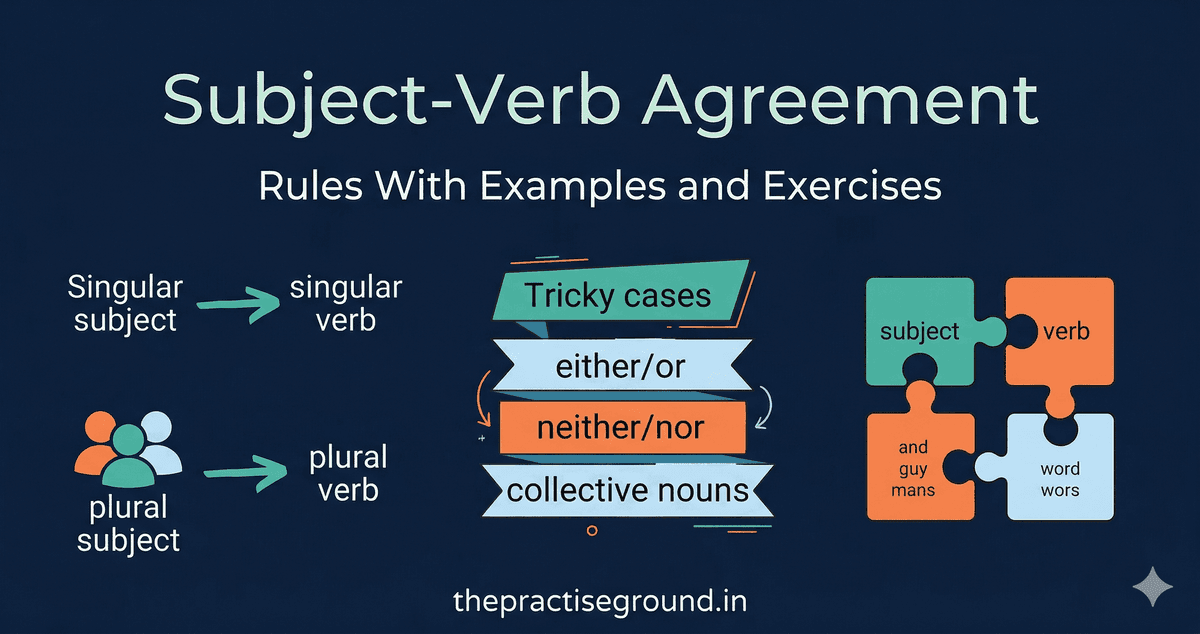
Subject-verb agreement (also called concord) is one of the most tested grammar topics in exams worldwide. The rule is simple: a singular subject takes a singular verb, and a plural subject takes a plural verb. But there are tricky cases that confuse students. Let's master them all!
The Basic Rule
Rule: The verb in a sentence must agree with the subject in number and person. Simple Examples:- The boy is happy. (singular subject, singular verb)
- The boys are happy. (plural subject, plural verb)
- She plays cricket. (singular subject, singular verb)
- They play cricket. (plural subject, plural verb)
How to Make Verbs Agree
Present Tense Verbs
In the present tense, we add "-s" or "-es" to the verb for third-person singular (he, she, it):
To Be Verbs
The verb "to be" has special forms:
| Subject | Verb |
|---|---|
| I | am |
| you | are |
| he/she/it | is |
| we | are |
| they | are |
Tricky Cases in Subject-Verb Agreement
Case 1: Compound Subjects with "and"
When two subjects are joined by "and," use a plural verb.
Case 2: Subjects with "or" or "nor"
With "or" or "nor," the verb agrees with the nearest subject.
Case 3: Collective Nouns
Collective nouns (group, team, class, committee, family) can be singular or plural depending on context.
Common collective nouns: team, class, group, army, jury, audience, crew, family, staff
Case 4: Words of Quantity
Words like "most," "some," "half," "percentage" agree with the noun they refer to.
Case 5: "None" Can Be Singular or Plural
Both are correct! In exams, use the one your curriculum suggests.
Case 6: "Each," "Every," "Either," "Neither"
These words are always singular, even when followed by "of":
Case 7: Plural Nouns with Singular Meaning
Some nouns are plural in form but singular in meaning:
Case 8: Nouns Ending in "-ics"
Nouns ending in "-ics" are usually singular in meaning:
Case 9: Who, Which, That (Relative Pronouns)
The verb agrees with the antecedent (the noun the pronoun refers to):
Case 10: "A Number of" vs. "The Number of"
Common Mistakes in Subject-Verb Agreement
Mistake 1: Ignoring intervening wordsQuick Check Method
To find subject-verb agreement mistakes, follow these steps:
- Find the real subject (ignore phrases between subject and verb)
- Check if the subject is singular or plural
- Choose the matching verb form
- Make sure the verb shows agreement
FAQ: Subject-Verb Agreement Questions
What if there's a long phrase between subject and verb?
Ignore the phrase! Find the real subject and match the verb to it. Example: "The students in our school who are intelligent are going to Delhi." (students is plural, so "are")
Can I use "are" with collective nouns?
Yes, if the group members are acting individually. "The team are celebrating their individual achievements."
Is "none" singular or plural?
Traditionally singular, but modern English accepts both. Check your curriculum's preference.
Practice Exercises
Choose the correct verb:
Master Subject-Verb Agreement
Practice is essential for mastering concord rules. Take our English quizzes to strengthen your skills!
Conclusion
Subject-verb agreement seems complicated, but it follows logical patterns. The key is identifying the real subject and remembering the tricky cases. With the rules and examples above, you can tackle any subject-verb agreement question. Practice regularly, and these rules will become second nature.
Start practicing today and boost your grammar confidence!
Taking a quick break? Test yourself!
Pause and try a quick Grade 8 English quiz — see how much you've picked up so far.