
Want to test what you know?
Try our free Grade 5 Maths quiz — 25 questions, instant results, no sign-up.
Speed matters in mathematics. Whether you're racing against the clock in an exam hall or solving practice problems, being able to calculate quickly and accurately gives you a real advantage. Let's explore proven mental maths techniques that work for students across CBSE, ICSE, Cambridge, and IB curricula.
1. The Multiplication Shortcut for Numbers Close to 10
The Trick: When multiplying two 2-digit numbers that are close to 10, use this method:For 12 × 13:
- Both numbers are close to 10
- Add the first number to the ones digit of the second: 12 + 3 = 15
- Multiply the ones digits: 2 × 3 = 6
- Answer: 156
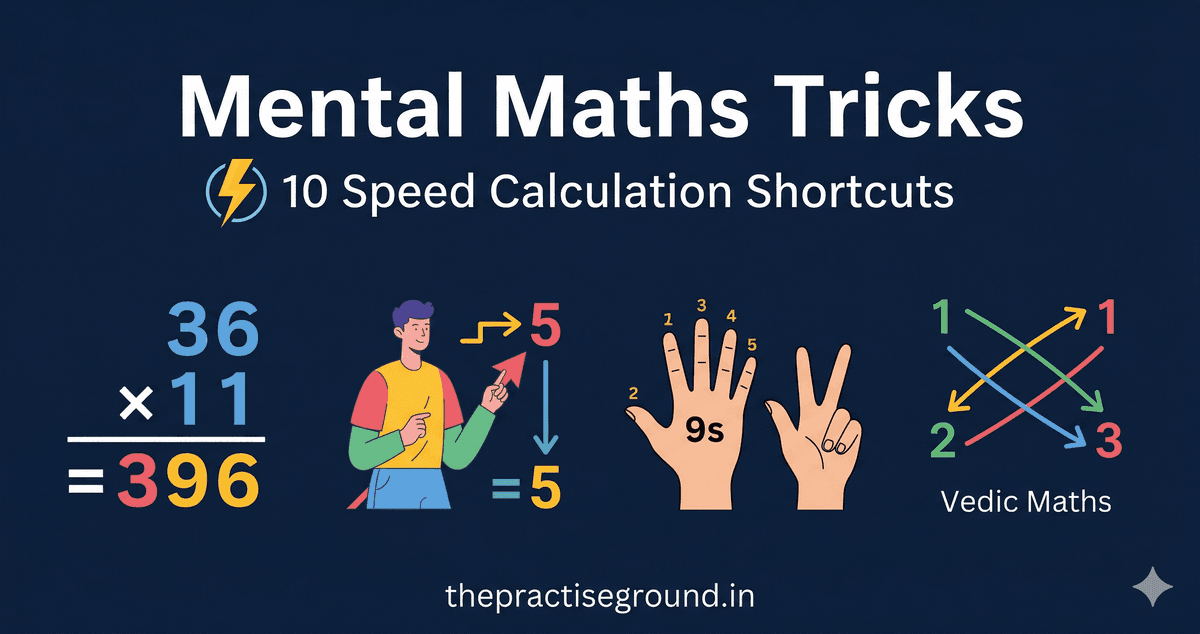
2. The Vedic Mathematics Criss-Cross Method
This ancient Indian technique (part of Vedic mathematics) makes two-digit multiplication almost effortless.
For 23 × 14:
- Multiply the ones digits: 3 × 4 = 12 (write 2, carry 1)
- Cross multiply and add: (2 × 4) + (3 × 1) + carry = 8 + 3 + 1 = 12 (write 2, carry 1)
- Multiply the tens digits: 2 × 1 = 2, plus carry = 3
- Answer: 322
3. Squaring Numbers Ending in 5
The Trick: Numbers ending in 5 square incredibly fast.For 35²:
For 75²:
For 85²:
4. Percentage Shortcuts for Real Life
Finding 10% of any number: Simply move the decimal point one place left.These are essential for calculating discounts in shops, banking calculations, and exam problems across all curricula.
5. Doubling and Halving Method
For multiplying numbers where one is even, use this elegance:
For 38 × 15:
Better: 38 × 15 = 19 × 30 = 570
The principle: Keep doubling one number and halving the other (when possible). This is quick mental arithmetic.
6. Squaring Numbers Close to 100
For 97²:
For 104²:
7. Divisibility Rules You Must Know
Divisible by 2: Last digit is even Divisible by 3: Sum of digits is divisible by 3 (example: 471 → 4+7+1=12, divisible by 3 ✓) Divisible by 4: Last two digits form a number divisible by 4 Divisible by 5: Ends in 0 or 5 Divisible by 6: Divisible by both 2 and 3 Divisible by 9: Sum of digits is divisible by 9 Divisible by 11: Alternating sum of digits is divisible by 11 (example: 1234 → 1-2+3-4=-2... check if divisible by 11)These rules save enormous time in competitive exams and problem-solving.
8. The 11 Multiplication Trick
For any two-digit number × 11:
23 × 11:
47 × 11:
54 × 11:
Practice on The Practise Ground
Ready to test these tricks? Our interactive maths quizzes for Grades 5-10 include speed calculation challenges where you can apply these techniques and build your mental maths fluency. Start with our Mental Maths Module!
Why These Tricks Matter
Mental maths isn't just about showing off. Research shows that students who develop strong mental calculation skills:
Whether you're studying for CBSE board exams, ICSE assessments, Cambridge IGCSE, or International Baccalaureate, these universal techniques apply everywhere.
FAQ
Will these tricks work for all numbers?
Most tricks work specifically for certain number patterns. The key is learning which trick applies when. With practice, recognition becomes instant.
How long until I can use these tricks automatically?
Most students master these within 2-3 weeks of daily practice. Consistency is more important than duration.
Are these tricks used in competitive exams like JEE or NEET?
Yes! Speed is crucial in competitive exams. Many toppers rely on mental maths shortcuts to save time for complex problems.
Which trick should I learn first?
Start with the 11 multiplication trick and percentage shortcuts—they're easiest to learn and immediately useful.
Applying These Tricks in Exams
Time Savings Calculate
In a typical competitive exam, you might perform 20-30 calculations. If each trick saves you 5-10 seconds:
Strategy: Master One Trick Per Week
Don't try to learn all tricks at once. Instead:
Week 1: 11 multiplication and 5 squaring tricksReal Exam Success Stories
Student A (JEE Aspirant): "Mental maths tricks helped me complete calculations 30% faster. This speed freed time to solve harder problems. My rank improved from 5000 to 1200." Student B (CBSE Board Exam): "The divisibility rules helped me quickly check if my answers were reasonable. I caught 3 calculation errors in the final checking phase." Student C (Competitive Exam): "The percentage shortcut was a game-changer for profit/loss problems. I could solve them in 20 seconds instead of 2-3 minutes."Building Your Personal Trick Toolkit
Different tricks work for different people. Your goal: build a toolkit of tricks that feel natural to you.
For those with strong visual memory: Focus on visualization techniques. Imagine the number line for subtraction, visualize the square arrangement for squaring tricks. For those who prefer patterns: Learn tricks based on algebraic identities. Understanding why tricks work is more satisfying than rote memorization. For those with good number sense: Leverage estimation and verification. After calculating, always check if the answer makes intuitive sense.Advanced Application: Mental Estimation
Once basic tricks become automatic, use estimation for checking:
Estimate: 47 × 23
This prevents catastrophic calculation errors where the answer is completely wrong.
Beyond Arithmetic: Developing Mathematical Intuition
Mental maths isn't just speed. It builds:
Intuition: After calculating with tricks, you develop number sense. You "feel" if an answer is wrong without rechecking. Confidence: Each successful mental calculation builds belief in your abilities. This confidence carries to harder problems. Flexibility: Learning multiple methods teaches that problems have multiple solutions. This flexibility is crucial in advanced maths.Maintaining Mental Maths Skills
Skills fade without practice. To maintain:
FAQ Continued
Will using these tricks make me dependent on them and unable to calculate normally?
No. These tricks enhance ability, not replace it. You still understand underlying mathematics. Tricks are shortcuts, not substitutes.
Are there tricks for algebraic manipulations or calculus?
Yes! Similar mental strategies exist for algebra, calculus, and other advanced topics. Master arithmetic tricks first, then explore advanced strategies.
How do I teach these tricks to younger siblings?
Start with the simplest tricks (11 multiplication). Use visual aids. Make it fun—race with them, gamify it. Young minds pick up patterns quickly!
Can I use these tricks on standardized tests that don't allow calculators?
Absolutely! These tricks are perfect for pen-and-paper exams. They're completely legitimate problem-solving strategies.
Taking a quick break? Test yourself!
Pause and try a quick Grade 5 Maths quiz — see how much you've picked up so far.