
Want to test what you know?
Try our free Grade 5 English quiz — 25 questions, instant results, no sign-up.
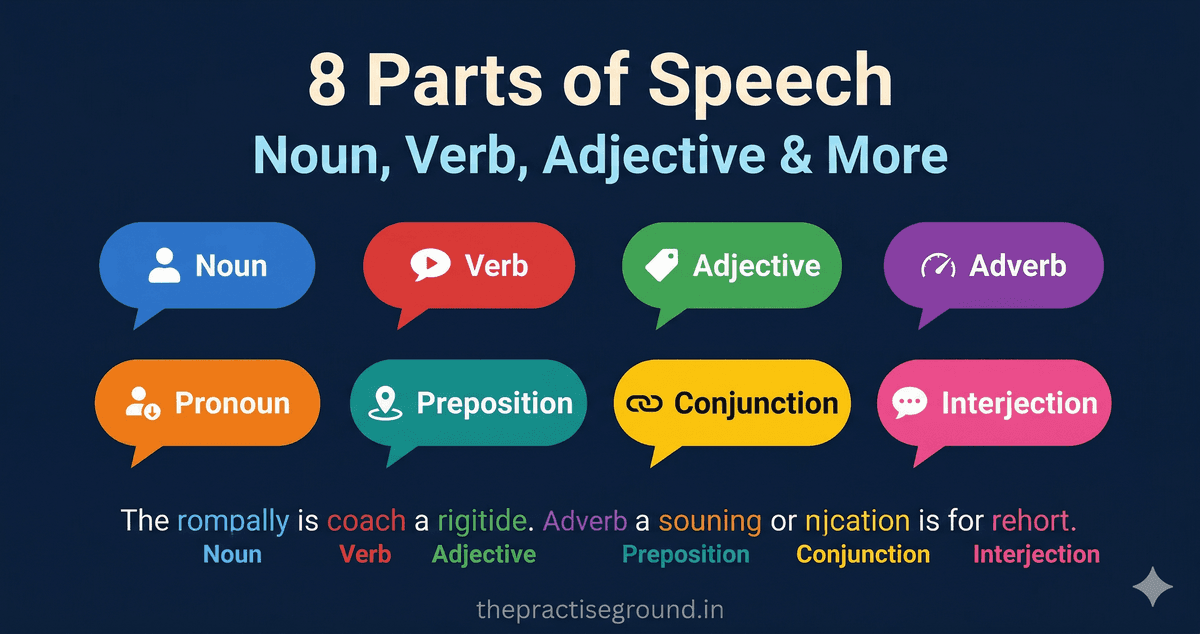
Parts of speech are like the alphabet of grammar. Once you understand what each part does, sentences make perfect sense! Let's learn about the eight main parts of speech with examples from your daily life.
What Are Parts of Speech?
Parts of speech are the different types of words in a sentence. Each word has a job to do. When you understand each word's job, you understand how English works!
1. Noun - The Name Word
A noun is a word that names a person, place, thing, or idea.
People: Teacher, student, doctor, mother, Priya, Emma, David Places: School, classroom, Delhi, library, park, London, Sydney, Toronto Things: Book, pen, table, cricket ball, water, computer, bicycle Ideas: Happiness, courage, friendship, justice, creativity Examples in sentences:- Arjun plays cricket in the park.
- My teacher explains lessons clearly.
- Honesty is a great quality.
2. Verb - The Action Word
A verb is a word that shows an action or state of being.
Action Verbs: run, eat, read, write, jump, play, sleep, help Being Verbs: am, is, are, was, were, be, being, been Examples in sentences:3. Adjective - The Describing Word
An adjective is a word that describes or modifies a noun. It tells us what kind, how many, or which one.
Quality: beautiful, happy, smart, brave, kind Color: red, blue, yellow, green, orange Size: big, small, tall, short, long Number: three, many, few, several Examples in sentences:4. Adverb - The Modifying Word
An adverb modifies a verb, adjective, or another adverb. It usually tells how, when, where, or to what extent.
How (Manner): quickly, slowly, carefully, well, badly When (Time): today, yesterday, tomorrow, now, then Where (Place): here, there, inside, outside, upstairs How Much (Degree): very, extremely, quite, almost, really Examples in sentences:5. Pronoun - The Replacing Word
A pronoun replaces a noun so we don't repeat the same word.
Personal Pronouns: I, you, he, she, it, we, they Possessive Pronouns: mine, yours, his, hers, its, ours, theirs Demonstrative Pronouns: this, that, these, those Relative Pronouns: who, whom, whose, which, that Examples in sentences:6. Preposition - The Position Word
A preposition shows the relationship between words. It usually comes before a noun and tells direction, location, or time.
Place: in, on, at, under, above, beside, between Direction: to, from, toward, away from Time: before, after, during, since, until Examples in sentences:7. Conjunction - The Connecting Word
A conjunction connects words, phrases, or sentences. It joins ideas together.
Coordinating Conjunctions: and, but, or, nor, so Subordinating Conjunctions: because, since, although, if, unless, while Examples in sentences:8. Interjection - The Expressing Word
An interjection is a word or phrase that expresses emotion or surprise. It stands alone or is loosely connected to the sentence.
Examples: Oh! Wow! Alas! Hurray! Great! Hello! Oops! Examples in sentences:Quick Reference Chart
| Part | Function | Examples |
|---|---|---|
| Noun | Names things | cat, Priya, school, happiness |
| Verb | Shows action | run, eat, is, jump |
| Adjective | Describes | happy, blue, big, smart |
| Adverb | Modifies verbs | quickly, very, today |
| Pronoun | Replaces nouns | he, she, mine, this |
| Preposition | Shows relationship | in, on, beside, after |
| Conjunction | Connects | and, but, because |
| Interjection | Expresses emotion | Oh! Wow! Hurray! |
How to Identify Parts of Speech
Here's a simple strategy:
- Ask "What is this word doing?"
- Does it name something? → Noun
- Does it show an action? → Verb
- Does it describe something? → Adjective or Adverb
- Does it replace a noun? → Pronoun
- Does it show position or time? → Preposition
- Does it connect ideas? → Conjunction
- Does it express emotion? → Interjection
Practice: Identify the Parts
Look at this sentence and identify each word's part of speech:
"She quickly wrote a beautiful letter in the quiet library."
FAQ: Parts of Speech Questions
What about the word "the" or "a"? What part of speech are they?
They're called "articles," which are a special type of adjective. "The" is a definite article, and "a/an" are indefinite articles.
Can a word be more than one part of speech?
Yes! The same word can be different parts depending on how it's used. "Run" is a verb ("I run"), but "run" can be a noun ("a long run").
How do I remember all these parts?
Start with the most common: Noun, Verb, Adjective, Pronoun, Preposition. Master these five first, then learn the others!
Master Parts of Speech with Our Quiz
Understanding parts of speech is the foundation for all grammar learning. Practice with our English quizzes to build your confidence. The more you practice, the easier it becomes!
Conclusion
Parts of speech are simple once you learn what each word-type does. Remember: Nouns are things, verbs are actions, adjectives describe, and adverbs modify. With practice, identifying parts of speech becomes automatic. Start with the chart above, practice with simple sentences, and gradually move to more complex ones.
Ready to test your knowledge? Take our English quizzes and see how well you've learned!
Taking a quick break? Test yourself!
Pause and try a quick Grade 5 English quiz — see how much you've picked up so far.