
Want to test what you know?
Try our free Grade 5 Maths quiz — 25 questions, instant results, no sign-up.
Fractions. The word alone makes some students nervous. But here's a secret: fractions aren't complicated. They're just a way of showing parts of a whole. And once you see them this way, everything becomes clear.
Let's demystify fractions together using things you see every day—pizza, chocolate bars, and shared lemonade.
What is a Fraction?
A fraction represents a part of something. It has two numbers:
Numerator (top number): How many parts you have Denominator (bottom number): How many equal parts the whole is divided intoThink of a pizza cut into 8 equal slices. If you eat 3 slices, you've eaten 3/8 of the pizza.
3 = numerator (slices you have) 8 = denominator (total slices)
That's it. You already understand fractions!
Types of Fractions
Proper Fractions: The numerator is smaller than the denominator. Examples: 1/2, 3/5, 7/8- These are parts of a whole, always less than 1
Common Misconceptions (Let's Fix Them!)
Mistake 1: "1/8 is bigger than 1/6 because 8 is bigger than 6" Reality: 1/8 is actually SMALLER. When you divide something into more pieces, each piece gets smaller. The denominator tells you how many pieces the whole is cut into—a bigger denominator means smaller pieces. Visual proof:Think of apples and oranges. 1/4 of an apple and 1/3 of an orange are different-sized pieces. You need to convert them to the same size pieces first.
Equivalent Fractions: The Magic Concept
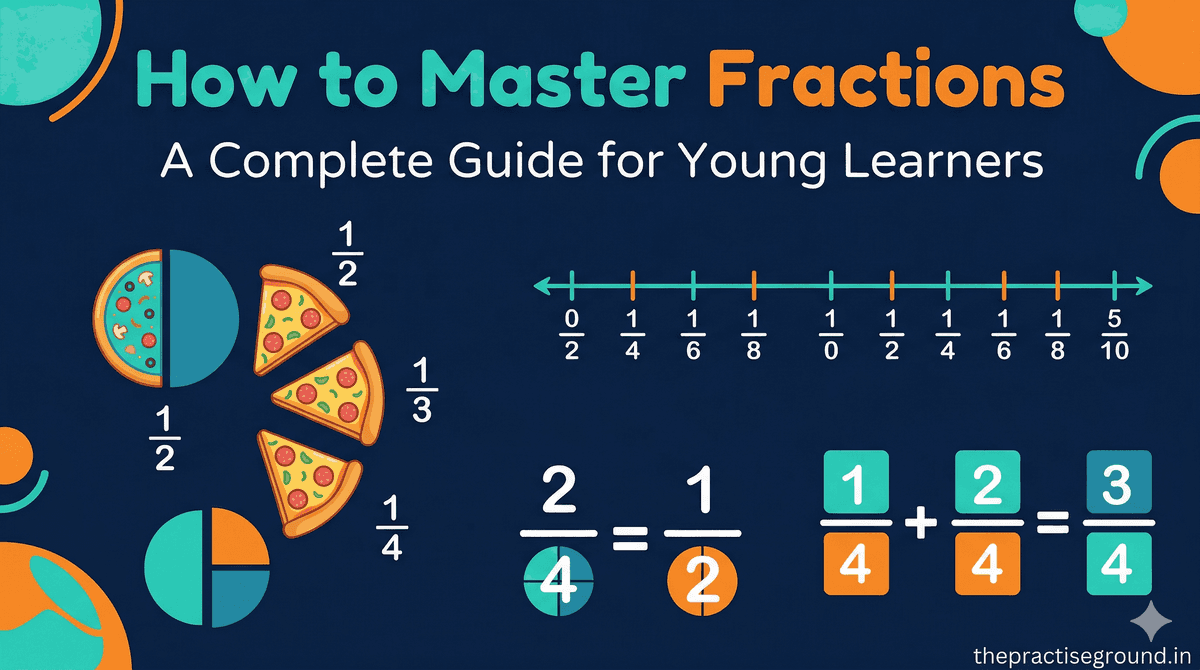
Here's something amazing: 1/2 = 2/4 = 3/6 = 4/8 = 5/10
All of these represent the SAME amount. How?
When you multiply both the numerator and denominator by the same number, you get an equivalent fraction.
1/2 × 2/2 = 2/4 1/2 × 3/3 = 3/6 1/2 × 4/4 = 4/8
You're not changing the value—you're just dividing the whole into more pieces and taking proportionally more pieces.
Why does this matter? Because equivalent fractions let you compare and add fractions with different denominators!Comparing Fractions
Method 1: Convert to Equivalent FractionsCompare 2/3 and 3/5:
Is 5/6 more or less than 1/2?
Compare 3/7 and 4/9:
Adding and Subtracting Fractions
Rule: You can only add or subtract fractions if they have the same denominator. Example: 1/4 + 2/4Think of it as counting different-sized pieces. You can only count pieces of the same size. First, convert them to the same size, then count.
Multiplying Fractions
This one is actually easier than adding!
Rule: Multiply numerators together and denominators together.1/2 × 2/3 = (1 × 2)/(2 × 3) = 2/6 = 1/3
Real-world example: "What is 1/2 of 2/3 of a chocolate bar?"
Dividing Fractions
Rule: Invert the second fraction and multiply.3/4 ÷ 1/2 = 3/4 × 2/1 = 6/4 = 3/2
Why? Dividing by 1/2 means asking "How many halves fit into 3/4?" The answer is 1.5, or 3/2.
Real-World Fraction Magic
Shopping: A shirt costs Rs. 800. It's on sale for 1/4 off. How much do you save?Practice on The Practise Ground
These concepts become solid through practice. Our interactive quizzes for Grade 5-7 include fraction challenges with visual aids, step-by-step solutions, and instant feedback. Master fractions with confidence!
Becoming a Fraction Master
The key to fraction mastery is:
- Visualize everything with drawings, diagrams, or real objects
- Practice with simple numbers first (halves, thirds, quarters)
- Apply fractions to real situations
- Build confidence gradually
FAQ
Why do we need fractions when we have decimals?
Fractions show relationships more clearly. 1/3 is exact; 0.333... is approximate. Also, some measurements (like 3/4 inch) are more practical as fractions.
How long does it take to master fractions?
With consistent practice (20-30 minutes daily), most students feel confident in 4-6 weeks. Building strong foundations now helps immensely with algebra later.
Are fractions used after Grade 7?
Yes! Fractions appear in algebra, geometry, and advanced maths. In fact, fraction skills are essential for success in higher grades.
What's the best way to practice fractions?
Start with concrete examples (actual pizza, chocolate), then use visual models, and finally move to abstract problems. This progression works for CBSE, ICSE, and all curricula. Note on Curricula: Fractions are taught similarly across CBSE, ICSE, Cambridge, and IB programmes, though terminology and emphasis may vary slightly. The core concepts in this guide apply universally.
Taking a quick break? Test yourself!
Pause and try a quick Grade 5 Maths quiz — see how much you've picked up so far.