Grammar illustration
GrammarGrade 6-10

How to Use Articles (A, An, The): Complete Guide

โœ๏ธBy The Practise Ground Team๐Ÿ“…11 February 2026โฑ๏ธ6 min readShare
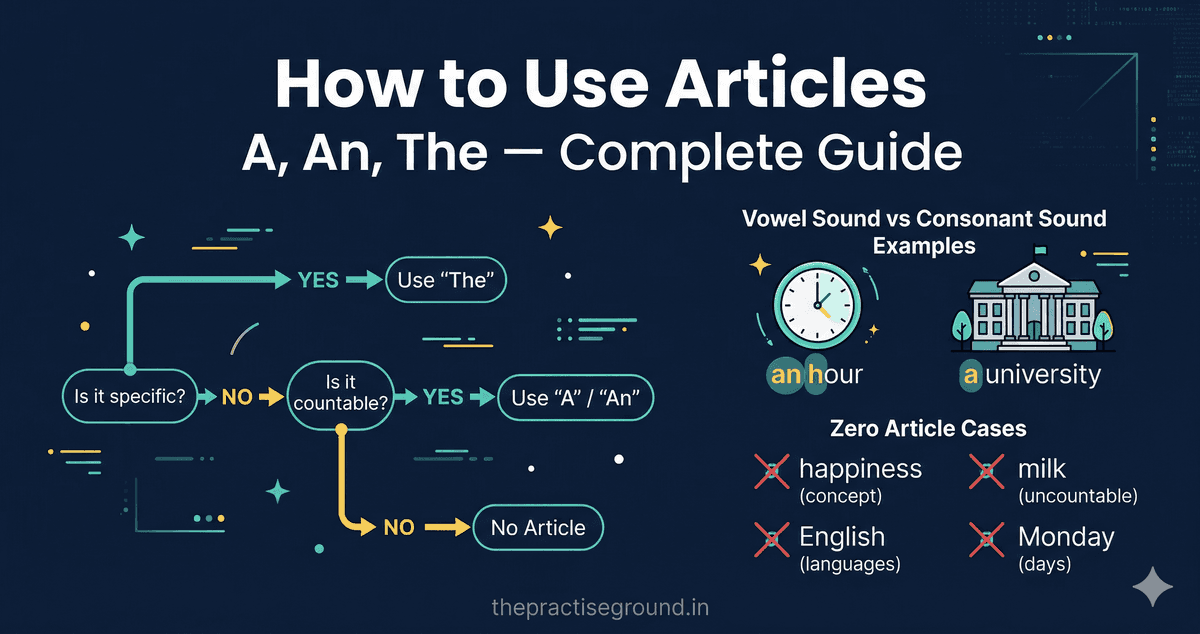
Articles infographic showing A, An, The usage rules with flowchart on dark navy background

Articles might seem like small words, but they're very important in English. Many students skip over them or use them incorrectly. This guide explains when to use "a," "an," and "the" with clear rules and examples.

What Are Articles?

Articles are small words used before nouns to show whether we're talking about something specific or general. English has three articles:

  • a (indefinite article)
  • an (indefinite article)
  • the (definite article)

When to Use "A" and "An"

Both "a" and "an" are indefinite articles. They refer to something not specific or not previously mentioned.

Use "A" Before:

  • Consonant sounds: "a boy," "a girl," "a dog," "a cat"
  • Words starting with consonants: "a book," "a pen," "a school"
  • Words starting with "u" sound: "a university," "a uniform," "a unit"
  • Use "An" Before:

  • Vowel sounds: "an apple," "an egg," "an orange," "an ice cream"
  • Words starting with vowels: "an animal," "an idea," "an elephant"
  • Words starting with silent "h": "an hour," "an honest person," "an heir"
  • Important: It's about the sound, not the letter!
  • "a university" (starts with "yoo" sound)
  • "an umbrella" (starts with "uh" sound)
  • Examples with "A" and "An":

  • I ate a banana and an orange.
  • She has a dog and a cat.
  • An apple a day keeps the doctor away.
  • I saw a movie and an interesting play.
  • When to Use "The"

    "The" is the definite article. Use it when referring to something specific or already mentioned.

    Use "The" When:

    1. Talking About Something Specific

  • I saw the movie you recommended. (a specific movie)
  • The teacher explained the lesson well. (a specific teacher)
  • The book on my desk is mine. (a specific book)
  • 2. Referring to Something Already Mentioned

  • I saw a movie yesterday. The movie was great! (now it's specific)
  • There's a park near my house. I play at the park every day.
  • 3. With Unique Things

  • The Prime Minister of India...
  • The President of the United States...
  • The sun, the moon, the earth, the ocean
  • The Taj Mahal, The Statue of Liberty, The Eiffel Tower
  • 4. Before Superlatives

  • This is the best book I've ever read.
  • She is the smartest student in class.
  • That's the tallest building in the city.
  • 5. Before Ordinal Numbers

  • He is the first boy to arrive.
  • This is the fifth time I'm telling you!
  • It's the second time I've seen this movie.
  • 6. With Plural Nouns Referring to a Specific Group

  • The students of Class X are intelligent. (specific students)
  • The teachers have a meeting today. (specific teachers)
  • When NOT to Use Articles

    1. Before Plural Nouns Used Generally

  • Books are useful. (general statement about books)
  • Dogs are loyal animals. (general statement)
  • Students need to study hard. (general students)
  • 2. Before Uncountable Nouns Used Generally

  • Water is essential for life. (not "the water")
  • Milk is good for health. (not "the milk")
  • Information is valuable. (not "the information")
  • 3. Before Proper Nouns (Names)

  • Priya, Rahul, Arjun (person names)
  • Delhi, Mumbai, London (city names)
  • India, France, Japan (country names)
  • Exception: Use "the" with some countries and geographical features:
  • The United States, The United Kingdom
  • The Himalayas, The Nile River, The Pacific Ocean
  • 4. With Professions After "Be"

  • Priya is a teacher. (not just "teacher")
  • He is a doctor.
  • She is an engineer.
  • Common Article Mistakes

    Mistake 1: Using "a" before vowel sounds
  • Wrong: "a apple"
  • Correct: "an apple"
  • Mistake 2: Using "the" with general plural nouns
  • Wrong: "I love the books."
  • Correct: "I love books."
  • Mistake 3: Missing the article before singular countable nouns
  • Wrong: "I saw movie yesterday."
  • Correct: "I saw a movie yesterday."
  • Mistake 4: Using article with unique things incorrectly
  • Wrong: "a sun is bright."
  • Correct: "The sun is bright."
  • Mistake 5: Using "the" with most proper nouns
  • Wrong: "I love the Priya."
  • Correct: "I love Priya."
  • Article Quick Reference Chart

    UseExamples
    Aa boy, a school, a university, a pen
    Anan apple, an hour, an elephant, an idea
    Thethe teacher, the book, the sun, the Taj Mahal
    No articleBooks are useful, Delhi is big, water is essential

    Special Cases

    Articles with Meals

  • Breakfast is at 8 AM. (general, no article)
  • I had a simple breakfast. (specific instance, use "a")
  • The breakfast here is delicious. (specific, use "the")
  • Articles with Seasons

  • Spring is beautiful. (no article)
  • In the spring, flowers bloom. (the season in relation to something)
  • Articles with Means of Transport

  • By a car, by car (both correct)
  • By the bus (specific bus)
  • By bus (general, no article)
  • FAQ: Article Usage Questions

    Why do we need articles?

    Articles help show whether we mean something specific or general. They're essential for clear communication.

    Is it wrong to omit articles in everyday speech?

    Technically yes, but people often skip them in casual conversation. However, in formal writing and exams, always use them correctly.

    How do I decide between "a" and "the"?

    Ask yourself: "Is this something specific that the listener knows about?" If yes, use "the." If no, use "a" or "an."

    Should I use "the" with India?

    Usually no. Say "India is beautiful," not "the India is beautiful." But use "the" with "The Republic of India" (formal name).

    Practice Exercises

    Fill in the blanks with a, an, or the:

    1. I ate apple and orange.
    2. teacher explained lesson well.
    3. This is _ best book I've read.
    4. She is _ engineer in Mumbai.
    5. Water is essential for _ life.

    Master Articles with Practice

    Understanding articles well is important for writing and speaking correctly. Practice regularly with our English quizzes!

    Conclusion

    Articles are small words with big importance. Remember: "a/an" for general things, "the" for specific things. With practice and attention to these rules, you'll use articles correctly in all your writing and speaking. The key is understanding when something is specific or general, and the articles will fall into place naturally.

    Start practicing today and become confident in using articles correctly!

    Found this helpful?

    Share it with your classmates and friends on WhatsApp โ€” help them ace their English too!

    Related Posts

    Practice What You've Learned

    Ready to Practice?

    Test your skills with our free interactive quizzes. Over 23,400 questions covering English, Maths, Science and more.