Want to test what you know?
Try our free Grade 6 English quiz — 25 questions, instant results, no sign-up.
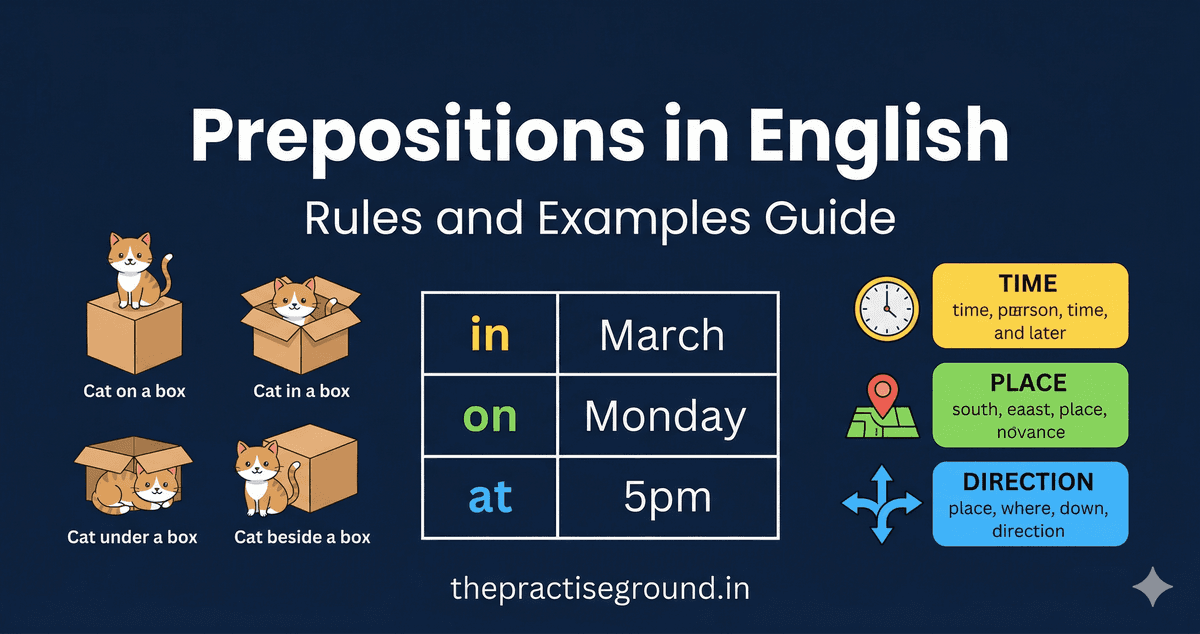
Prepositions are tricky for many students, but they're essential for correct English. A preposition shows the relationship between words—usually between a noun and other words in a sentence. Let's explore the most common prepositions and when to use them.
What Is a Preposition?
A preposition is a word that shows the relationship between a noun and other parts of the sentence. It usually comes before a noun and indicates direction, location, time, or manner.
Examples:- The book is on the table.
- She walks to school.
- He arrived at 9 o'clock.
Prepositions of Place (Location)
These prepositions tell us where something is.
In
Use "in" for enclosed spaces or inside something:On
Use "on" for surfaces:At
Use "at" for specific points or locations:Between
Use "between" for two things with space in the middle:Among
Use "among" for more than two things (a group):Under
Use "under" for something below or underneath:Over / Above
Use "over" and "above" for something higher up:Behind / In Front Of
Use "behind" for back position and "in front of" for front position:Inside / Outside
Use "inside" for within and "outside" for external:Near / Beside
Use "near" and "beside" for closeness:Prepositions of Time
These prepositions tell us when something happens.
At
Use "at" for specific times:In
Use "in" for months, seasons, and years:On
Use "on" for specific dates and days:During
Use "during" for something that happens within a time period:Before / After
Use "before" and "after" for time order:Since / For
Use "since" for when something started and "for" for how long:Prepositions of Direction
These prepositions show movement or direction.
To
Use "to" for destination or direction:From
Use "from" for starting point:Into
Use "into" for movement into something:Out Of
Use "out of" for movement away from:Through
Use "through" for movement within or across:Across
Use "across" for movement from one side to another:Along
Use "along" for movement beside something:Prepositions of Manner
These prepositions show how something is done.
By
Use "by" for the method or doer of an action:With
Use "with" for using something or accompanying:Without
Use "without" for lacking something:Common Preposition Mistakes
Mistake 1: Wrong preposition for placePrepositions That Are Often Confused
In vs. On vs. At
| In | On | At |
|---|---|---|
| Inside | Surface | Specific point |
| Months/years | Days/dates | Time of day |
| Cities | Roads/streets | Place name |
To vs. For
| To | For |
|---|---|
| Destination: "I go to school" | Purpose: "I study for the exam" |
| Recipient: "Give it to me" | Duration: "I studied for 2 hours" |
FAQ: Preposition Questions
How do I know which preposition to use?
There's no perfect rule—many prepositions depend on usage and practice. Make flashcards of common preposition phrases and memorize them.
Can one noun take different prepositions?
Yes! "On time" vs. "in time" mean different things. "On time" means punctual, "in time" means early enough. Practice these phrases.
Are there any prepositions at the end of sentences?
Yes, especially in questions: "What are you thinking about?" (about is the preposition). Avoid ending with prepositions in formal writing.
Common Preposition Phrases to Remember
Practice Exercises
Fill in the correct preposition:
- The pencil is _ the pencil box.
- We play _ the park after school.
- She arrived _ 5 o'clock.
- _ Monday, we have English class.
- He travels _ bus every day.
- The building stands _ the road.
- They've been here _ 2020.
- Birds fly _ the sky.
Master Prepositions with Practice
Practice and build your confidence in using prepositions correctly!
Conclusion
Prepositions are essential for expressing place, time, direction, and manner in English. While there's no single rule for all prepositions, learning common phrases and patterns helps. With the examples and explanations above, you can handle most preposition questions. Remember to practice regularly, and soon preposition usage will feel natural.
Start practicing today and build your confidence in using prepositions correctly!
Taking a quick break? Test yourself!
Pause and try a quick Grade 6 English quiz — see how much you've picked up so far.